
一,Materials Science: The synergistic enhancement of fibre processing and reinforcing agents.
1. Controlling the shape of fibres: a technological revolution from cutting to shredding
The strength of pulp moulding is mostly determined by the shape of the fibres. The standard pulping procedure makes the skeleton loose by cutting fibres too much. On the other hand, viscous pulping of medium and long fibres makes the hydrogen bonding area between fibres much bigger by adjusting the pulping concentration (4–6%) and fibre separation degree. For instance, a company in Shandong Province that makes electronic packaging used a dynamic pulping model to optimise the specific energy use of coniferous wood pulp to 250 kWh/T. This made the paper 15% stronger and 8% less expensive to make, which was a double optimisation of strength and cost.
2. Enhancer System: Changing from a single formula to a composite formula
Enhancers make things stronger in two ways: by chemically linking them and by physically filling them. Cationic starch generates a network sticky structure by attracting cationic groups and negative charges to the fibre surface by electrostatic forces. A dose of 1–2% can make the product 30% stiffer. More modern composite additive formulations, including 0.2% AKD sizing agent, 1% cationic starch, 0.5% PVA, 0.6% CMC, and 9% nano SiO ₂ dispersion, may make interlayer bonding stronger by 92%, which solves the problem of powder loss. The epoxy-coated sodium bicarbonate microcapsule technology also creates a microporous structure by releasing gas. This makes it stronger while keeping it light, which makes it perfect for cushioning high-end electronics.
二,Process optimisation: moving from trial and error to exact parameter control
1. The grinding process is the perfect balance between particular energy use and SEL.
The amount of fibre pulverisation is directly related to the grinding strength. The main measure is specific energy consumption (KWh/T). For coniferous wood pulp, the best range is 250KWh/T, while for broad-leaved wood pulp, it is 80KWh/T. If the original grinding disc design cuts too many fibres, you can switch to shallow tooth wide groove grinding discs (like the 2.4/2.8/6.1 tooth type). You can also get precise control of fibre broom and cutting by optimising the specific edge load (SEL) (1.65J/m for coniferous wood pulp and 0.5J/m for broad-leaved wood pulp). For instance, a southern company used a graded grinding method to separate long fibres (concentration >10%) from small fibres (concentration 4.55%). This made the product 20% stiffer.
2. Moulding and drying: managing temperature and humidity in real time
To keep the fibres from spreading out unevenly, you need to keep an eye on the temperature and humidity of the slurry during the moulding step. The hot water pulping procedure makes stiffness enhancers work better by raising the slurry temperature (60–80 °C), which cuts down on the amount of additives needed by 15%. The drying process needs to be managed in steps. In the first step, the temperature should be less than 90 °C so that the surface fibres don't dry out too quickly and become brittle. In the second step, the temperature should be between 150 and 170 °C to let hydrogen bonding solidify. If you need your products to be really moisture-proof, you should keep the drying temperature between 50 and 60 °C to let the moisture-proof enhancers set.
3. Hot pressing shaping: getting the pressure and time just right
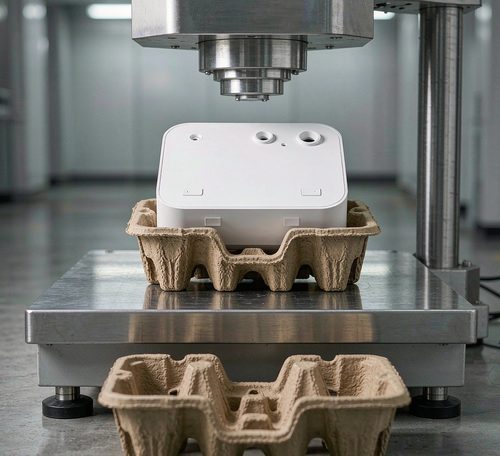
The hot pressing method changes the way the fibres are arranged by using high pressure and high temperature. The product's tightness may be increased by 25% by using a combination of 180-200 °C, 0.4-0.6 MPa, and 30-50 seconds. The surface flatness error is less than 0.1 mm. For instance, a company that makes packaging for mobile phones employs CNC precision machining hot pressing moulds and real-time pressure feedback systems to cut the amount of scrap from 8% to 0.5% and boost daily production capacity per line by 30%.
三, Upgrade of equipment: from standardisation to modularity in manufacturing innovation
1. Modular manufacturing: a double assurance of precision and stability
Modular design makes sure that blocks are accurate by processing different functional modules (like forming units and hot pressing units) separately using CNC precision technology. Then, it removes metal stress through high stability casting techniques (like QT-50 ductile iron). For instance, a modular production line from a certain equipment supplier has cut the time it takes to debug by 60%, made the equipment last more than 10 years, and made it easy to change moulds quickly to match the needs of different types of manufacturing.
2. Smart detection: going from manual sampling to complete process traceability
With the use of laser scanners and AI visual inspection systems, it is now possible to monitor product size variations (accuracy ± 0.05mm) and surface flaws (such burrs and cracks) in real time. By using a MES system to compare and analyse production data with quality inspection findings, a specific company was able to lower the defect rate from 2% to 0.3%. This also allowed them to trace production batches and improve process parameters.
四, Industry Practice: From Technological Breakthrough to Scale Application
Case 1: Lenovo's intention to use plastic instead of metal
Lenovo will start replacing plastic cushioning in laptop packaging with pulp moulding in 2022. This will make the package stronger and more accurate by using the following technology combinations:
Optimise the fibre ratio by raising the percentage of long fibres by 30% to create a skeleton structure. Use high broom mechanical pulp (TMP) to improve the degree of fibre interweaving.
Using Enhancer: Adding 0.2% PAM solution to make a network membrane structure cuts down on chip shedding by 86%.
Improvement in the hot pressing process: The product is 20% tighter with a combination of 180 °C, 0.5 MPa, and 40 seconds, and the surface flatness error is smaller than 0.08 mm.
Lenovo has completely replaced pulp moulded packaging by 2024. This has cut the cost of shipping a single laptop by 15% and raised customer satisfaction by 12%.
Case 2: Apple's Fibre Aesthetics New Idea
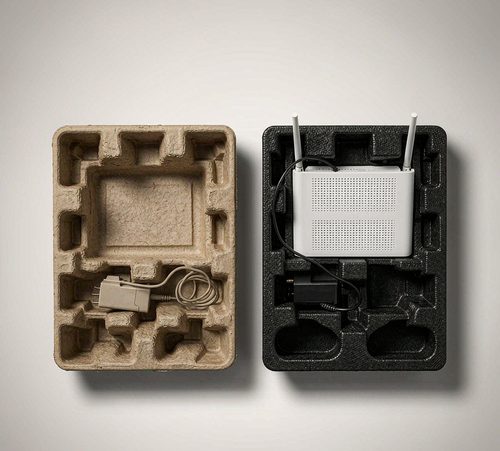
The packaging for Apple Beats Studio Pro earbuds is comprised of 100% fiber-based materials (bamboo fibre and sugarcane bagasse fibre). This makes it strong and accurate at the same time by using the following technologies:
Nanocellulose Enhancement: Adding nanocellulose (50–100 nm in diameter) makes the material 50% stronger in tension, which is what precision instruments need to work properly;
Design of the micro porous structure: 0.3mm honeycomb cells are employed to partition the region, which lowers the rate of damage to the parts from 8% to 0.3% during drop testing.
Modular manufacturing: Using CNC precision machining moulds guarantees that the packing size is accurate to within ± 0.05 mm, which makes it easy to put together with the product.