
一, Test standard: parallel international and domestic dual track
To make sure that the results meet industry standards, moulded pulp packing must be tested for compression using both international and domestic standards.
1. A set of international standards
ISO 12048: outlines the static compression test technique for packaging, which is good for testing the compressive strength of transport packaging when it is stacked.
ASTM D642 is a standard from the American Society for measuring and Materials that covers measuring the compressive strength of packaging materials in both static and dynamic loading situations.
ISTA 3A is a standard from the International Safe Transport Association for e-commerce logistics. It simulates vibration, impact, and stacking pressure during real transit.
2. The domestic standard system GB/T 4857.4 is the same as ISO 12048. It describes the static compression test technique for transport packing and sets core parameters including the test speed and pressure loading method.
GB/T 36787-2018: General technical standards for pulp moulded goods that suggest maximum values for important indicators including compressive strength and deformation.
QB/T 4765-2014: Improve the guidelines for getting samples ready and judging the results of compression tests on certain products, like egg trays.
3. Addendum to Business Standards
Some businesses set their own standards depending on the features of their products, such as:
Apple: When modelling a three-layer stacking height (around 1.8 meters), packaging must not be damaged in any way and must deform by no more than 3% of the original height.
Lenovo Group: A dynamic impact test pressure peak of at least 1500N is required for foldable screen mobile phone packaging. This is to make sure that the cushioning structure can absorb energy well when the phone is dropped.
二, Testing equipment: a whole chain setup from basic to high-precision
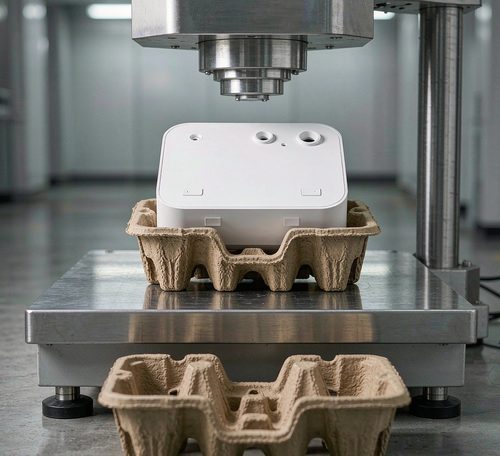
To do compression testing, you need professional gear. Some of the most important ones are pressure testing machines, environmental simulation boxes, and extra measuring tools.
1. A machine for evaluating pressure
Types: electronic universal material testing machine (for static testing) and packing compression testing machine (for dynamic stacking simulation).
Requirements for parameters:
Load range: 0–100 kN, which is enough to test everything from small egg trays (which need 500 N) to big boxes for household appliances (which need more than 10 kN).
Loading speed: For static testing, it's normally 10mm/min, but for dynamic testing, it can be changed based on the situation (for example, it can go up to 50mm/min when simulating fast handling).
Correctness: The inaccuracy in the pressure sensor is less than or equal to ± 1%, and the error in the displacement measuring system is less than or equal to 0.1mm.
2. A box that simulates the environment
Function: Keep an eye on the temperature and humidity levels, and see how materials behave in different settings.
Requirements for parameters:
The temperature range is from -40 to 120 degrees Celsius, which is good for both cold chain transit and high-temperature storage.
The humidity level can be between 10% and 95% RH, which mimics how a humid environment affects the absorption of pulp water.
Stability: The temperature can change by no more than ± 1 °C, and the humidity can change by no more than ± 2% RH.
3. Extra measuring instruments
Use a vernier calliper to check the sample size variation and make sure that errors in length, breadth, and height are less than or equal to 1mm.
Level ruler: Make sure the sample is placed straight up and down to avoid uneven force that could lead to low test results.
Humidity meter: Check the humidity in the area where the pre-processing is happening to make sure it meets acceptable requirements.
三, The procedure of testing: Standardised steps from getting the samples ready to figuring out the results
Stress testing must follow specific rules to make sure that the data can be traced and the results are reliable.
1. Getting the sample ready
Quantity: Randomly select 3-5 samples from the same batch to guarantee no damage, distortion, or bonding faults.
Before processing:
Controlling the temperature and humidity: Put it in a room with a temperature of 23 °C ± 1 °C and a relative humidity of 50% ± 2% for 24 hours, as GB/T 4857.2 says to do.
Filling in the content: Fill weight blocks (such sand and gravel, metal blocks) with cushioning materials (like bubble wrap and paper scraps) to make real-life situations.
2. Calibrating the equipment
Calibration of the pressure sensor: Use standard weights to check that the load is correct.
Checking the parallelism of the pressure plate: To avoid local pressure concentration, make sure that the contact surface between the pressure plate and the sample is parallel to within 1 mm.
3. Carrying out the test
Sample placement: Put the sample in the middle of the pressure plate under the compression testing equipment, and use a level ruler to make sure it is straight (deviation ≤ 1 °).
Test for loading:
Test that doesn't move: Load at a rate of 10 mm/min and write down the pressure values until the first strange noise, corner breaking, and pressure plate movement approach 2% of the original height.
Dynamic testing: Create stacking scenarios, keep the load at a given pressure (such 1.5 times the predicted load set by company requirements), or entirely destroy the sample.
Collecting data: Real-time recording of the testing time (s), the pressure plate displacement (mm), and the pressure values (N or kPa).
4. Judging the results
Requirements for qualification:
Deformation: ISTA 3A says that the height of the original item must not change by more than 3% and that there must be no functional damage (such the box collapsing or the contents being visible).
The destruction pressure ratio is the ratio of the pressure at the time of destruction to the projected stacking load. It must be at least 1.5 to be safe.
analysis of data
Compressive strength (F): The highest pressure value measured during testing, which is the average (F ˉ) and standard deviation (σ) of several samples.
Specific compressive strength is the ratio of compressive strength to package weight (N/kg), and it is used to compare how well different packaging designs work.
Pressure deformation curve: Look at the elastic stage (stiffness), the yield point (the point at which structural failure is most likely), and the failure point (the point at which the structure can no longer hold weight).
四,Case Study: Closed Loop From Testing to Optimisation: Practice
For example, the initial design of the packaging for a certain brand of smartphone used a tray made of 100% sugarcane bagasse. The following problems were observed during testing:
Problem: In the simulated 3-layer stacking test, the corners of the pallet fell apart, with a deformation of 4.5% of the original height, which is more than the company's normal limit of 3%.
Analysis: Sugarcane bagasse fibres are short (0.8–2.5 mm) and don't connect well, which makes the edges and corners weak when they are compressed.
Structural level: The tray doesn't have any reinforcement ribs, therefore tension builds up in the corners.
Plan for optimisation:
To make the material better, add 2% coniferous wood pulp (fibre length 2.56–4.08 mm) to make the fibres stronger as they interweave.
Structural optimisation: To spread out the pressure, add L-shaped paper reinforcing ribs to the four corners of the tray.
Change the process: Raise the mould temperature to 180 °C to help the fibres stick together; lengthen the moulding duration to 120 seconds to make sure the fibres dry enough.
Verification of the effect: After optimisation, the tray's distortion was decreased to 2.8%, and its compressive strength was enhanced by 35% under the same testing conditions. This met the company's standards for certification.