
The parameter analysis of the structure design of the tray product, because the industry has different requirements for the paper tray, and the specifications and sizes of different products are also different, the paper tray used as a packaging generally needs to be customized.
①Transition arc: In the design of the paper support structure, the corners of the inner and outer surfaces of the paper support, the connection between the vertical ribs and the main body, and the ends of the vertical ribs must be transitioned with arcs to avoid straight edges and right angles. The arc transition of the paper tray packaging is beneficial to the manufacture of the mold and the attachment of the net, the demolding during the transfer of the wet paper mold, the flow of the pulp liquid material during the adsorption molding, and it is also beneficial to avoid stress concentration causing package damage. The radius of the transition arc can be determined according to the specific product and paper properties and the special requirements of packaging, generally 2-5mm.
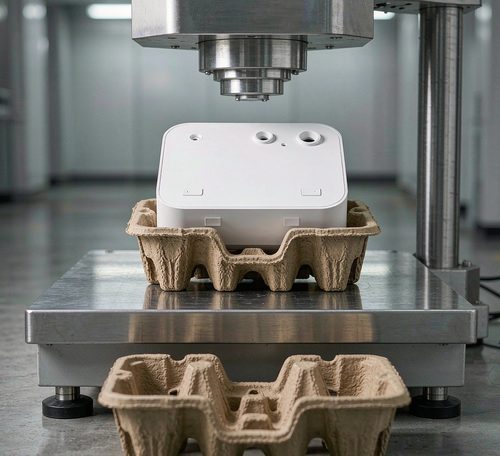
②Size and wall thickness: The basic requirement of the paper tray structure design is to ensure close contact with the packaged object to prevent the packaged object from moving in the circulation process. Therefore, the size of the paper tray packaging structure design must be compact. On this basis, the subsequent buffering and anti-vibration issues will be considered. The wall thickness is an important factor that affects the strength of the paper support, and the wall thickness should be reduced as much as possible under the premise of meeting the strength of the paper support.
③ Demolding inclination: During the paper tray packaging molding process, the wet paper mold is closely attached to the mesh mold and the paper fiber will be embedded in the mesh of the mesh mold. In order to facilitate the transfer of the wet paper mold, and the direction of demolding The surfaces of the parallel paper support should have a reasonable draft angle. The larger the inclination, the easier it is to demold. If the inclination is too small, it will be difficult to demold, and it will also cause scratches or cracks on the surface of the paper support. Too large a slope will reduce the dimensional accuracy of the paper tray, and also affect the load-bearing capacity and elastic recovery force of the paper tray. At present, the draft angle is generally 3°--6°.