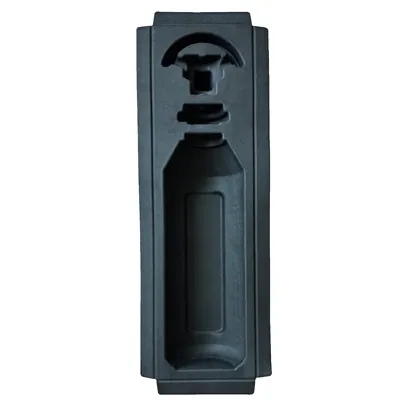
At present, the use of paper tray packaging can be seen everywhere in all walks of life, and many traditional packaging materials on the market have been gradually replaced by paper tray packaging. The paper tray is a product made from paper pulp. Paper trays are currently very environmentally friendly and practical new packaging, so products in many fields have gradually begun to use paper trays as packaging. Paper tray packaging usually needs to be customized according to your own products, so what is the specific process of paper tray production? The editor of Mingfeng Packaging will introduce to you.
What is the specific process of paper tray production:
1, crushing and beating
Put the waste paper or straw commercial pulp board into the hydraulic pulper and break it into pulp again. Industrial packaging products are often used in the production of horizontal hydraulic pulpers, and the pulp concentration during disintegration is 5%-8%. Its advantages only disperse paper fibers, no cutting effect, high disintegration efficiency, short disintegration time, low power consumption, simple structure, small footprint, and can treat waste paper with more dopants and metal impurities.
The pulverized pulp falls into the storage tank, adjusts the appropriate concentration, and pumps it to an intermittent beater or a continuous refiner or a refiner for beating. The pulp can also be crushed according to production needs. After the high-concentration cleaning machine, fiber deconstruction machine, and double-disc refiner, the slag removal, deconstruction, and beating are carried out, and the beating slurry is discharged into the storage tank or the slurry mixing tank for use. The degradation degree of beating is generally 28 degrees -35 degrees.
2, mixing paddle
In the process of beating, several raw materials can be quantitatively added to the slurry tank according to the designed slurry ratio, and the slurry can be classified and a small amount of functional additives can be added. If a sizing agent is added to increase the liquid permeability resistance of the paper molded product, the sizing agent used is generally rosin, paraffin latex or rosin paraffin latex. It is worth mentioning that the product after adding this additive cannot be called a paper tray. For non-adhesive waste paper product pulp, add 3% rosin glue equivalent to a certain dry fiber mass of the pulp; for bonding waste paper products, add 1.5%-2% rosin glue.
It is also possible to add talc powder as a filler in the pulp to achieve a higher slurry retention rate. An aqueous suspension containing 20%-30% talc filler can be processed in a mixer at high speed for 6 minutes, then diluted with water, then chemical additives are added, and then processed for 5 minutes to make a filler suspension, and then added to the slurry, some Paper tray manufacturers also added a small amount of oil repellent, water repellent, wet strength agent and retention aid to the slurry. In the pulping process, appropriate amount of white water or clean water should be added to adjust the pulp concentration to 1%-2% for the production of molded products.
3, paper molding
Forming is a key process in the production process of paper trays. It plays a decisive role in the quality, breakage rate, production energy consumption and production efficiency of paper molded products. According to the dehydration principle of the forming equipment, there are two main methods for forming paper trays: vacuum forming and hydroforming.
The vacuum forming method is vacuum filtration forming. Place the forming mold in a pulp solution with a concentration of about 1%, and vacuum the mold cavity to form a negative pressure, so that the fibers in the pulp are evenly deposited on the surface of the forming mold on the mold screen, which is taken away during the vacuum suction process A lot of moisture. When the product reaches the required thickness, the molding die is taken out of the slurry for extrusion and dehydration until the water content of the product is 75%-80%, and then compressed air is passed into the mold cavity to release the wet paper mold. This method has high production efficiency and uniform product thickness. Suitable for making thin parts that are not too deep, such as paper trays for packaging eggs, fruits, cutlery, tray boxes, etc.
Hydro-forming method uses hydraulic pressure to generate higher extrusion pressure through hydraulically driven mechanical devices. Its working principle is to inject a certain amount of pulp into the mold cavity, and the upper mold squeezes downward under the action of hydraulic pressure, so that the pulp is formed on the mesh mold in the mold cavity and the water is discharged. From the bottom of the net model. The parts are taken out of the mold by vacuum suction and transferred to the next process. Due to the high molding pressure, this method is suitable for producing shallow pan products with heavier basis weight and higher density.
The above content is an introduction to the specific process of paper tray production. Paper tray packaging has strong plasticity and can be planned and opened according to user needs. The surface quality, color, shape and other appearance elements of the product can be customized. Compared with other packaging, the paper tray is more practical. Paper tray packaging has excellent shock resistance and cushioning properties. After treatment, it can also play a role in preventing moisture and protect the product.