
一, Environmental Compliance: Sustainable Practices That Go Above and Beyond International Standards
1. Leading the Way in EU PPWR Regulation
The European Union will completely adopt the PPWR legislation in 2026. It suggests three main standards for packaging materials:
Using renewable materials: Molded pulp is created from renewable fibers such waste paper, sugarcane bagasse, bamboo pulp, and others. These fibers naturally fit the requirements for the amount of renewable materials. For instance, G-COVE Fupeng Green Technology makes packaging for household appliances out of bamboo fiber. The company has received FSC forest management accreditation, which means that all of its raw materials can be traced back to their source.
Performance that can be recycled: The integrated molding process lets you manage the porosity of molded pulp packaging to within 30%, which is far lower than the legal limit of 50%. More than 90% of its clean goods can be recycled, which comfortably meets the goal of 40% reuse by 2028.
Biodegradability: It meets the EN 13432 compostability standard, and it may be totally broken down in 3 to 6 months after being thrown away. This completely solves the problem of white pollution caused by regular EPS foam. The air conditioning packaging that Midea Group sends to Europe is lined with molded pulp and has been certified by T Ü V Germany. It is one of the first home appliance packing boxes to meet PPWR standards.
2. A system of dual certification in the US market
In the United States, the rules for packaging household appliances are mostly about food safety and environmental performance:
FDA certification: Molded pulp packaging is evaluated according to FDA 21 CFR 176.170 standard for household appliances that come into touch with food (such kitchen appliances) to make sure that no dangerous substances move from one place to another. For instance, the Japanese company Nissui employs patented fiber density control technology to make sure that dissolved compounds are never found during microwave heating. This is better than the maximum amount of microplastics that can be left in plastic packaging.
BPI Biodegradation Certification: The American Biodegradable Products Institute (BPI) certification says that packaging must break down by more than 90% in 180 days when put in an industrial composting environment. The refrigerator packaging that Haier Group sends to the US is made of molded pulp and honeycomb cardboard. It has passed BPI certification and is now a preferred packaging for Amazon's "Climate Friendly Commitment" program.
3. Setting the pace for the improvement of Chinese standards
By 2025, China will have to follow the "General Requirements for Home Appliance Packaging," which clearly state that:
Green materials should be used first. These are materials that can be used again, recycled, and renewed and that meet GB/T 16716. Because it uses raw materials that may be reused and doesn't pollute the environment, molded pulp packing has become a suggested standard option.
Testing of the surroundings very strictly: Added tests for high temperatures and high humidity (85 °C/85% RH for 72 hours), static clamping, and other conditions that are like those that may happen during extreme transportation. The China Home Appliance Research Institute tested Gree Electric Appliances' air conditioning unit in a wide variety of temperatures from -40 to 70 degrees Celsius, and the packaging has not been damaged.
二, Physical performance: satisfies the strict standards for moving appliances
1. Resistance to impact and cushioning ability
A three-dimensional fiber network in molded pulp packaging lets it absorb and spread energy.
The packaging for a brand of washing machine uses molded pulp lining, which is in line with the ISO 2248 standard. The damage rate for the product fell from 1.5% of the standard EPS foam to 0.2% when it was thrown from a height of 1.2 meters.
Dynamic Compression Test: Lenovo Group's laptop packaging is made of molded pulp and corrugated cardboard, which can handle static pressure of 500kg without bending. This meets the standards for sea freight stacking.
2. Ability to adapt to different environments
Molded pulp packing makes performance advances by changing the materials used to make it work better in the harsh conditions of shipping household goods:
Temperature resistance: The package may keep working well between -20 and 80 degrees Celsius after adding a nano silica layer. The packaging for Huawei Mate series smartphones is lined with molded paper pulp, and the packaging has held up well in the Middle East, where it has been tested in both sandstorms and high temperatures.
Moisture resistance: Using paraffin latex adhesive technology, the water absorption rate of food-grade molded pulp packing may be kept below 5%. Panasonic's microwave ovens that are sent to Southeast Asia come in waterproof treated molded pulp packaging. They may be stored in a room with 95% RH humidity for 72 hours without any symptoms of moisture inside the devices.
3. Adaptability of structure
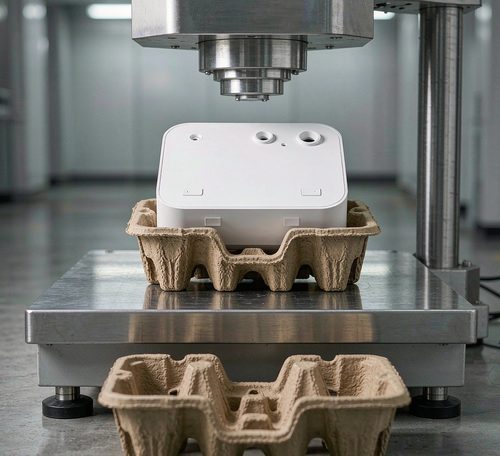
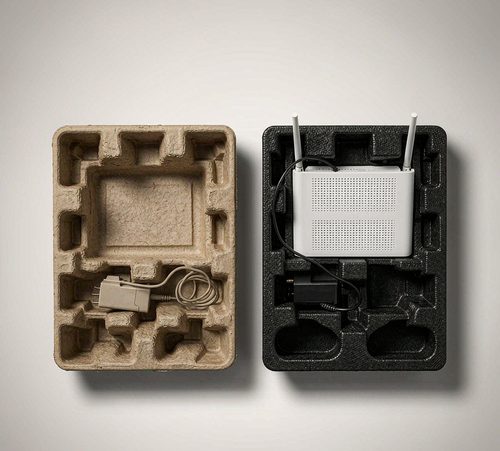
CNC mold forming technique makes molded pulp packages fit perfectly with household equipment.
Alien protection: Molded pulp packaging can be made with a split structure for appliances with curved surfaces, such curved TVs. This spreads out the pressure through honeycomb support points. The packaging for Samsung Electronics' QLED TVs uses this design, which cuts down on breakage during shipping by 60%.
Lightweight design: Molded pulp is just 0.6–0.8 g/cm³ dense, which is 30% less than EPS foam. Midea Group has improved the packing structure of indoor air conditioning units. This has increased the number of units that can fit in a single container from 120 to 180 and cut logistics expenses by 28%.
三, functional innovation: going from protection to brand value.
1. Combining smart packaging
Molded pulp packing is changing from a single protective substance to a smart carrier:
Checking the temperature and humidity: Haier Group's high-end refrigerator packaging has RFID chips and sensors built in that can keep an eye on the temperature and humidity of the shipping environment in real time. The cloud keeps the data in sync with the logistical system and sends alerts when something goes wrong.
Traceability for anti-counterfeiting: Gree Electric's air conditioning packaging has "one item, one code" full lifecycle traceability thanks to QR codes and blockchain technology. People can scan the code to make sure the product is real and to get information about how to recycle the packaging.
2. Improving the user experience
Innovative design makes molded pulp packing more exciting to open:
Interactive structure: The Dyson hair dryer packaging has a "drawer style" molded pulp lining, and consumers have to take out the product layer by layer to open the box, which makes it more enjoyable to explore. According to social media research, these kinds of designs have made unpacking videos for products 300% more popular.
Secondary use value: Lenovo Group turned laptop packaging into a reusable storage box with RFID chips built into the bottom for tracking and recycling. This technique raises the recycling rate for packaging to 92% and lowers the cost of getting new customers.
3. Passing on brand value
Molded pulp packaging is now the main way for household appliance producers to put ESG ideas into practice:
Carbon Neutral Label: Fupeng Green Technology makes G-COVE, a packaging solution for electronic and electrical items. It helps clients put the "carbon neutral" label on their products by keeping track of and certifying their carbon footprints. This kind of packaging for Siemens Home Appliances' dishwashers led to a 15% rise in sales in Europe.
Cultural symbol implantation: The Japanese company Nissui uses Kabuki actors to promote the texture of its pulp lunch boxes and makes Japanese art more beautiful with matte textures. High-end home appliance firms like Haier and Midea use similar new ideas in their packaging, which makes their brands stand out more and makes them more competitive.