


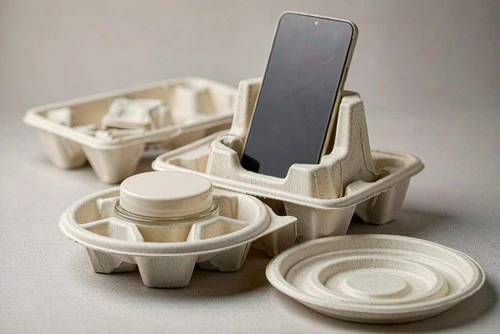
Molded pulp packaging is rigid packaging made by forming a fiber slurry (recycled paper, virgin wood pulp or non-wood fibers such as bagasse and bamboo) into shape on a mold, then drying or pressing it. It is used for egg trays, protective inserts, food-service bowls and clamshells, and increasingly for electronics packaging and cosmetics packaging.
Three regulatory changes took effect in 2026, and they now shape who can sell what, and where. This article covers the market data, the rules and the technology shifts that matter to buyers this year.
Key Takeaways
- Market size: 2026 estimates range from $4.7 billion (Smithers) to $8.4 billion (Future Market Insights), depending on how each firm defines the market. Forecast growth is 4.1% to 7.5% CAGR.
- EU: Since August 12, 2026, food-contact packaging in the EU may not exceed 25 ppb for any single PFAS, 250 ppb for the PFAS sum, or 50 ppm total fluorine.
- US: Antidumping and countervailing duty orders on thermoformed molded fiber from China and Vietnam were issued on January 27, 2026, with rates reported up to 540% on certain products.
- Industry sentiment: In the International Molded Fiber Association (IMFA) benchmarking survey, nearly 80% of producers expected higher output in 2026 and almost 75% planned capacity investment within two years.
- Technology: Metsä Group's planned 3D fiber line in Finland targets more than 100 million products a year, with start-up planned for 2028.
How Big Is the Molded Pulp Packaging Market in 2026?
The global market is worth roughly $4.7 billion to $8.4 billion in 2026, depending on the research firm. The gap comes from scope: some reports count only packaging, while others include tableware, industrial inserts and processed pulp.
| Source | 2026 estimate | Forecast | CAGR |
|---|---|---|---|
| Smithers | $4.7B | $5.5B by 2030 | 4.1% |
| Mordor Intelligence | $5.71B | $7.05B by 2031 | 4.31% |
| Straits Research | $5.94B | $9.97B by 2034 | 6.68% |
| Fortune Business Insights | $6.16B | $11.01B by 2034 | 7.52% |
| Grand View Research | $6.65B | $10.18B by 2033 | 6.3% |
| MarketsandMarkets (Sept 2026) | $8.02B | $10.82B by 2031 | 6.2% |
| Future Market Insights | $8.4B | $15.8B by 2036 | 6.5% |
Every major source expects growth. Even the most conservative forecast, Smithers' 4.1% CAGR, outpaces global GDP growth, according to the firm.
Where the growth is:
- Region: Asia Pacific held a 46.79% share in 2025 (Fortune Business Insights).
- Product: Trays made up 41.2% of 2025 revenue, while bowls and cups are forecast to grow fastest at 9.1% CAGR through 2031 (Mordor Intelligence).
- Process: Transfer molding led 2025 volume with a 36.7% share, while thermoformed molded pulp is forecast to grow at 7.24% CAGR through 2031 (Mordor Intelligence).
- Sector: Healthcare and medical packaging is forecast at 8.6% CAGR, driven by sterile-barrier needs and PFAS bans (Mordor Intelligence).
Molded fiber is still a small slice of fiber packaging overall. Afry estimates it at roughly 3%, against nearly three-quarters for containerboard, which leaves a lot of room to grow.
Trend 1: The EU PFAS Ban Is Now Law
The EU Packaging and Packaging Waste Regulation (PPWR) has applied since August 12, 2026, and it bans PFAS above set limits in food-contact packaging. The three limits are 25 ppb for any single non-polymeric PFAS, 250 ppb for the sum of targeted PFAS, and 50 ppm for total PFAS including polymeric ones. Products already manufactured cannot be placed on the EU market if they exceed the limits.
The European Commission says packaging waste would grow 19% by 2030 without action, and plastic packaging waste by up to 46%.
For molded pulp, the impact is twofold:
- Opportunity. About 70% of IMFA survey respondents said regulation is boosting demand, as brands replace single-use plastics with fiber.
- Technical challenge. PFAS were historically mixed into the slurry for grease resistance. Sabert's engineering director told Packaging Dive that PFAS-free barriers can cost more or slow machine performance. Under the PPWR, a polymeric coating above 5% of a package's weight may be treated as plastic, which is a contentious point for fiber producers.
Trend 2: US Duties Are Reshaping Sourcing
The US Department of Commerce issued antidumping (AD) and countervailing duty (CVD) orders on thermoformed molded fiber products from China and Vietnam on January 27, 2026. The orders cover products such as plates, bowls, clamshells, trays and lids. Packaging Dive reports rates of up to 540% on certain products, and rates vary by exporter. The US International Trade Commission had made its final injury determination in December 2025.
The US is a major importer. Afry data cited by Packaging Dive indicates that US demand exceeds domestic capacity by about 50%, and China leads global supply and exports. Duties on thermoformed products from the two largest Asian suppliers push buyers to:
- diversify to other origins and regional producers;
- re-check product classification, since the orders target thermoformed products specifically;
- compare thermoformed against transfer-molded alternatives, which have different process characteristics.
Confirm scope and classification with your customs broker, because coverage depends on how a product is made and classified.
Trend 3: California's SB 343 Complicates "Recyclable" Claims
California's "Truth in Recycling" law (SB 343) applies from October 4, 2026, to products manufactured on or after that date. A material may carry recyclability claims only if at least 60% of Californians have collection access and the material is sorted by facilities serving 60% of Californians.
The IMFA says molded fiber has over 90% collection access but shows 0% sortation in CalRecycle's data, a figure the association disputes. CalRecycle's separate SB 54 data put molded fiber's recycling rate at 7%. In September 2026, a federal court barred the state attorney general from enforcing parts of SB 343 pending further proceedings, but the October 4 date itself was not changed.
Industry observers expect effects beyond California, because brands rarely print state-specific packaging. Review the recyclability and compostability claims on your labels now.
Trend 4: Faster, Leaner Manufacturing
- Dewatering: Jabil Packaging Solutions says new dewatering technology can cut cycle times by up to 80%. Traditional wet molding starts from a slurry that is about 99.5% water.
- Dry molding: Producers are testing biopolymer additions and small amounts of water to improve strength, which was a past weakness of dry processes.
- 3D fiber at scale: Metsä Group selected Valmet in August 2026 to deliver its first commercial-scale 3D fiber line in Äänekoski, Finland, with capacity above 100 million products annually and start-up planned for 2028.
Trend 5: Beyond Egg Trays
Future Market Insights projects these segments for 2026-2036:
- Electronics inserts: $1.27 billion in 2026 to $3.48 billion by 2036 (10.6% CAGR).
- Beauty and cosmetics inserts: $579 million in 2026 to $1.71 billion by 2036 (11.4% CAGR).
These are single-publisher forecasts and should be read as directional. They are consistent with the wider shift of premium and protective packaging from foam and plastic to fiber.
Trend 6: Non-Wood Fibers
Bagasse, bamboo and agricultural residues are attracting investment. French start-up Z1RO announced in October 2026 that it is developing molded fiber from non-wood biomass, using lignin as a natural binder, with three B2B pilot projects in the EU. A market report cited by industry sources puts non-wood sources at about 7.5% CAGR.
What Buyers Should Do Now: A Checklist
- Request PFAS test reports (targeted PFAS and total fluorine) for any food-contact product shipped to the EU.
- Verify customs classification and process type (thermoformed vs. transfer-molded) before importing into the US.
- Audit label claims for California: chasing-arrows symbols, "recyclable" and "compostable" wording.
- Ask suppliers about their grease-resistance chemistry, including the coating type and its weight as a share of the product.
- Diversify sourcing, and weigh landed cost, not just unit price.
Frequently Asked Questions
Q: How big is the molded pulp packaging market?
A: Estimates for 2026 range from $4.7 billion (Smithers) to $8.4 billion (Future Market Insights), depending on market definition. Most forecasts project 4% to 7.5% annual growth.
Q: Is molded pulp packaging PFAS-free?
A: Not automatically. PFAS were commonly added for grease resistance, and EU rules in force since August 12, 2026 limit them in food-contact packaging to 25 ppb for any single PFAS, 250 ppb for the sum, or 50 ppm total fluorine. Buyers should ask suppliers for test reports - see our test reports.
Q: What is the difference between thermoformed and transfer molded pulp?
A: Thermoformed pulp is cured in heated molds and gives a smoother finish and tighter tolerances. Transfer molding is the more established process and held 36.7% of 2025 volume, according to Mordor Intelligence.
Q: Are there US duties on molded pulp products?
A: Yes, on thermoformed molded fiber products from China and Vietnam, under antidumping and countervailing duty orders issued on January 27, 2026. Rates vary by exporter and product, with reported rates of up to 540% on certain products.
Q: Can molded fiber be labeled recyclable in California?
A: It is contested. Under California's SB 343 criteria and CalRecycle's current data, the International Molded Fiber Association says molded fiber cannot currently be labeled recyclable, and the industry is working to challenge the data.
Sources
- Smithers via Pulp & Paper News, March 25, 2026: pulpapernews.com
- Mordor Intelligence: mordorintelligence.com
- Straits Research: straitsresearch.com
- Fortune Business Insights: fortunebusinessinsights.com
- Grand View Research: grandviewresearch.com
- MarketsandMarkets, PR Newswire, Sept 10, 2026: prnewswire.com
- Future Market Insights: futuremarketinsights.com
- Packaging Dive, July 13, 2026 (IMFA survey, Afry, SB 343, Jabil): packagingdive.com
- Packaging Dive, Commerce duties on China and Vietnam: packagingdive.com
- USITC final determination: usitc.gov
- European Commission, Aug 11, 2026: environment.ec.europa.eu
- Bergeson & Campbell on PPWR PFAS limits: lawbc.com
- Wiley, SB 343 deadline and court order, Sept 14, 2026: wiley.law
- Future Market Insights on Metsä Group's Muoto line, Oct 9, 2026: newstrail.com
- Z1RO, Sustainable Packaging News, Oct 9, 2026: spnews.com
Looking for PFAS-free, compliant molded pulp products? Contact Hesheng for samples and test reports.


