
System Engineering Design and Barrier Technology for Molded Pulp Liquid Containers (Laundry Detergent / Dishwashing Bottles)
I. Overall Engineering Concept: Not a "Paper Bottle", but a Composite Barrier System
The fundamental challenge of molded pulp liquid containers is not forming the shape itself. Structurally, pulp molding is straightforward. The real difficulty lies in maintaining long-term stability of a naturally porous fiber network when exposed to surfactant-based liquids.
Typical molded pulp materials exhibit a porosity range of 30% to 60%, forming a continuous capillary network between fibers. This structure is beneficial in dry applications due to its cushioning and lightweight properties, but in liquid environments it becomes an inherent wicking system, continuously drawing fluid into the material.
For this reason, molded pulp liquid packaging cannot be treated as conventional packaging material. It must instead be engineered as a composite system consisting of a fiber structural skeleton, a polymer barrier layer, and a mechanically sealed closure interface.
In practical development, no single improvement-whether increasing hot-press density or thickening the coating layer-can solve long-term leakage. A manufacturable solution must simultaneously control three variables: fiber densification, coating continuity, and sealing integrity at the neck interface.
II. Fiber System Design: The Structural Ceiling of the Product
In liquid container applications, pulp formulation must be biased toward high-strength virgin fiber systems. A stable industrial formulation typically consists of 50% to 65% bleached softwood pulp, which provides tensile strength and wet stability. Bagasse pulp is generally used at 20% to 40% to improve formability and reduce cost, while recycled fiber content is usually kept below 20%, as higher ratios significantly increase pore heterogeneity and weaken coating adhesion.
For wet strength reinforcement, PAE (polyamide epichlorohydrin) remains the most established solution. The typical dosage ranges from 0.8% to 2.5% based on oven-dry fiber weight. Below 0.8%, wet strength retention becomes insufficient for structural stability. Above 2.5%, excessive surface film formation can occur, negatively affecting interlayer bonding with subsequent coatings.
At this stage, the objective is not to maximize strength indiscriminately, but to establish a stable and uniform fiber scaffold that can properly receive and anchor barrier coatings. The fiber matrix itself is not expected to provide waterproofing functionality.
III. Barrier System Design: Where Liquid Failure Actually Occurs
More than 90% of failures in liquid molded pulp systems originate from improper barrier layer design rather than structural forming defects or insufficient material strength.
Industrial solutions generally adopt a multi-layer barrier architecture, but its effectiveness comes not from stacking layers, but from sequentially eliminating liquid penetration pathways.
The first layer is the pore-sealing layer, designed to close micro-capillaries on the fiber surface. This is typically achieved using water-based acrylic emulsions or waterborne polyurethane systems, with solid content ranging from 35% to 55% and coating weights of approximately 8 to 15 g/m². If this layer is not properly formed, subsequent coatings will be absorbed into the fiber network rather than forming a continuous barrier film.
After pore sealing, the primary barrier layer is applied. The most stable industrial approach is a waterborne polyurethane system modified with wax dispersions. The introduction of microcrystalline or paraffin wax significantly reduces surface energy, improving hydrophobic performance. Final film thickness is typically controlled between 15 and 35 microns. The design target is not absolute waterproofing, but maintaining a 24-hour water absorption rate below 5%.
For higher performance requirements, crosslinked PVOH systems or PLA-based bio-barriers can be introduced. However, both systems require much tighter process control. In PVOH systems, crosslink density is critical: insufficient crosslinking leads to swelling under detergent exposure, while excessive crosslinking results in brittle film fracture.
The outermost layer is typically designed as a chemical resistance layer, particularly for detergent systems containing anionic surfactants. Silicone-modified chemistries or PFAS-free fluorine alternatives are commonly used. The goal is to reduce surface tension below 25 mN/m while maintaining structural integrity during prolonged immersion.
A key engineering point must be emphasized: barrier failure is often not caused by direct water penetration, but by gradual interfacial degradation induced by surfactants-a failure mechanism frequently overlooked in early-stage development.
IV. Hot-Press Densification: The Physical Boundary of Permeation
Beyond coating design, the hot-press process defines the fundamental permeability of the structure. If fiber porosity is not sufficiently reduced, even an ideal coating system will eventually fail under long-term pressure exposure.
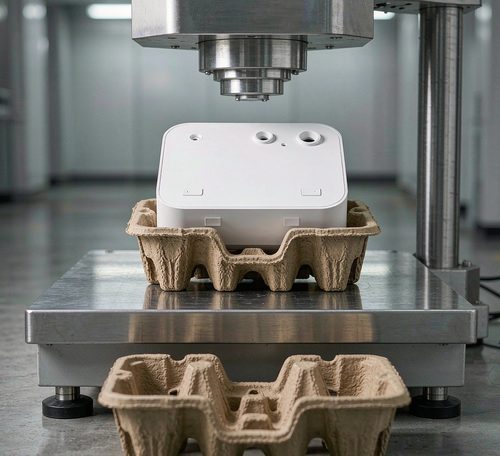
A stable industrial hot-press window typically ranges from 180°C to 250°C, with pressure between 30 and 80 bar and dwell times from 20 to 90 seconds. The process induces plastic fiber reorientation, pore collapse, and the formation of a glassified surface layer that significantly reduces liquid transport pathways.
If pressure is insufficient, residual interconnected pore networks remain. If temperature or dwell time is excessive, fiber degradation or embrittlement may occur, leading to latent crack formation during drop tests.
A commonly observed pattern is that nearly half of all leakage cases in liquid pulp containers can be traced back to insufficient densification and incomplete pore closure during hot pressing.
V. Structural Design: Strength Issues Are Often Not Material-Driven
In many development programs, leakage is incorrectly attributed to material weakness. However, engineering analysis shows that structural stress concentration is often the dominant failure driver.
Liquid containers should avoid purely straight-wall geometries, as impact loads during drop or stacking tests tend to concentrate stress in localized regions. Effective designs typically incorporate ring reinforcements, vertical rib structures, and domed base geometries to distribute load more evenly.
Wall thickness is generally controlled between 2.5 mm and 4 mm, but the neck region often requires localized reinforcement of 30% to 80%, as torsional forces during opening and closing can induce micro-cracking in weaker sections.
VI. Sealing System: The Ultimate Bottleneck of the Entire System
Regardless of how well the fiber matrix and barrier coatings are engineered, the performance of the entire system is ultimately determined by the sealing interface at the bottle neck.
At present, the only mature and commercially reliable solution is an embedded plastic neck system, where PP or PET injection-molded neck components are integrated during pulp forming. The fiber matrix is then hot-pressed to mechanically lock the structure, while EPDM or silicone gaskets provide chemical-grade sealing performance.
Such systems can withstand internal pressures of 0.3 to 0.6 MPa and maintain leakage rates below 0.1% over long-term storage conditions.
Fully pulp-based threaded neck systems remain in early development. The primary issue is mechanical creep under repeated torque loading, leading to thread deformation and micro-gapping. As a result, these systems are currently more suitable for single-use or low-pressure refill applications rather than standard detergent packaging.
VII. Failure Modes: The Real Engineering Risks
In practical development, failure rarely presents as immediate leakage. Instead, it typically manifests as progressive degradation.
Micro-leakage is often caused by coating discontinuity or incomplete pore sealing. Coating delamination typically results from poor interfacial compatibility between the primer layer and fiber surface energy.
Material softening is commonly observed in insufficiently crosslinked PVOH systems, where surfactants gradually disrupt hydrogen bonding networks, leading to strength loss over time.
The most critical failure remains sealing failure. Even when the bottle body is fully impermeable, improper neck design can result in leakage during transportation vibration. For this reason, sealing systems must be treated as an independent safety-critical subsystem rather than a secondary structural element.
VIII. Conclusion: The Fundamental Logic of a Manufacturable System
The engineering logic of molded pulp liquid containers can be reduced to a single system chain:
The fiber matrix defines structural integrity, hot pressing establishes the physical permeability boundary, barrier coatings control molecular-level diffusion, and the sealing system determines final reliability.
System failure occurs when any one of these elements falls outside its operating window.
A successful design is therefore not defined by selecting a "better material," but by ensuring that four systems operate simultaneously within compatible process windows:
Fiber porosity must be reduced below the critical percolation threshold through densification
Coatings must form a continuous, low-surface-energy barrier film
Chemical systems must resist surfactant-driven interfacial degradation
Sealing structures must independently withstand mechanical and pressure loads
Only when these four conditions converge within a stable design window does molded pulp liquid packaging become truly commercially viable.