
一, Choosing and preparing raw materials: the first step to flatness
1. Finding the best type and ratio of fiber
The qualities of the fibers have a direct effect on how well pulp may be formed. The fibers in coniferous wood pulp are relatively long (1.2–3.5 mm), which can make the product stronger and less likely to tear, but the amount must be controlled to avoid rough surfaces caused by fibers getting tangled up. The fibers in hardwood pulp are relatively short (0.5–1.5 mm), which can make the pulp flow better and help fill the mold evenly. It is best to mix coniferous wood pulp and broad-leaved wood pulp in a 3:7 ratio for practical use to get the right balance of strength and surface smoothness.
2. Exact control of the pulping process
The beating degree (tapping degree) is an important factor that affects how fibers are spread out. Wet grinding technology can be used to make micro porous structures on the surface of fibers, which will improve the slurry's ability to absorb. For instance, Apple supply chain companies use a graded pulping process. Long fibers (coniferous wood pulp) are pulped at a high concentration of 10% or more to make them swell and break down; short fibers (hardwood pulp) are controlled to have a beating degree between 30 ° SR and 45 ° SR to keep them from being cut too much. Using the dynamic pulping model has made the paper on one manufacturing line 15% stronger and cut the amount of wood pulp used by 8% per ton of paper.
3. The combined impact of additions
Cationic polyacrylamide (CPAM) is an enhancer that neutralizes charges to make fibers stick together more firmly. Adding 0.2% solution can create a network membrane structure during negative pressure dehydration, which cuts chip loss by more than 86%.
Adhesive: Mixing 0.2% AKD adhesive with 1% cationic starch can make the bonds between layers 92% stronger and stop fibers from ripping off the surface.
Waterproof agent: paraffin lotion produces a layer on the fiber surface that protects it from water damage and keeps its strength consistent.
二, Improving the molding process to get control to within a millimeter
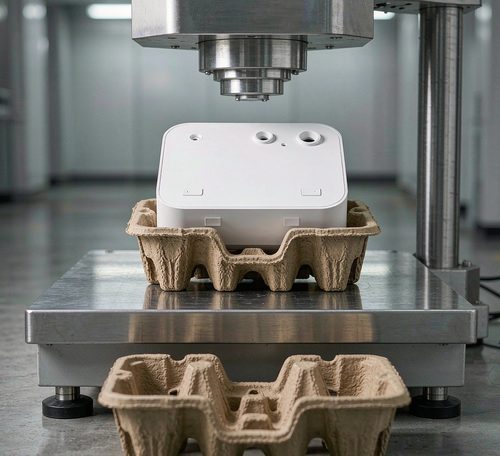
1. Technology for vacuum suction molding
Vacuum suction molding is a common method in the industrial packaging business. It uses negative pressure adsorption to fill the mold evenly with slurry. Control of key parameters includes:
Vacuum level: Keep it between -0.06MPa and -0.08MPa to make sure the slurry adsorbs quickly and to keep the fibers from straining too much.
Change the adsorption time based on how thick the product is. It normally takes 8 to 15 seconds. If it's too short, it might not fill all the way, and if it's too long, the fibers might settle and come apart.
Temperature of the mold: To speed up the evaporation of water and encourage hydrogen bonding between fibers, preheat the mold to 150 to 200 degrees Celsius.
2. The process of wet compression molding
When the product has 50% to 75% moisture content, it is treated with wet pressing. The product's tightness can be raised by 20% when the pressure is between 0.4 and 0.6 MPa and the temperature is between 180 and 200 °C. The surface roughness is Ra ≤ 0.8 μm. A certain company employs hot pressing machines to press and polish the iPhone's inner tray. This makes the surface as smooth as a mirror and lowers the friction coefficient to 0.354.
3. The technology for drying in a microwave
Microwave drying may heat the inside and outside of a product at the same time, which lowers the stress of drying compared to typical hot air drying. By managing the drying curve in sections (with a temperature of<90 ℃ in the front section and 120 ℃ -150 ℃ in the back section), the surface fibers may be prevented from drying out soon and becoming brittle, and the moisture content of the product can be uniformly reduced to 10% -12%.
三,New ideas for mold design: breaking physical boundaries
1. Making molds with a lot of accuracy
Choosing the right material: Made of aviation-grade aluminum alloy (such 7075-T6) or chrome-plated steel, with a hardness of HRC60 or higher, and can handle more than 100,000 molding cycles.
Surface treatment: A CNC five-axis machining center is used to precisely carve the mold cavity, which has a surface roughness of Ra ≤ 0.4 μ m. Chromium plating treatment makes the surface 30% harder and makes fibers less likely to stick to it.
System for exhaust: To make sure that the slurry is evenly absorbed and doesn't get stuck, arrange the exhaust holes (with a diameter of 0.5–1.0 mm and a spacing of 15–20 mm) and the 0.01 mm filter screen in the best way possible.
2. Optimization of structural topology
The mold cavity is designed to be lightweight using CAE simulation analysis. The Huawei Mate series packaging mold, for example, has a honeycomb-reinforced rib structure that makes it 30% lighter and 40% more resistant to impact. The apple inner tray mold has 12 different sizes of honeycomb cells. It uses topology optimization to find the right balance between weight and strength.
3. Adding a self-cleaning feature
Ultrasonic vibration devices (20kHz-40kHz) can be built into mold designs to quickly shake off fiber debris during the molding process. Alternatively, Teflon coating (5-10 μ m thick) can be utilized to reduce fiber adherence and the need for human cleaning.
四,Typical Case Study: Transition from Laboratory to Industrial Application
Case 1: The inner tray of an Apple iPhone
The raw ingredients are bamboo pulp (60%), sugarcane pulp (30%), and nanofibers (10%). The fibers are 0.8 to 1.2 millimeters long.
Wet pressing shaping pressure of 0.5MPa, temperature of 190 ℃, and time of 40 seconds; microwave drying power of 5kW and time of 8 minutes.
Effect: The surface roughness is Ra ≤ 0.5 μm, the fitting error with the phone's contour is <0.1 mm, and the phone passed the 1.5-meter drop test.
Case 2: Packaging for the Sony Xperia 1 V
80% recycled pulp and 20% degradable conductive ink make up the raw ingredients. The surface resistivity is 10 ⁶ -10 ⁹ Ω/sq.
The process involves vacuum suction molding with a vacuum degree of -0.07MPa and an adsorption period of 12 seconds. The brand LOGO is laser engraved to a depth of 0.03 millimeters.
Effect: The surface wear resistance has passed 500 Martindale tests, and the transportation temperature and humidity monitoring function has been put in place.