
一, Mould design: control down to the millimetre, and a small structure
1. Making 3D models and figuring out how things work
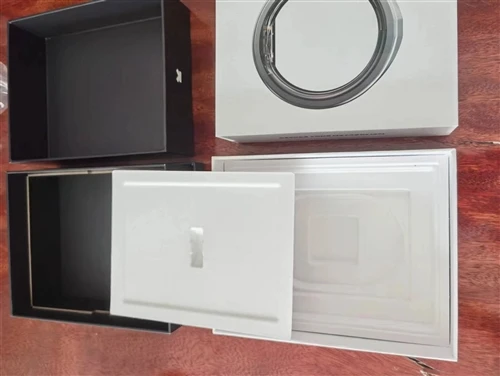
To make a high-precision mould, you need to get the exact shape of the object first. You may make a mould cavity that fits the shape of the object perfectly by employing 3D scanning technology to get accurate dimensions data on electronic items and software like RHINO and UG for reverse modelling. The Lenovo ThinkPad X1 Carbon packaging, for instance, uses CNC machining moulds with a surface transition error of less than 0.05mm. This keeps the gap between the packaging cavity and accessories like mobile phones and charging cables within 0.2mm, which stops shaking during shipping and cuts down on extra space.
2. Structure that copies and modular design
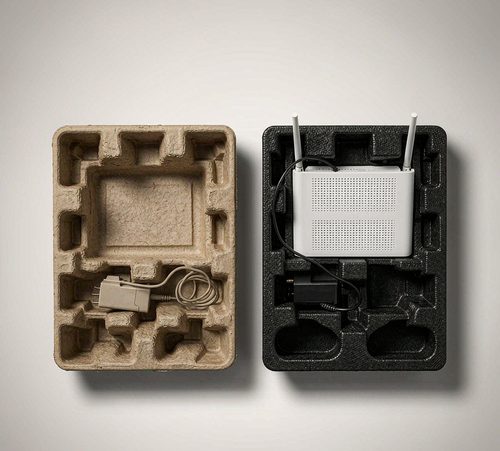
When designing moulds for irregular electronic devices like headphones and game controllers, "negative profiling" technology must be used. This technique makes grooves that perfectly fit the shape of the object using 3D printing or five-axis linkage processing. For example, the pulp-molded tray that holds the Sony PS5 game system uses profiling design to keep the host, handle, cable, and other accessories in separate modules. The total volume of the packaging is 30% smaller than that of regular foam plastic. At the same time, modular design makes it easy to put together and take apart quickly.
3. Finding the best demolding angle and R angle
The demolding angle (mould inclination) and R-angle (fillet radius) are two important factors that impact how tightly packed the package is. For easy demolding, traditional moulds frequently employ greater demolding angles (≥ 3 °), which makes the packing sides tilt and wastes space. By optimising the demolding structure (like side core pulling and hydraulic demolding), high precision moulds can lower the demolding angle to within 1 °. They can also dynamically change the elevation R angle based on the height of the product (the higher the height, the larger the R angle). This maximises the use of vertical space while still allowing for smooth demolding. For instance, the pulp moulded tray in the Apple iPhone packaging box has a 0.5 ° micro demolding angle. This makes the packaging 5mm shorter and 8% less bulky.
二, The moulding process uses micrometer-level control to find the right balance between density and accuracy.
1. The procedure of wet pressing and vacuum suction filtration
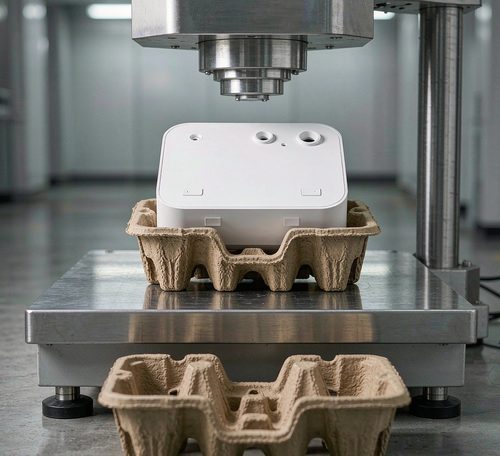
The wet pressing method uses high pressure (≥ 10MPa) and high temperature (180–200 °C) to tightly pack pulp fibres. This is the main way to make packaging denser. Using high-precision moulds with vacuum filtering systems may swiftly get rid of moisture and air during the moulding process, which makes the material less porous. For instance, the packaging for the Huawei MateBook X Pro uses wet pressing technology, which lowers the surface roughness from Ra6.3 μ m to Ra1.6 μ m and raises the density by 20%. At the same time, it lowers the danger of brittle fracture produced by too much fibre compression by shortening the suction period from 8 seconds to 5 seconds and changing the vacuum degree from -0.08MPa to -0.1MPa.
2. Hot pressing and treating the surface
The hot pressing moulding technique uses high temperature (150–170 °C) and high pressure (5–8MPa) to do a second pressing on the dried pulp moulded semi-finished product. This gets rid of burrs and unevenness on the surface. The high-precision mould cavity has a surface smoothness of Ra0.8 μ m. When paired with a PTFE coating to decrease stickiness, this makes the packing surface flatness close to that of plastic injection moulded parts. For instance, the packaging for Xiaomi neck-hanging Bluetooth earphones is processed by hot pressing to make the surface less rough, going from Ra3.2 μ m to Ra0.4 μ m. At the same time, etching procedures create micro-scale textures on the surface, including fine sand patterns and leather patterns. These textures not only increase friction to keep things from slipping, but they also make the visual hierarchy better by reflecting light and shadows.
3. Moulds with many stations and automated manufacture
High-precision moulds need to work with production equipment that works well. Multi-station moulds, like rotary and reciprocating moulds, can do several steps in one cycle, like suction, moulding, and demolding. This cuts the time it takes to make each piece to 8–12 seconds. The completely automatic pulp moulding production line from Guangdong Hansen Intelligent Equipment Co., Ltd. uses 12 station moulds and mechanical arms to take up items automatically. It can make 50,000 pieces each day. We make sure that each package is the same size by using closed-loop control of the mould temperature (error ± 1 °C) and dynamic pressure correction (error ± 0.1MPa). This helps with the design process.
三, Choosing materials: Fibre composites and functional coatings make structures more compact.
1. Improving the density and fibre composite
It's hard for single fibre materials like sugarcane bagasse and bamboo fibre to match the needs for strength, flexibility, and affordability at the same time. By mixing diverse fibres, like bamboo fibre, sugarcane bagasse, and wood fibre, high-precision moulds can have better performance. For instance, bamboo fibre is quite strong (≥ 500MPa), sugarcane bagasse is very flexible (it stretches at break ≥ 15%), and wood fibre structure is very stiff (its elastic modulus is ≥ 10GPa). When you mix the three in a 6:3:1 ratio, you can manage the density of pulp moulding at 0.6–0.8g/cm³, which is 15% greater than the density of a single material. The mold's fibre orientation technique also makes the package 20% denser in the vertical direction (the direction of compression) than in the horizontal direction, which makes better use of space.
2. Coatings that serve a purpose and make surfaces stronger
High-precision moulds can use functional coating technology to make packaging more resistant to moisture and abrasion. For example, the packaging for Sony WH-1000XM5 headphones has a bio-based waterproof coating (thickness ≤ 5 μm) on the surface of the pulp moulding. This lowers the packaging's water absorption rate from 12% to 3%. Nano silica (pencil hardness ≥ 3H) makes the coating harder at the same time to keep it from getting scratched while being moved. The microstructure of the mould (depth 0.1–0.3mm) can also be used to create relief technologies, like 3D printing of brand logos. This not only makes the brand more recognisable, but it also makes the image look less bloated by using light and shadow effects.
四, Industry example: Compact use of high-precision moulds
1. Packaging for the Apple iPhone 15 Series
Apple uses high-precision moulds to make "zero gap" package design:
Mould accuracy: Using five-axis linkage processing, the mould cavity inaccuracy is less than 0.03mm.
Structural optimisation: The mobile phone, MagSafe charger, and instruction manual are all fixed in separate modules that look like the design. This cuts down on the size of the packaging by 18% compared to the previous iteration.
New materials: It has a density of 0.7g/cm³ and is made from a mix of 100% recycled bamboo fibre and sugarcane bagasse pulp. It is 25% stronger in compression.
2. Packaging for the Lenovo Moto Razr 50d Folding Screen Phone
Lenovo uses modular mould design to make the "floating display" effect in its packaging:
Mould structure: By using side core pulling and hydraulic demolding technology, the demolding angle is lowered to 0.8 °, which means that the verticality of the package side wall is at least 98 °;
Surface treatment: Hot pressing and laser hot stamping create dynamic optical textures on the packaging surface that make it look thinner.
The honeycomb support structure takes the place of the old foam, which cuts the weight of the packing by 30% and the volume by 25%.