一,The "quality pass" is an international norm that everyone knows about.
Export packaging must meet the standards of both the target market and the means of delivery. The internationally recognised system includes:
1. Rules regarding how to pack things for shipping
The American Society for Testing and Materials (ASTM D6198) says that packaging must be tested to make sure it is structurally sound by simulating transport vibrations, impacts, stacking, and other situations. For instance, the packaging for a certain brand of mobile phone must not be damaged and must not distort more than 3% when stacked in three layers (height 1.8 meters).
ISO 12048: The International Organisation for Standardisation created the "Static Compression Test Method for Packaging." It sets standards for things like the loading speed of the pressure testing machine and the parallelism of the pressure plate. This makes it easier to compare compressive tests.
ISTA 3A: This is a standard from the International Safe Transport Association for e-commerce logistics. It simulates many situations that can happen during shipping, like vibrations, drops, and changes in temperature. It is good for checking the packaging of high-value electronic products.
2. Standards for materials and the environment
The EU REACH rule limits the amount of dangerous compounds like lead, cadmium, and mercury in packaging materials to < 100ppm and compels enterprises to give RoHS testing results.
The EU's Single Use Plastic Directive (SUPD) says that plastic packaging must break down naturally, and moulded pulp packaging must be certified according to EN 13432, which shows that it will break down by at least 90% in 180 days.
FSC certification: The Forest Stewardship Council must certify that timber fibre materials used for packaging come from forests that are maintained in a way that is good for the environment.
3. Unique needs of the target market
North American market: employ plant fibre cushioning materials more than foam plastics; transport signs must meet ISO 780 standards and include warning labels such "this end up" and "moisture-proof."
Japanese market: tight rules about how accurate the size of the packaging must be, with errors kept to within ± 1mm; The Japanese Ministry of Health, Labour, and Welfare must approve food packaging to make sure that no chemicals can move through it.
In the Middle East, some nations require packaging to have Halal certification stamps on it and not use materials that come from pigs.
二, Main way to test: Validation from laboratory to practical applications
There are three parts to testing the performance of packaging: static compression resistance, dynamic impact, and environmental adaptation. The following are the most important steps in testing:
1. Test of compressive performance
The electronic universal material testing equipment has a pressure range of 0 to 100 kN and an accuracy of ± 1%.
Steps: Put the packaging in the middle of the pressure plate of the testing machine, load it at a pace of 10 mm/min, and write down the pressure value when the first strange noise or corner break happens.
How to figure out the highest compressive strength:
P=W×(H/h)×f 1 (where W is the quality of the packing, H is the storage height, h is the height of the packaging, f is the deterioration coefficient, and the best values are 1.6-2.0)
3. For example, a given mechanical component packing (20 kg, 3 m high for storage, 0.5 m high for packaging, f=1.8) needs to be able to handle a pressure of at least 2160N.
2. Test for dropping
Standard: Drop a single colour box from a height of 0.8 to 1 m. Test one corner, three edges, and six sides.
Equipment: A drop testing machine with an acceleration sensor that records the G value at the moment of impact.
Judgement: The product's function and appearance don't alter when it falls, and the package doesn't break. For instance, the packaging for a certain brand of headphones needs to be able to play regularly even after falling from a height of 1m, and the box shouldn't change shape.
3. Testing for adaptability to different environments
Temperature and humidity cycling: testing in a range of -40 to 70 degrees Celsius and 10% to 95% RH, which is like moving things through a cold chain or storing them in a tropical warehouse.
Water absorption test: To follow the GB/T 460 standard, draw a 1mm broad ink line on the product's surface and measure the ink line's diffusion width after 30 seconds. It should be 2mm.
Odour testing: Make sure there are no bad smells and that the items that come into contact with food are safe by smelling them.
三, Following the rules and getting certified: The Key to Getting Past Trade Barriers
To export packaging, you need to secure certification for your target market. Here is a typical process:
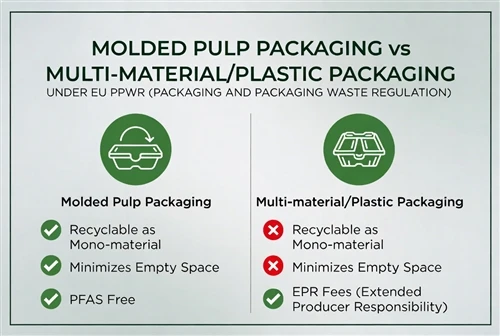
1. EU EPR registration: Manufacturers must sign up with LUCID in Germany, CITEO in France, and other systems to take care of recycling packaging waste.
process
Check what kind of packaging material it is (like plastic or pulp).
Sign up for the target country's EPR system and earn a unique ID number.
Every year, you have to pay a recycling charge. The fee depends on the item; for example, cardboard boxes cost about 0.05 euros per kilogramme.
2. Writing the test report
Important papers:
Report on REACH testing (heavy metal content).
Report on RoHS (Restriction of Hazardous Substances).
Certification from EN 13432 for biodegradable plastic packaging and from FSC for wood fibre raw materials.
For example, a company that sells pulp-molded tableware to Germany has to show that the lead content is less than 90 parts per million and that the raw materials come from sustainable forests.
3. Identification and Labels
The Environmental Protection Label has a green dot symbol and says "Printed Recyclable Label."
Warning: Mark icons like "Fragile" and "Moisture proof" according to the ISO 780 standard.
Language requirement: Labels in more than one language (such English, French, and Arabic) to make sure the content is easy to read.
四, Case Study: Closed Loop Practice from Testing to Optimisation
Background of the case: A certain type of drone was sent to North America, and the initial packaging employed pallets made of pure sugarcane bagasse. The following issues were discovered during testing:
The problem is that in the simulated 3-layer stacking test, the corners of the pallet collapsed, causing a 4.5% deformation, which is more than the company's usual limit of 3%.
Examination:
Material: The fibres in sugarcane bagasse are not very strong and are just 0.8 to 2.5 mm long.
Structure: There are no reinforcement bars, and stress builds up at the corners.
Plan for optimisation:
To make the material better, add 2% coniferous wood pulp (fibre length 2.56–4.08 mm) to make the fibres stronger as they interweave.
Structural optimisation: To spread out the pressure, add L-shaped paper reinforcing ribs to the four corners of the tray.
Change the process: Raise the mould temperature to 180 °C and the moulding time to 120 seconds.
Verification of the effect: After optimisation, the tray's deformation went down to 2.8%, and its compressive strength went up by 35%, passing ISTA 3A certification.