


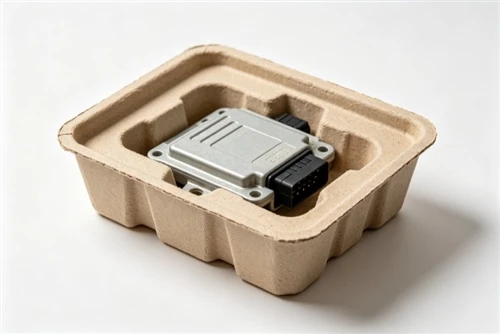
Automotive Molded Pulp Packaging: Protecting Sensors, Battery Components and Precision Parts
Modern vehicles contain thousands of parts that must arrive at assembly lines free of scratches, bending, electrostatic damage or contamination. For decades, automakers and Tier-1 suppliers relied on EPS foam and EVA inserts to cushion these components. That is changing. Molded pulp packaging is now moving into automotive supply chains as automakers push for lighter packaging, lower carbon footprints and easier end-of-life disposal.
This article looks at where molded pulp works best in automotive logistics, how to choose between wet press and dry press, and what it actually costs to switch.
Why Automotive Suppliers Are Switching from Foam to Fiber
EPS and EVA have two structural weaknesses that matter in automotive logistics: they are bulky to store and ship, and they are difficult to recycle after use. A truckload of empty EPS inserts takes up roughly the same volume as a truckload of finished parts. Molded pulp trays stack flat before forming and nest after use, so inbound packaging density improves noticeably.
The bigger driver, however, is carbon accounting. Automotive OEMs now ask suppliers to report packaging-related emissions. Recycled paper pulp carries a much lower carbon footprint than virgin EPS resin, which is produced from petroleum. For a mid-size Tier-1 supplier shipping 200,000 units per year, replacing EPS inserts with molded pulp can cut packaging weight by 30-50% and reduce packaging-related CO₂e by roughly 40-60% per shipment, depending on transport distance (estimated figures based on typical LCA studies).
Best-Fit Applications in the Vehicle Supply Chain
Molded pulp is not suitable for every automotive part. Heaviest blocks and long structural beams still use steel frames or wood. But for the components below, pulp trays and inserts are proven, cost-effective solutions:
| Component Group | Typical Parts | Recommended Process | Main Protection Need |
|---|---|---|---|
| Sensors & ECUs | ABS modules, radar sensors, cameras, control units | Dry press or wet press | Shock absorption, ESD-safe surfaces |
| Battery & HV parts | Cell spacers, busbar covers, battery module trays | Wet press (thin wall) | Dimensional accuracy, creep resistance |
| Precision machined parts | Gears, valves, pump housings, aluminium brackets | Wet press or heavy dry press | Scratch-free surfaces, oil resistance |
| Wiring & connectors | Harnesses, connectors, fuse boxes | Dry press | Anti-static, nesting stability |
| Trim & interior | Dashboard inserts, speaker grilles, vents | Wet press | Cosmetic surfaces, brand-ready finish |
The general rule for buyers: if the part is small, light and needs cushioning, dry press molded pulp is usually enough. If the part is heavy, sharp-edged, or must stay in a precise position for weeks of storage, wet press provides thinner walls, a denser surface and tighter tolerances.
Wet Press vs Dry Press for Automotive Parts
The two processes serve different cost points:
- Dry press molded pulp uses a vacuum to pull fiber onto a mesh mold, then heat-dries it in a second mold. Wall thickness typically runs 2-3 mm. It is the lower-cost option and suits sensors, connectors and small machined parts. Surface texture is slightly rough, which is fine for hidden cushioning.
- Wet press molded pulp presses the formed part hydraulically while it is still wet, squeezing out excess water and densifying the fiber. Walls can be as thin as 1.5-2.5 mm, and the surface becomes smooth enough for visible retail-style packaging. It costs more per piece but uses less material per unit, which narrows the gap at high volumes.
For battery-related packaging, wet press is the safer choice. Thin, dense walls resist creep under sustained load, so a heavy HV connector does not sink into the tray during ocean freight or long warehouse storage.
ESD and Moisture Considerations
Automotive electronics are sensitive to static, so buyers often ask whether molded pulp is ESD-safe. Standard pulp is not inherently conductive, and it can generate static in dry conditions. Where static protection is required, suppliers add antistatic treatments or combine pulp trays with conductive inserts. Treat this as an engineering question, not a yes/no answer: request an ESD test with your actual part before committing.
Moisture is less of a problem than many buyers expect. Dry press parts typically hold 6-9% moisture; wet press parts can be held to a lower, more consistent level. For overseas shipments, trays are usually bagged with desiccant, the same way foam parts are. Salt-spray and humidity tests are common for automotive packaging qualifications and should be part of any validation plan.
What Switching Actually Costs
Two costs matter: one-time tooling and per-piece price.
- Tooling (one-time): Dry press tooling for a typical automotive tray starts at roughly USD 1,500-4,000 per cavity, while wet press tooling runs USD 3,000-8,000 per cavity depending on size and precision (estimated, see our tooling guide for details). Multi-cavity tools spread this cost across production.
- Per-piece price: Dry press trays for small parts typically range USD 0.15-0.60; wet press trays with thin walls and smooth surfaces range USD 0.30-1.20, strongly dependent on volume and wall thickness (estimated).
The economics usually work when annual volume exceeds roughly 50,000 pieces, because foam tooling is cheap but foam per-piece cost stays flat, while pulp per-piece cost drops as volume grows.
Getting Started: What to Send a Molded Pulp Supplier
To quote an automotive application accurately, a supplier needs:
- A CAD file (STEP or IGES) of the part, or a physical sample
- Annual volume and shipment frequency
- Whether the tray is for inbound logistics only, or also for retail display
- Any ESD, oil-resistance or humidity requirements
- Preferred packaging orientation (how the part should sit)
Hesheng Innovation Development Ltd. has supplied custom molded pulp trays and inserts for automotive and industrial applications since 2013, with in-house tooling for both dry press and wet press processes. For a quote on your specific part, send your CAD file through the contact page, or ask about our standard sample program for first-time buyers.
FAQ
Q: Why is molded pulp used for automotive parts packaging?
A: Molded pulp trays are custom-molded to the exact contours of sensors, connectors and EV components, giving them fixed-position protection in transit while staying lightweight and fully recyclable.
Q: Can molded pulp packaging protect heavy or delicate automotive parts?
A: Yes. Wall thickness and rib design are tuned to part weight and geometry, and stackable tray designs keep parts in place without shifting during long shipments.
Q: Is molded pulp packaging suitable for EV battery components?
A: Molded pulp is non-conductive and does not promote static buildup, and it can be formed to close tolerances, which suits protective packaging for battery modules and electronic assemblies.
Q: Does Hesheng build molds for automotive packaging in-house?
A: Yes. Hesheng designs and manufactures tooling in-house, which shortens lead times and makes it easier to iterate tray geometry during prototyping.


