


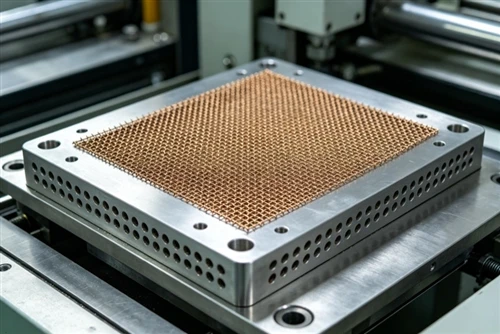
Molded Pulp Tooling: Mold Design and Tooling Cost, a Practical Guide for Buyers
Ask any packaging engineer what surprises them most about molded pulp, and the answer is almost always the same: the tooling. Buyers used to plastic injection are familiar with mold costs, but pulp tooling works differently. It is cheaper than injection tooling, faster to modify, and yet poorly understood by most purchasing teams. Get the tooling decisions right and a custom molded pulp project is straightforward. Get them wrong, and you pay twice.
This guide explains how pulp molds are built, why dry press and wet press tooling differ, what drives tooling cost, and what information a supplier needs to quote your project correctly.
Why the Mold Is the Heart of a Molded Pulp Project
In molded pulp, the mold determines nearly everything: the shape and wall thickness of the part, its surface texture, its dimensional tolerance, and how fast it can be produced. Unlike plastic injection where the mold is a closed cavity, pulp tooling is a permeable mesh or perforated structure through which water and air are pulled by vacuum. The tool is half the manufacturing process, not just a shaping device.
This is why the same product concept can produce very different parts depending on who builds the tool. A well-designed tool with correct draft angles, smooth flow paths and even vacuum distribution produces consistent parts with low reject rates. A rushed tool produces warped edges, thin spots and a high scrap rate that no amount of downstream trimming can fix.
Types of Pulp Molds
Pulp tooling falls into three main families, each with its own cost and durability profile:
| Mold Type | Typical Use | Tooling Cost Range (est.) | Life Expectancy | Notes |
|---|---|---|---|---|
| Perforated aluminum / stainless steel | Wet press, high-volume, precision parts | USD 3,000-8,000 per cavity | 500,000+ cycles | Best dimensional accuracy, smooth surface |
| Perforated / mesh steel (dry press) | Dry press, medium to high volume | USD 1,500-4,000 per cavity | 200,000-500,000 cycles | Lower cost, slightly rougher texture |
| Resin / composite plaster | Prototypes, low volume, first samples | USD 500-2,000 per cavity | 5,000-50,000 cycles | Fast to make, good for design validation |
| 3D-printed / additive | Prototyping only | USD 300-1,500 | 1,000-10,000 cycles | Useful for fit checks, not production |
Most production parts use perforated steel or aluminum molds. The pattern of holes, their size and the backing mesh all affect how evenly fiber deposits, which shows up in wall thickness consistency.
Dry Press vs Wet Press Tooling: What Changes
The visible difference between dry and wet press products starts in the tooling.
Dry press tooling consists of a forming mold (the mesh surface where fiber collects) and a drying mold (the heated form that presses the part while it dries). Because the drying mold is a simple heated form, dry press tools are simpler and cheaper. Wall thickness control is looser, typically 2-3 mm, and the surface picks up the mesh texture.
Wet press tooling adds a third stage: the part is transferred to a press mold and squeezed hydraulically while still wet. The press mold must be precise, because the squeeze sets the final density and dimensions. Wet press tools therefore cost more, but they produce thinner walls (1.5-2.5 mm), denser edges and a smooth, almost molded-surface finish that dry press cannot match.
Rule of thumb for buyers: if the part will be visible to end customers, plan for wet press. If it is hidden cushioning, dry press is usually sufficient and more economical.
What Drives Tooling Cost
Five factors move the price more than anything else:
- Part size and mold dimensions. A tray for a large pump housing needs more mold material, more vacuum coverage and more machining. Size scales cost faster than most buyers expect.
- Draft angle and geometry. Molded pulp parts need draft angles of at least 3-5 degrees on vertical walls so the part releases cleanly from the mold. Parts designed with near-vertical walls or undercuts force rework or multi-piece tooling, which adds cost and slows lead time.
- Ribs, bosses and added features. Reinforcement ribs improve stiffness, but every rib is a groove in the mold that must be machined and that must release cleanly. Keep ribs shallow and drafted if you want to hold tooling cost down.
- Dimensional tolerance. Tighter tolerances mean more precise machining and more test cycles. Packaging tolerances of ±0.5-1.0 mm are normally achievable without premium tooling; asking for injection-grade tolerances (±0.1 mm) is possible but expensive and rarely necessary.
- Surface finish and texture. A smooth, brand-ready surface for wet press requires finer mesh and additional mold finishing. If you only need a functional cushioning surface, you can save on this item.
Typical Lead Times and Budgets
For planning purposes, here are typical numbers for a mid-size custom tray (estimated, actual quotes depend on your drawings):
| Item | Prototype (resin) | Production (steel/aluminum) |
|---|---|---|
| Tooling lead time | 7-15 days | 20-45 days |
| Tooling cost (single cavity) | USD 500-2,000 | USD 2,000-8,000 |
| Sample time after tooling | 3-7 days | 5-10 days |
| Typical first article approval | 2-3 weeks total | 5-8 weeks total |
Multi-cavity tooling spreads the one-time cost across more parts per cycle, which is how high-volume projects bring per-piece prices down.
Common Mistakes Buyers Make
Three errors show up again and again in custom pulp projects:
- Sending only a 2D drawing. Pulp tooling needs the part geometry in 3D, or a physical sample. 2D sketches force guesswork and rework.
- Designing the part like plastic. Injection molding can handle thin, deep, vertical-wall geometries. Pulp cannot. Design with draft, generous radii and uniform wall thickness from the start.
- Choosing dry press for a cosmetic part to save money. The per-piece saving is real, but the surface will look like mesh texture. If the tray is part of the retail experience, budget for wet press from the beginning.
What to Prepare Before Requesting a Quote
A good supplier can quote your tooling within days if you provide:
- CAD file (STEP, IGES) or a physical sample
- Target annual volume (this decides multi-cavity and dry vs wet)
- Wall thickness range you have room for
- Whether the part needs a smooth, cosmetic surface
- Any drop-test or compression requirements
Hesheng Innovation Development Ltd. has designed and built custom molded pulp tooling in-house since 2013, covering both dry press and wet press for electronics, industrial, food and cosmetic packaging. If you are evaluating a custom project, send your part file through the contact page and our engineering team will come back with tooling options, cost estimates and a sample timeline.
FAQ
Q: How much does molded pulp tooling cost?
A: Tooling cost depends on part size, complexity and process. As a rough guide, dry-pressed tools are usually lower in cost than wet-pressed tools because the mold structure is simpler. Exact quotes require part drawings and production volumes.
Q: How long does molded pulp tooling take to manufacture?
A: Lead time for a new tool typically ranges from 3 to 6 weeks, depending on complexity and whether machining is done in-house.
Q: What factors affect mold design for molded pulp?
A: Key factors are part geometry, draft angles, wall thickness consistency, mold material, vacuum and drying requirements, and expected production volume.
Q: Does Hesheng make molded pulp molds in-house?
A: Yes. Hesheng designs and machines tooling in-house, which shortens prototyping time and gives us direct control over both tooling cost and part quality.


