


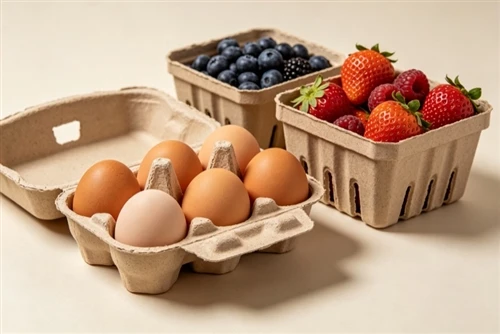
Molded Pulp Packaging for Fresh Produce: Cutting Food Waste in Fruit, Vegetable and Egg Transport
Lead: Roughly a third of all food produced for human consumption is lost or wasted, and a meaningful share of that happens between the farm and the store shelf. Molded pulp packaging - fiber trays, fruit punnets, egg cartons, and produce liners - is quietly becoming one of the most practical fixes, because it is breathable, cushioning, and fully recyclable at the same time.
The Waste Problem Molded Pulp Addresses
Post-harvest loss is not a niche issue. Global estimates (directional figures, treated as approximate) put food loss and waste at around 1.3 billion tonnes per year, with fruit and vegetables carrying the highest loss rate of any food category - in the range of 20–30% in some supply chains before products reach the consumer. Much of this damage is mechanical: bruising, crushing, and abrasion during sorting, packing, and transit.
Conventional produce packaging - plastic punnet films, foam nets, and expanded-polystyrene trays - cushions but does not breathe well, and it creates a disposal problem at the retail end. Molded pulp combines three properties that plastic trays lack:
- Breathability. The fiber structure lets moisture and ethylene gas escape, which slows ripening and reduces mold. This is the single most important functional advantage for fruit.
- Shock absorption. The pulp wall deforms on impact instead of shattering, protecting eggs and soft fruit from drop damage.
- End-of-life simplicity. A molded pulp tray goes straight into the paper recycling stream or the compost pile, with no film to strip off.
Egg Cartons: The Original Molded Pulp Product
The egg carton is where molded pulp proved itself. Modern molded pulp egg cartons hold eggs in individual dimples that isolate each shell from its neighbors, and the pulp's slight flexibility absorbs the jolts of trucking. Industry practice (and manufacturer test data) shows molded pulp egg cartons routinely survive the drop tests specified by major grocery chains, while offering a stackable, printable, and curbside-recyclable package.
For exporters shipping eggs or small, fragile produce over long distances, the molded pulp carton's ability to be printed with origin, grade, and branding - in the same die as the tray - removes an extra labeling step.
Beyond Eggs: Fruit Punnets, Produce Trays and Liners
Eggs were the starting point, but the same material logic now applies across the fresh-produce aisle:
| Produce type | Typical molded pulp format | Key benefit |
|---|---|---|
| Eggs | 12-cell, 18-cell, 30-cell cartons | Individual dimple isolation, drop protection |
| Berries & tomatoes | Ventilated punnets and clamshells | Breathability, moisture wicking, reduced mold |
| Stone fruit & apples | Shallow pulp trays with lid | Bruise protection during stacking |
| Avocados | Molded pulp cradle trays | Firm support, ethylene management |
| Cucumbers & peppers | Tray + film-free liner | Cushioning, reduced abrasion |
| Mushrooms | Punnet with airflow vents | Humidity control, longer shelf life |
A point worth emphasizing for produce buyers: molded pulp does not need a plastic film overlay to function. For berries, a ventilated pulp punnet can replace a plastic punnet plus its film wrap, removing two layers of non-fiber material at once. The trade-off is that pulp punnets are slightly heavier than thin plastic equivalents, so freight cost per unit rises a little - but that is usually offset by lower product damage and lower packaging-disposal fees.
The Numbers on Damage, Shelf Life and Carbon
Produce buyers make decisions on measurable outcomes, so here are the dimensions a molded pulp switch typically moves (estimates, treated as directional):
| Outcome | Typical improvement with molded pulp |
|---|---|
| In-transit bruising / damage | 10–30% reduction vs plastic foam trays (estimated) |
| Shelf-life of berries (mold onset) | +1–3 days with ventilated pulp punnet (estimated) |
| Packaging recyclability | 100% curbside recyclable, home-compostable options |
| Packaging carbon footprint vs EPS/plastic tray | 40–60% lower per unit (estimated) |
| Plastic film removed per punnet | Up to 100% for film-free designs |
The shelf-life effect deserves the most attention. Because molded pulp breathes, humidity inside a ventilated punnet stays lower and mold develops later. In grocery trials reported by fiber-packaging suppliers, ventilated molded pulp punnets extended berry shelf life by roughly one to three days compared with sealed plastic equivalents - enough to cut store-level shrink meaningfully.
Supply Chain and Compliance Drivers in 2026
Two forces are accelerating the shift from plastic produce trays to molded pulp.
EU packaging waste regulation (PPWR) and national EPR schemes. Under the phased EU rules, packaging must be recyclable by 2030, and EPR fees in several member states now penalize hard-to-recycle formats such as EPS and multi-layer film. Molded pulp is mechanically recyclable in paper streams and frequently home-compostable, placing it in the lowest fee bands - the same regulatory tailwind already reshaping bottle and food packaging.
Retailer sustainability scorecards. Major grocery chains in Europe and North America now score suppliers on packaging recyclability, recycled content, and plastic reduction. A produce supplier that can show a fully fiber-based punnet line is at a measurable advantage in tenders.
Design Considerations for Produce Tooling
Fresh produce molds differ from bottle or electronics tooling in three ways:
- Ventilation pattern. The die must create airflow holes sized to the produce - too small and moisture traps, too large and the tray loses strength. Punching pattern is tuned per fruit.
- Food-contact safety. Trays that touch food directly need food-grade fiber and must meet regional food-contact rules (e.g., EU food-contact requirements, FDA-compliant materials for the US market).
- Moisture resistance. Long cold-chain transit calls for a moisture-resistant treatment so the tray does not soften when condensation forms. Standard trays are fine for short trips.
For a producer of eggs, berries, or stone fruit, tooling is typically amortized over high volume, which keeps per-unit cost competitive with plastic even after the pulp price is accounted for.
How Hesheng Approaches Produce Packaging
Hesheng Innovation Development Ltd. manufactures custom molded pulp packaging - egg cartons, fruit punnets, produce cradles, and export liners - from recycled fiber, with in-house tooling and both wet-press and dry-press lines. Since 2013, the company has served food, beverage, electronics, and cosmetics clients across North America, Europe, South America, and Australia.
For a produce project, Hesheng starts from the fruit's dimensions and handling profile, recommends a ventilation and coating design, approves tooling samples, then ramps serial production with dimensional and drop-test QC. Both food-contact and moisture-resistant options are quoted, so buyers can compare the right specification for their cold chain.
Ready to prototype a fruit punnet or egg carton? Contact Hesheng or WhatsApp, and the team will confirm tooling feasibility and sample lead time within one business day.
FAQ
Q: Why is molded pulp used for fresh produce packaging?
A: Molded pulp trays are rigid yet breathable, holding fruits and vegetables in place while allowing airflow that reduces moisture build-up and spoilage.
Q: Is molded pulp produce packaging compostable?
A: Yes. Molded pulp made from recycled paper or bagasse is home- and industrially compostable, and it can be recycled again after use.
Q: Can molded pulp trays be used for wet produce?
A: Trays can be treated with water-resistant coatings for high-humidity produce, while standard trays suit dry items such as apples, pears and citrus.
Q: What is the typical wall thickness of produce trays?
A: Dry-pressed produce trays are typically up to about 3 mm thick, balancing strength with material cost.


