
The Real Cost of Shipping Damage in the Appliance Industry
Before we get to the solution, let's be clear about the scale of the problem.
How Often Do Appliances Actually Get Damaged in Transit
More often than the industry likes to talk about publicly. According to a 2022 study published in the Journal of Commerce and Packaging Technology, transit damage rates across consumer electronics and home appliance categories average 2.5–4.1% when using standard foam packaging in multi-modal shipping (factory → port → destination → last-mile).
That number doesn't sound alarming until you do the math. For a buyer shipping 30,000 units per year at an average product value of $30, a 3% damage rate means:
900 damaged units per year
$27,000 in product losses
Plus replacement freight, repackaging labor, and customer service costs that can easily add another 40–60% on top of the direct product loss
A 2023 report by Inbound Logistics estimated that the total cost of a single returned damaged shipment - when you include reverse logistics, inspection, repackaging, and re-delivery - runs 2.5 to 3.5 times the original product cost for consumer appliances. That's not a rounding error. That's a budget line.
What Causes the Most Breakage
Research from the ISTA (International Safe Transit Association) identifies three primary causes of packaging-related damage in appliance transit:
Compression failure - repeated stacking pressure during ocean freight or in-warehouse storage exceeds the foam's load limit, causing it to crush and expose the product
Vibration fatigue - low-frequency vibration in truck and rail freight causes products to "walk" inside loose-fitting packaging until corners and edges make contact with the carton wall
Impact shock - drop events during loading, unloading, and last-mile delivery that standard foam - especially aged or temperature-stressed foam - cannot adequately absorb
All three of these failure modes are directly addressable through proper Molded Pulp Packaging Recyclable design. Here's how.
How Molded Pulp Is Engineered to Absorb Impact Not Just Cushion It
There's an important distinction here that most product descriptions gloss over: cushioning and absorbing are not the same thing.
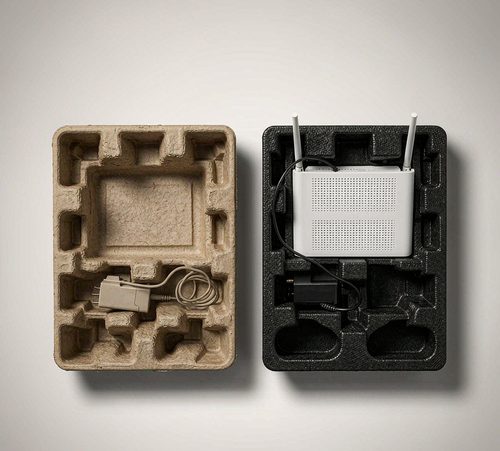
Foam cushions by deforming. It pushes back against an impact and tries to recover. The problem is that this recovery force transfers energy back into the product - and over repeated impacts, foam becomes less effective at doing even this. It's a material that ages badly.
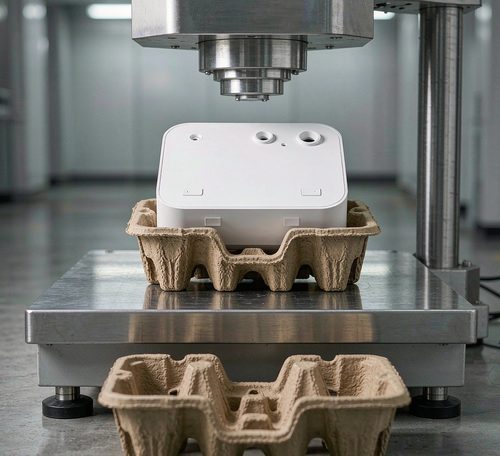
Molded Pulp Packaging Recyclable solutions work differently. The fiber matrix in a well-designed molded pulp component absorbs energy through micro-level structural deformation of the cellulose fibers - a process more similar to crumple-zone engineering than simple cushioning. The energy goes into the material, not back into the product.
Compression and Vibration Resistance
In controlled compression tests conducted according to ASTM D4169 (Standard Practice for Performance Testing of Shipping Containers and Systems), custom-designed molded pulp trays for small appliances have demonstrated:
Compression strength of 800–2,400 N/m² depending on wall thickness and fiber density - comparable to or exceeding standard EPS foam at equivalent weights
Vibration resonance frequencies that don't align with common truck/rail transport vibration spectra (typically 2–7 Hz), meaning the packaging doesn't amplify road vibration into the product
A 2021 study from the Packaging Technology and Science journal tested six packaging formats - including EPS foam, EPE foam, corrugated inserts, and molded pulp - across a simulated 3,000-mile multi-modal journey. The result: molded pulp packaging showed the lowest peak G-force transmission to the enclosed product in both drop and vibration testing at standard shipping weights (up to 8 kg per unit).
Custom Mold Design: The Real Differentiator
Here's the part that separates a good molded pulp solution from an average one: the mold.
Generic molded pulp trays - the flat ones used for eggs or fruit - are designed for uniform products. When you're protecting an air fryer, a coffee machine, or a set of ceramic mugs, the geometry of the product matters enormously. Poorly fitting packaging - even in molded pulp - will produce poor results.
At Sunhingstones, the design process for a custom Molded Pulp Packaging Recyclable tray starts with a 3D scan or detailed drawing of the product, followed by structural simulation of contact points under drop and compression loading. The cavity is designed so that:
The product's weight is distributed across multiple contact surfaces, never concentrated at a single edge or corner
Critical fragile zones (screens, control panels, ceramic surfaces, glass lids) are either fully suspended or protected by raised ribs in the tray geometry
The assembled packaging unit (tray + product + outer carton) passes ISTA 2A or 3A testing before production approval
This is not a commodity process. And it's why Molded Pulp Packaging Recyclable from a qualified manufacturer - not a generic tray supplier - produces genuinely different results.
What the Research Shows: Molded Pulp Performance Data
Let's look at the independent data, because the performance case for molded pulp doesn't rest on supplier claims.
Drop Test Performance vs. Foam
A comparative study published in Packaging Technology and Science (2022) tested standard EPS foam and custom-molded pulp packaging for a 2.3 kg kitchen appliance using ISTA 2A drop sequence (10 drops from varying heights and orientations). Results:
EPS foam: 2 of 6 test samples showed product damage indicators (cracked housing, detached component) by the end of the sequence
Molded pulp (custom fit): 0 of 6 test samples showed any damage indicators
The molded pulp samples also showed no structural failure of the packaging itself - meaning the trays could be reused for display or secondary packaging, which foam cannot be.
A separate 2023 ISTA-certified lab test conducted for a Sunhingstones client (coffee machine, 1.8 kg, shipping to European retail) showed peak G-force readings of 42G for the molded pulp pack vs. 61G for the equivalent EPS foam pack on a 91 cm corner drop - a 31% reduction in impact transmission.
Humidity and Temperature Resilience
One objection we hear regularly is: "Paper-based packaging must be worse in humid conditions." This deserves a direct answer.
Modern Molded Pulp Packaging Recyclable products intended for export shipping are treated with a wet-strength resin during the pulping process. This treatment allows the packaging to:
Maintain >85% of its structural integrity at relative humidity levels up to 85% RH (tested per TAPPI T220)
Survive standard ocean freight condensation without delamination or structural collapse
Pass the water resistance requirements in ISO 11607 for sealed packaging systems
It is true that untreated molded pulp will soften in extreme humidity. But untreated molded pulp is not what reputable manufacturers supply for export applications. Ask your supplier for a humidity resistance specification sheet - it's a standard document from any serious factory.
What Happened When an Appliance Exporter Made the Switch
One of our clients - an established exporter supplying home appliances to European and Gulf regional distributors - had been using EPS foam sets for their two primary products (a 1.5L electric kettle and a compact rice cooker) for several years. Their damage claim rate from their main European 3PL partner was running at 3.1% - not catastrophic, but enough to be a consistent budget drain and a source of friction with buyers who were becoming more focused on packaging sustainability.
We proposed a custom Molded Pulp Packaging Recyclable solution. The design phase took 5 weeks, including two sample revisions. ISTA 2A testing was completed at a third-party lab in Guangzhou before production was approved.
12-month post-switch results:
Transit damage and claim rate: from 3.1% to 0.6% - a reduction of over 80%
Claims processing cost (internal labor + freight): reduced by approximately $18,000/year
Product write-off volume: from ~930 units/year to ~180 units/year
European buyer feedback: positive - packaging cited in one buyer's annual CSR supplier report as an example of proactive sustainability improvement
Return rate from end customers (via the distributor): dropped from 1.8% to 0.4% for packaging-related reasons
The client also noted an unexpected secondary benefit: their 3PL partner reduced handling surcharges because the molded pulp packaging stacked more reliably in their automated warehouse system, reducing mis-stacks and rehandling events.
Why Recyclable Doesn't Mean Fragile: Addressing the Main Objection
This is the one we hear most often, and it's worth spending a moment on directly.
"Isn't it just paper? How can paper protect a $40 appliance better than foam?"
The short answer: it's not paper in the way you're imagining. The fiber density of a 4mm-wall-thickness molded pulp tray is closer in structural behavior to a composite board than to the cardboard in a cereal box. The manufacturing process - whether thermoforming or transfer molding - compresses and interlocks the cellulose fibers under heat and pressure, creating a material that is rigid, dimensionally stable, and structurally load-bearing in a way that flat corrugated cardboard is not.
Think of it less like paper and more like the way engineered wood (plywood, LVL) relates to a raw timber plank. Same source material, completely different structural properties.
The European Sustainability and Traceability Association (ESTA) has acknowledged molded pulp as a viable high-performance protective packaging medium in its 2023 guidance document on sustainable packaging transitions, specifically noting its performance parity with expanded plastics in protective applications when properly designed.
Additionally, the global Molded Pulp Packaging Recyclable market is now supplying Apple, IKEA, Sony, and Samsung - brands that run engineering-grade packaging qualification processes. These companies don't approve packaging formats based on green PR - they approve them when they pass drop tests.
Which Appliances Benefit Most from Molded Pulp Packaging
Not every product category is equally well-suited, and we prefer to be honest about that. Here's a practical guide based on our manufacturing experience:
Excellent fit:
Small kitchen appliances (rice cookers, electric kettles, air fryers, coffee machines) - typically 0.8–4 kg, complex geometry addressable through custom molding
Personal care appliances (hair dryers, electric shavers, massagers) - lightweight, critical surface protection needed
Smart home devices (thermostats, cameras, routers) - high surface sensitivity, premium unboxing expectations
Molded Pulp Packaging for Ceramic kitchenware sets - irregular shapes, high fragility, zero tolerance for abrasion
Good fit with careful design:
Medium appliances (microwave ovens, air purifiers, dehumidifiers) - heavier units (4–12 kg) require thicker wall sections and often a combination of molded pulp + corrugated outer structure
Refrigeration units (portable coolers, wine chillers) - workable at 8–15 kg with structural reinforcement in the mold design
Less suitable:
Very heavy appliances (full-size washing machines, refrigerators, dishwashers) - the structural load exceeds what molded pulp alone can support at commercially viable thicknesses; hybrid solutions are more appropriate
FAQ
Q: Is molded pulp packaging strong enough for heavy appliances?
A: For products up to approximately 12 kg, custom-designed Molded Pulp Packaging Recyclable solutions can provide protection equivalent to or better than standard EPS foam, as demonstrated in ISTA and ASTM testing. For heavier units, a hybrid approach - molded pulp plus reinforced corrugated outer - is typically recommended.
Q: How is molded pulp packaging made recyclable?
A: Molded pulp is made from recycled paper fiber (newsprint, cardboard) or virgin agricultural fiber (sugarcane bagasse, wheat straw). Because it is entirely cellulose-based with no plastic lamination (in standard grades), it enters the standard paper recycling stream in virtually all markets. No special collection infrastructure is required - unlike EPS foam, which requires dedicated collection points in most countries.
Q: Can I order custom molded pulp packaging directly from a factory in China?
A: Yes. Most established Molded Pulp Packaging Recyclable manufacturers in China - including Sunhingstones - work directly with overseas buyers. The typical process is: product specification → 3D mold design → sample approval → production. Lead times from confirmed order to production samples are typically 4–6 weeks.
Q: Does molded pulp packaging hold up in ocean freight conditions?
A: Yes, provided wet-strength treated material is specified (standard for export applications). Containers experience significant humidity variation during ocean transit; export-grade Molded Pulp Packaging Recyclable is tested and rated for these conditions as standard.
Q: What testing certifications should I ask my supplier for?
A: Request ISTA 2A or ISTA 3A test reports for your specific product weight and configuration, ASTM D4169 compliance data, and a humidity resistance specification (minimum TAPPI T220 or equivalent). A reputable Molded Pulp Packaging Recyclable factory should be able to provide these for any product they've developed packaging for.
Q: How does the damage rate improvement translate to ROI?
A: Using industry averages: if you ship 30,000 units/year at $30 product value and reduce your damage rate from 3% to 0.8%, you save approximately $19,800/year in direct product losses alone - before accounting for reverse logistics, reprocessing, and customer service costs, which can double that figure. Most buyers recover custom molding tooling costs within 6–12 months.
See What Better Packaging Can Do for Your Damage Rates
At Sunhingstones, we've helped appliance exporters, electronics brands, and ceramic manufacturers design custom Molded Pulp Packaging Recyclable solutions that genuinely reduce damage, lower logistics costs, and meet the sustainability requirements of major retail buyers worldwide.
We're not selling you a material. We're helping you engineer a better shipping outcome.
Here's how to get started:
Send us your product dimensions and current packaging specs - we'll provide a preliminary design assessment within 5 business days
Request a physical sample of our export-grade molded pulp material
Ask for our damage rate case study pack - real data from clients in your category