
Warehouse Space Is MoneyThe Problem Most Packaging Decisions Ignore
When a procurement team evaluates packaging, the conversation is almost always about unit cost and damage protection. Warehouse footprint almost never comes up - until it does, loudly, usually when a 3PL sends a storage overage invoice or a warehouse manager realizes that one product line is consuming 40% of a racking bay because the cartons don't stack cleanly.
How Foam Packaging Wastes Vertical and Horizontal Space
Here's the core problem with foam-based packaging in a warehouse context: it's optimized for cushioning, not for space efficiency.
EPS and EPE foam inserts are typically cut or molded to a larger footprint than the product they protect, because the cushioning layer needs to extend beyond the product's edges to absorb lateral impact. This means:
The outer carton is always larger than the minimum possible for the product - often by 15–25% in volume terms
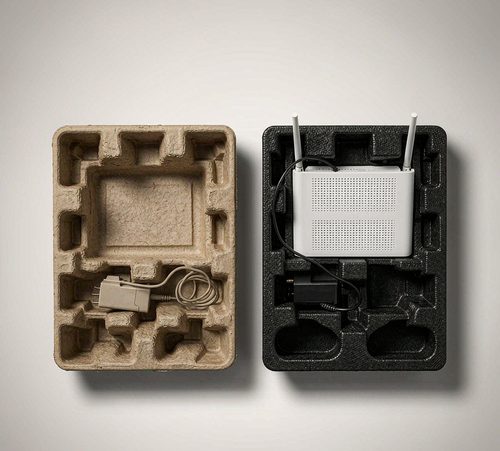
When cartons are received and opened at the warehouse, the foam components cannot be nested or flat-stacked - they take up similar space empty as they do full
Foam pieces from received goods that need to be repacked or returned create a loose-fill storage problem - they're bulky, they don't compress without tearing, and they have essentially no resale or recycling value on-site
For a buyer storing ceramic tableware - plates, mugs, bowls, serving sets - this is a particularly acute problem. Ceramic items are dense (high weight-to-volume ratio), so you want packaging that is as space-efficient as possible. Generic foam protection often adds 20–35% to the effective shipping volume of a ceramic product line, according to internal logistics assessments we've conducted with ceramic export clients.
Packaging Density: What the Numbers Say
The concept of packaging density - the ratio of product volume to total shipped volume - is one that logistics-focused teams are starting to track seriously. A 2022 analysis by McKinsey & Company on e-commerce packaging efficiency found that poorly designed protective packaging accounts for an average 23% volume waste across consumer goods categories, with home goods and ceramics among the worst-performing segments.
A separate study by WRAP (Waste & Resources Action Programme) in the UK found that optimizing packaging dimensions and reducing void fill could save UK businesses collectively £1.8 billion in logistics costs annually - driven almost entirely by better pallet utilization and reduced freight volume.
At the pallet level, this translates directly to freight savings. More product per pallet means fewer pallets per container, which means lower freight cost per unit. It also means lower 3PL handling fees, since many warehouses charge per pallet position or per movement event.
How Molded Pulp Is Designed for Stacking, Nesting, and Density
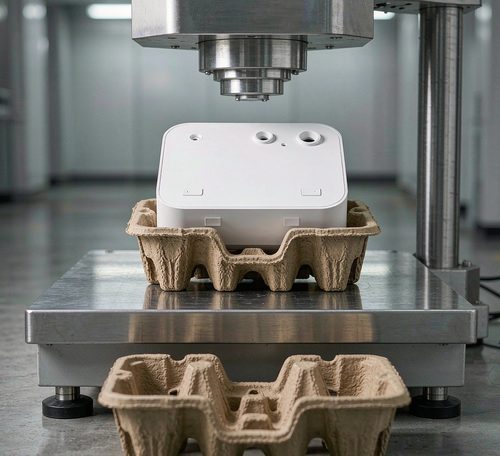
Molded Pulp Packaging for Ceramic and other product categories is engineered from the start around a concept that foam is not: the distinction between loaded and unloaded geometry.
Nesting Design: Empty Trays Take Up a Fraction of the Space
One of the most immediately practical advantages of molded pulp - and one that warehouse managers notice within the first week - is that empty trays nest.
A molded pulp tray with a 3:1 nesting ratio (a standard design target) means that a stack of 30 empty trays occupies the same vertical space as 10 trays stacked flat with foam inserts inside. In a 3PL environment where you're receiving raw packaging components and assembling on-site, or returning empty trays from finished goods, this matters enormously.
For one of our ceramic exporter clients, the switch from foam to Molded Pulp Packaging for Ceramic trays reduced the floor space needed to store one month's supply of packaging components by approximately 65%. That freed up nearly 40 square meters of warehouse floor - which at their 3PL's rate of £18/m²/month translated to over £8,600/year in released storage cost.
Precise Dimensions for Consistent Palletizing
Foam inserts, particularly hand-cut or low-precision molded varieties, have dimensional tolerances of ±5–10mm. That may not sound like much, but in a pallet stack of 60–80 cartons, accumulated dimensional variance causes:
Unstable stacks that require extra corner boards, stretch wrap, and handling time
Inefficient use of pallet height (gaps and uneven surfaces mean you can't fill to full pallet height safely)
More frequent rehandling events in the warehouse, which increases labor cost and damage risk
Custom Molded Pulp Packaging for Ceramic manufactured to engineering tolerances of ±1.5–2mm produces cartons that are dimensionally consistent from unit to unit. This means:
Pallets stack to the full legal/racking height with stable geometry
No void space between carton layers
Predictable, repeatable palletizing that works with automated palletizing systems as well as manual warehouse teams
A 2022 study from the Packaging Research Institute found that consistent packaging dimensions alone - without any other operational change - improved pallet utilization rates by 9–14% in warehouse environments that had previously used hand-packed foam protection. That's additional product per pallet, per container, per shipment.
Ceramics: The Category That Benefits Most
We work across many product categories at Sunhingstones, and we'll say it plainly: Molded Pulp Packaging for Ceramic is the application where the performance and space-efficiency advantages of molded pulp are most consistently dramatic.
Here's why ceramics are uniquely well-suited:
Common Ceramic Breakage Problems with Generic Foam
Ceramic products - plates, mugs, bowls, vases, decorative pieces - have a combination of properties that make them particularly challenging to package well:
Irregular geometry - a mug has a handle. A serving bowl has a rim that's structurally weaker than the body. A plate set has multiple items that need to be isolated from each other. Generic foam blocks treat all of these as uniform rectangles.
Surface sensitivity - ceramic glazes scratch. Contact with foam beads (EPS) during vibration in transit causes micro-abrasion that shows as dull patches or fine scratches on finished surfaces. This is a particular problem for high-gloss or luxury ceramic finishes.
Point-load fragility - ceramics don't fail gradually; they fail suddenly when a localized stress concentration reaches the ceramic's tensile limit. Foam that compresses unevenly creates point loads. Custom molded pulp cavities distribute load evenly across the widest possible contact surface.
Moisture compatibility - ceramic is not damaged by humidity. Molded pulp is compatible with ceramic in a way that some foam treatments (particularly certain polyurethane variants) are not, because off-gassing from certain foam chemicals can affect ceramic glazes over long storage periods.
According to industry data compiled by the British Ceramic Confederation, packaging-related damage accounts for approximately 4.2% of ceramic product losses in international shipping - higher than the appliance or electronics average. The primary cause in over 60% of documented cases was inadequate point-load protection at handles, rims, and bases - exactly the zones where custom molded pulp excels and generic foam fails.
How Custom-Fit Molded Pulp for Ceramic Reduces Void Fill Needs
One of the largest contributors to wasted warehouse space in ceramic packaging is void fill - the bubble wrap, paper packing, foam peanuts, or airbags used to fill the gap between the product and the carton wall when the packaging isn't a precise fit.
Custom Molded Pulp Packaging for Ceramic eliminates void fill entirely. The cavity is designed to match the product geometry with ±2mm tolerance, so there is no gap to fill. The product sits in the tray; the tray sits in the carton; the carton closes flush. No secondary materials needed.
This has three direct warehouse benefits:
Receiving time decreases - no void fill to remove and dispose of at the destination
Carton size decreases - because the packaging doesn't need to accommodate void fill material, the outer carton can be sized to the minimum viable dimension
Returns packaging is simpler - if a product needs to be returned or reshipped, re-packing in a molded pulp tray is fast and produces a consistent, reliable result
What Warehouse Efficiency Actually Looks Like in Practice
A ceramic tableware exporter - supplying retail chains in Germany and the UK - came to us with two problems. The first was a breakage rate of about 3.8% on their flagship mug range during European distribution. The second was a storage cost problem: their UK 3PL partner had flagged that the bulky foam packaging on their ceramic sets was consuming disproportionate pallet space and slowing pick-pack throughput.
We designed a two-piece Molded Pulp Packaging for Ceramic solution: a base tray with individual cavities for 4 mugs, and a lid tray that locked the set in position and provided stacking load-bearing support. The mold design took the handle geometry into account specifically, creating a suspended contact zone so the handle was never under direct compression.
Results after 9 months:
Transit breakage rate: from 3.8% to 0.9% - a 76% reduction
Outer carton volume: reduced by 19% due to elimination of void fill and tighter dimensional fit
Pallet utilization: improved from 72% to 87% - more cartons per pallet at the same height
3PL storage cost per unit: reduced by approximately £0.07/unit due to higher pallet density
At 80,000 units/year, that's a £5,600/year storage cost reduction
Receiving/unpack time at the 3PL: reduced by an average of 1.2 minutes per carton (no void fill removal)
UK buyer sustainability audit: packaging noted as a positive differentiator in two buyer sustainability questionnaires
The client expanded the molded pulp program to their bowl and plate range within 12 months of the initial launch.
What the Research SaysPackaging Density and Storage Efficiency Data
The business case for packaging-driven warehouse efficiency is well-documented beyond our own client experience:
McKinsey & Company "Sustainability in Packaging" (2023) found that companies optimizing packaging design for density - not just for protection - saw average logistics cost reductions of 8–13% over a three-year period, with the savings split roughly equally between freight and warehousing.
PMMI (Association for Packaging and Processing Technologies) 2023 Industry Report identified "packaging-integrated logistics efficiency" as a top-five priority for consumer goods packaging directors, with 67% of respondents saying they planned to invest in packaging redesign specifically to improve pallet utilization over the next two years.
WRAP UK 2022 analysis of packaging optimization programs across 40 consumer goods companies found that switching from foam to fiber-based protective packaging reduced average shipped package volume by 12–22% for equivalent protection levels, with ceramic and glassware categories showing the highest improvement.
A 2021 peer-reviewed study in the International Journal of Production Economics modeled the warehouse cost impact of packaging format changes across a consumer goods distribution network and found that a 10% improvement in pallet utilization rate translated to a 6.3% reduction in total logistics cost across a typical European distribution footprint.
The European Sustainability and Traceability Association (ESTA) has published guidance identifying molded fiber packaging as a preferred format for achieving combined packaging efficiency and sustainability targets in retail supply chains, particularly in the home goods and ceramics sector. ESTA's 2023 position paper notes that molded pulp packaging is "increasingly being recognized not merely as a sustainable alternative, but as a logistics performance tool."
Other Industries Where This Approach Applies
While Molded Pulp Packaging for Ceramic is our headline use case in this article, the warehouse efficiency benefits of molded pulp apply across several related categories:
Electronic accessories and small devices - consistent dimensions, no foam debris, excellent pallet stacking density; particularly relevant for smart home product ranges
Glass kitchenware (glass containers, carafes, drinking sets) - similar fragility profile to ceramics, similar benefit from precision cavity design
Cosmetic and personal care product sets - gift sets with multiple glass or ceramic components; molded pulp trays replace foam peanuts and tissue paper entirely, with better protection and faster packing
Decorative home goods - figurines, candle holders, picture frames; irregular geometry that benefits from custom cavity design and eliminates the point-load failures that foam causes
Wholesale gift and tableware - buyers in this segment often source from multiple factories and consolidate at a warehouse; consistent, nestable Molded Pulp Packaging for Ceramic trays make consolidation and repacking dramatically more efficient
If you're a buyer in any of these categories sourcing from a Molded Pulp Packaging for Ceramic manufacturer or broader molded pulp supplier, the warehouse efficiency question is worth running through your own numbers. The calculation isn't complicated: current storage cost per unit × expected density improvement = annual savings. We can help you run that estimate.
F A Q
Q: Can molded pulp packaging for ceramic be custom-shaped to fit unusual product geometries?
A: Yes - this is one of the primary advantages of molded pulp over foam inserts. A custom mold can accommodate handles, spouts, asymmetric bases, multi-item sets, and any other product geometry, as long as there's sufficient draft angle for mold release (typically 3–5 degrees, which rarely affects product fit). Most Molded Pulp Packaging for Ceramic manufacturers offer design consultation as part of the mold development process.
Q: How much warehouse space can I realistically save?
A: Based on our client data, buyers switching from foam to custom Molded Pulp Packaging for Ceramic typically see 12–25% reduction in total shipping volume per unit and 15–30% improvement in pallet utilization, depending on the starting point. For companies paying $80–$180 per pallet position per month, these improvements represent meaningful annual savings - often $8,000–$25,000/year for mid-volume operations.
Q: Is molded pulp packaging for ceramic available from factories in China, and what are typical lead times?
A: Yes. China is the primary global manufacturing center for Molded Pulp Packaging for Ceramic, with major production clusters in Guangdong, Zhejiang, and Fujian provinces. Tooling development typically takes 4–6 weeks from approved 3D design to production samples. Production lead times after sample approval are typically 3–5 weeks for initial orders, with faster turnarounds available for repeat orders.
Q: What's the minimum order quantity for custom molded pulp packaging for ceramics?
A: Most Molded Pulp Packaging for Ceramic factories set MOQs at 5,000–10,000 units per SKU, with tooling fees of $3,000–$10,000 charged separately and amortized over agreed volumes. For buyers with multiple SKUs in a ceramic range, tooling costs can sometimes be shared across a family design with minor cavity variations.
Q: Does molded pulp packaging hold up in humid warehouse environments?
A: Export-grade Molded Pulp Packaging for Ceramic is manufactured with wet-strength resin treatment and maintains full structural integrity at relative humidity up to 85% RH, which covers virtually all standard warehouse and container environments. Cold storage applications (below 0°C) require specific grade confirmation from the supplier.
Q: Can I get samples before committing to a tooling investment?
A: Yes. At Sunhingstones, we can provide stock samples of similar product categories (existing molds) to allow a hands-on evaluation of material quality, surface finish, and structural characteristics before any tooling commitment is made. For bespoke designs, 3D-printed pre-production samples are available at a nominal cost.
Let's Look at Your Numbers Together
If you're shipping ceramics - or any fragile home goods - in foam packaging right now, there's a reasonable chance you're spending more on warehousing, freight, and damage claims than you need to be. The numbers in this article aren't edge cases; they're consistent with what we see across client projects year after year.
At Sunhingstones, we specialize in custom Molded Pulp Packaging for Ceramic and home goods categories, with end-to-end capability from mold design to production to export documentation. We work directly with overseas buyers, retailers, and importers - no middleman.
Your next step:
Share your product dimensions and current packaging format - we'll respond with a preliminary space efficiency and cost estimate
Request a sample pack of our ceramic packaging solutions
Book a 30-minute call with our packaging engineer to walk through the mold design process