
Does Molded Pulp Get Cheaper at High Volume
Yes. Per-unit cost falls significantly as volume rises, and at high, continuous volumes molded pulp frequently beats foam on total cost. The reason is structural: tooling is a fixed, one-time cost, so the more units it produces, the smaller its share of each one becomes. Fiber feedstock, by contrast, is cheap and abundant, so the variable cost stays low.
How tooling cost amortizes
The single most important fact about molded pulp tooling is that the molds are durable and long-lived, capable of producing millions of parts before replacement. That changes the cost picture completely.· At low volume, the tooling has not paid for itself, so each part carries a large share of it.· At medium volume, the tooling starts to pay off and per-unit cost drops.· At high volume, the tooling is a rounding error per part, and industry sources note that economies of scale can cut the per-unit cost by roughly 20 to 30 percent on their own.For appliance manufacturers with steady, large packaging needs, that amortized tooling is quickly offset by lower material waste and smoother operations.
Material and automation economics
The variable costs reinforce the same direction. At production scale, molded pulp lands around 91 to 140 dollars per ton, a low and stable feedstock cost. Where fiber is sourced locally, recycled-fiber trays can even undercut EPS foam by about 10 percent. And automated production lines, which suit high volume, can shave a further 15 to 20 percent off manufacturing cost by running faster with less waste.
At What Volume Does Molded Pulp Beat Foam
There is no single magic number, because it depends on part size, complexity, and your shipping profile, but the principle is clear: the higher and more continuous your volume, the stronger the case for fiber. Below a certain threshold, a stock foam insert can still be cheaper because there is no tooling to amortize. Above it, fiber pulls ahead and keeps widening the gap.To ground the discussion, basic molded pulp containers typically run about 0.20 to 0.70 dollars each, while specialized or high-strength designs run roughly 0.70 to 1.50 dollars each. On a straight per-piece basis that can sit a little above basic foam, but bulk orders commonly reduce the unit cost by 20 to 30 percent, and the logistics savings then close or reverse the gap.
How Volume Changes the Math
|
Production Scale |
Per-Unit Cost Trend |
What's Happening |
|
Low / prototype |
Highest |
Tooling not amortized; stock foam or corrugated may be cheaper |
|
Medium |
Falling |
Tooling starting to pay off; logistics savings appear |
|
High / continuous |
Lowest (drops about 20–30%) |
Tooling negligible per part; automation adds 15–20% savings |
What Does High-Volume Molded Pulp Production Actually Look Like
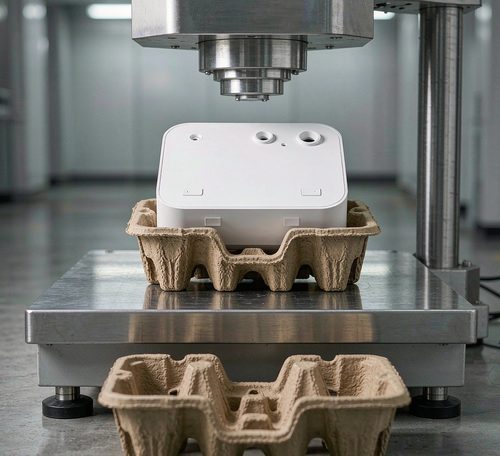
High-volume molded pulp is an automated, repeatable process, not a craft operation. Pulp slurry is formed on molds, pressed, and dried on automated lines that turn out consistent parts shot after shot. That consistency matters as much as cost, because a continuous appliance line needs every insert to fit the same way without hand-fitting.The parameters below show what a production-grade fiber insert is built around.
Molded Pulp Inserts: Production Parameters
|
Parameter |
Typical Value or Range |
|
Forming type |
Thick-wall, transfer-molded, or thermoformed |
|
Wall thickness |
0.6–1.3 mm (thermoformed) up to 3–12 mm (thick-wall) |
|
Feedstock cost at scale |
About 91–140 USD per ton |
|
Scale cost reduction |
About 20–30% at higher volumes |
|
Automation savings |
About 15–20% on manufacturing cost |
|
Tooling life |
Millions of parts per mold set |
|
Load support |
Designs up to ~50 kg/m² |
|
Recyclability |
Curbside recyclable and biodegradable |
Industry Trends: Who Is Adopting Molded Pulp at Scale
Volume adoption is accelerating, and the numbers show it. The global molded pulp packaging market sat near 4.6 billion dollars in 2022 with projections toward 5.7 billion by 2027, while regional reports put North America on a faster track, around 1.43 billion dollars in 2024 rising toward 2.62 billion by 2033. Consumer electronics and appliances are a core driver, because those categories ship in high, steady volumes that suit fiber tooling perfectly.
Three forces push the trend. Rising virgin-plastic prices and landfill surcharges widen the cost gap in fiber's favor. Foam bans and EPR fees raise the long-term cost of EPS. And large retail and brand customers increasingly require recyclable packaging as a condition of shelf access, so the choice is partly about market entry, not just unit price. A Green Molded Pulp Packaging program answers all three at once.
Common Misconceptions About High-Volume Molded Pulp
The first myth is that tooling is always too expensive. It is a real up-front cost, but spread across millions of parts it becomes tiny per unit, which is the whole point of high volume.The second is that fiber quality is inconsistent. Modern automated forming and drying lines produce repeatable parts, which is exactly why they suit continuous assembly.The third is that pulp production is too slow for mass production. Automated lines run fast, and the consistency they deliver often speeds up packing compared with hand-fitted alternatives.
When Is Molded Pulp Not the Right Call
It would not be an honest guide without the flip side. For a one-off run, a prototype batch, or a genuinely low annual volume, the tooling cost cannot amortize, so a stock foam insert or a simple corrugated solution may cost less. The decision comes down to volume and continuity. The higher and steadier your production, the stronger the case for fiber tooling. When you are unsure, the right move is to run the numbers against your actual annual quantity rather than assume.
F AQ
Q: Is molded pulp cost-effective at high volume?
A: Yes. Tooling is a one-time cost that spreads across millions of parts, so per-unit cost falls sharply at scale, often by 20 to 30 percent, which makes Molded Pulp Inserts very competitive in continuous appliance production.
Q: How much does molded pulp tooling cost?
A: It varies with part size and complexity, but it is a durable, long-lived investment that produces millions of units. The key is matching it to enough volume to amortize the cost.
Q: What is the minimum order for molded pulp?
A: There is usually a practical minimum tied to tooling amortization. Higher volumes earn the best per-unit price, so discuss your annual quantity with the supplier before deciding.
Q: Does automation lower the price?
A: Yes. Automated forming and drying lines run faster with less waste, trimming manufacturing cost by roughly 15 to 20 percent, which favors high-volume runs.
Q: When is foam still cheaper than molded pulp?
A: For one-off, prototype, or very low-volume runs where tooling cannot amortize. In those cases, stock foam or corrugated may cost less per unit.
Q: Is the part quality consistent across a large run?
A: Yes. Automated lines produce repeatable parts shot after shot, which is one reason molded pulp suits high-volume, continuous production
Where to Go From Here
The honest way to settle the foam-versus-fiber question for your operation is to put your own annual volume into the math. Send us your yearly quantity and product, and our team will calculate the tooling amortization and a real per-unit price, then compare it against your current foam program so the decision rests on numbers, not assumptions. Reach out to a molded pulp inserts manufacturer for a quote, tooling details, or a wholesale price.