
一, Three main ideas behind structural design
1. Exact fit: Adjust to the shape of the object with tolerances of a millimeter
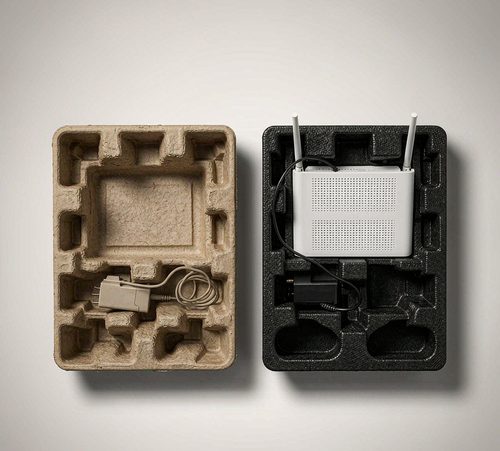
Bluetooth earphones contain a lot of different parts that make them look complicated. For example, they include ear hooks that aren't the same on all sides, curved charging compartments, and thin charging wires. To get "zero gap" contact between the tray and the product, they need to be modeled in 3D. For instance, Cleer Arc5 uses molds with very high accuracy to keep tolerances within ± 0.3mm. Wet forming technology turns its interior support into a three-dimensional mesh structure that flawlessly copies the complicated surface of the headphones' asymmetric ear hook. This keeps the headphones from getting scratched or broken when being moved. To make this design, you need to combine product CAD data, use reverse engineering to make tray models, and make several changes to the mold during the mold development phase.
2. Layered buffer system: a way to absorb energy at different levels
A double-layer buffering structure of "main support cavity+accessory compartment" needs to be built for Bluetooth earphones' weak parts, including the earmuffs and charging ports. For example, Cleer Arc5:
Main bearing chamber: The bottom has honeycomb reinforcement ribs that spread out vertical impact stress through a biomimetic honeycomb structure. The measured static compressive strength is at least 80 kg, and it can handle the weight of an adult standing on it without bending.
Attachment compartment: Separate compartments for storing charging cables and earplug coverings, held together using folded paper cards instead of plastic blister boxes. This cuts down on the amount of fillers that are thrown away.
3. Modular Scalability: Works with several models for quick changes
Tray design needs to contain modular elements to lower the expenses of mold development. For example, you can change the local structures of the same mold to fit different types of earphones from the same brand. For example, you can change the depth of the ear hook support slot and the height of the charging bin positioning post. You can use Cleer Arc5 with other Arc series products by making small changes to the inner mold through standardized interface design. This cuts research and development expenses by more than 40%.
二, Analyzing the main structural modules
1. The main support structure
Borderless structure: good for light headphones (less than 50g), it spreads out the stress of lateral impacts by slanted sidewalls. For instance, a certain type of TWS earphone tray has no edges, with an edge dimension of less than 2mm, and the side wall makes a 15° angle with the load direction. The damage rate from the drop test is barely 0.15%.
Structure of the flip edge: For high-end headphones (weight >80g), the outward expanding skirt outward flip structure can make the whole thing more stable. When evaluated according to ISTA 3A standards, 70% of the impact energy is absorbed by a certain brand of noise-canceling headphone tray with a flip edge design that is 15mm wide at the edge and bottom reinforcement ribs. This is the same as 3mm thick EPE pearl cotton.
2. Design that keeps moisture and static electricity out
Doping conductive fibers: To meet the anti-static requirements of electronic components, add 1% to 2% carbon fiber to the pulp. This will lower the tray's surface resistance to 10 ⁶ to 10 ⁹ Ω. This design lets a certain brand of sports headphone tray get rid of static electricity in a dry place in less than two seconds.
Barrier coating that is water-based: Using a water-based coating made from maize starch instead of a standard plastic film coating increases moisture resistance by more than 60%. The Cleer Arc5 tray coating is only 0.1mm thick, which keeps water vapor from getting through it. It can also be recycled by being beaten together with the paper.
3. Extra features for protecting the environment
Convertible protective case: The tray's edge has a clasp mechanism that lets users turn it into a box for storing headphones. Adding two placement slots to a given brand of headphone tray, for example, can turn it from packaging to protective shell and lengthen the life of the product.
Customizing the texture to fit your needs: Using wet pressing technology to show off natural textures like stone and wood grain. By changing the roughness of the mold's surface, a certain brand of headphone tray made both the touch and the look of the product better, which made users 30% happier.
三, Path for putting the process into action
1. Choosing the right materials and making the formula better
The ratio of raw materials: 60% waste paper, 30% sugarcane bagasse, and 10% bamboo fiber are used to make high-strength pulp using a wet forming process. Experimental data from a specific brand indicates that the tensile strength of this formula tray attains 12MPa, with a fracture elongation of 8%, surpassing that of pure waste paper trays.
Add 0.5% flexible agent (like polyvinyl alcohol) to make it more resistant to impact and 0.3% waterproof agent (like silane coupling agent) to make it more resistant to moisture. For instance, a certain brand of headphone tray improved its additive formula and exhibited a size change rate of less than 0.5% after being in an 85% humidity environment for 72 hours.
2. Making and designing molds
Mold structure: The parting surface is at the edge of the product so that it is easier to demold. For instance, one kind of headphone tray mold has a three-piece structure made up of a "upper mold," a "lower mold," and a "core." The core can be rapidly changed to fit different models.
Precision control: CNC machining with a surface roughness of Ra<0.8 μm is used to make important components of the mold, like the headphone placement slots and charging interface holes. The real test of a certain brand's mold demonstrates that after making 10,000 pieces in a row, the size difference of the pallet is still kept to within ± 0.2mm.
3. Settings for the molding procedure
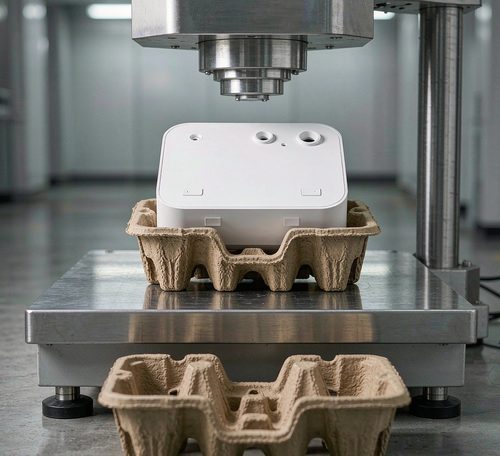
The slurry concentration for wet compression molding is kept between 8% and 10%, the vacuum level is -0.08MPa, the molding pressure is 1.5MPa, and the time it takes to hold the pressure is 15 seconds. According to the experiment of a brand, the tray density is 0.35g/cm ³ and the cushioning performance is superior than that of 2mm thick EPS foam.
Drying process: The temperature is 80 °C and the period is 40 minutes. This reduces the moisture content to 8% to 10%. To keep the product from becoming unstable because of deformation, the shrinkage rate of a certain brand tray after drying is less than 1%.
四,Examples of how the industry is used
1. The packaging for Beats earphones is made of full pulp molding.
New ways of building: The outer box has a compressive strength of at least 800N and is made of two layers: a "corrugated cardboard box" and a "molded fiber inner tray." The inner tray is held in place between the earphones and the charging compartment by high-precision molds.
Benefits for the environment: A single set of packaging cuts down on plastic use by 15 tons a year, cuts down on carbon footprint by 40%, and has been certified by the EU REACH and US FDA.
2. Tray made of biobased composite material from Cleer Arc5
Breakthrough in materials: A three-dimensional network structure is made by mixing 60% bamboo fiber with 40% sugarcane bagasse. The construction has a tensile strength of 15MPa.
Function integration: The unboxing experience is 50% better with a hidden handle, a self-locking cover plate, and a QR code window. The recycling rate is 92%.