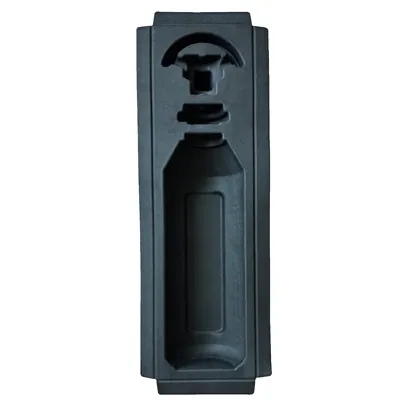
1. The load-bearing principle of molded pulp is the intersection of structural mechanics and material science.
The load-bearing capacity of molded pulp is not only reliant on the material's inherent strength; rather, it improves its mechanical properties through a "three-dimensional fiber interwoven structure" and a "stress dispersion mechanism."
Three-dimensional weaving of fibers into a structure
Waste paper and bamboo pulp are two examples of plant fibers that can be utilized to generate molded pulp. The vacuum suction molding method turns it into a three-dimensional network structure. The mold comprises fibers that are knitted together in a random way to make a three-dimensional support system that appears like a honeycomb. This method can spread outside pressures uniformly and minimize stress levels in some places. For example, a regular egg tray weighs only 65 grams yet can hold 80 kilos of static weight without breaking. This is because the honeycomb design spreads the force of the hit.
Making the shape better
The design of the mold can give molded pulp chambers and reinforcing ribs inside, like the vertical ribs in hanger molds. This makes it much less likely to bend. For example, the pulp liner that a manufacturer developed for the outdoor unit of an air conditioner has a pattern of hexagonal honeycomb cells. The product's maximum acceleration is 27% lower than that of ordinary EPS foam in the 1m drop test, and the structure is not damaged. Using high temperature and high pressure, the multi-layer composite construction also combines multi-layer pulp boards. The link between the fiber layers is stronger, and the compressive strength is 30% to 50% stronger. Instead of wooden pallets, it can carry 500 kg of products.
How to deal with stress
The way the structure bends and stretches, not how the substance compresses, gives moulded pulp its cushioning properties. For example, honeycomb grids break up the packing of things that aren't regular into smaller pieces. When anything touches the outside of the unit, it changes shape and absorbs energy. This stops the whole thing from falling apart. This design helps molded pulp preserve its shape while also altering shape to disperse out the energy of an impact when it has to support weight.
2. A big step forward in technology: going from "lightweight" to "high-strength"
Early molded pulp was largely used for cheap products like egg trays because it cost a lot and changed shape when it became wet. But modern technologies like wet pressing, nano waterproof coatings, and structural topology optimization have made it work far better:
The ability to shape things at high temperatures and pressures
After the embryo has formed, put it in a high-pressure and high-temperature environment (5–10 MPa) at 180–250 °C to change the hydrogen bonds between the fibers, make it more stiffer, and elevate the density to 0.6–0.8 g/cm³. A certain company made a pulp tray for washing machines that is only 10mm thick but can hold a static load of 200 kg, which is enough for big appliances.
Technology that lets you change things by adding items
You can make the bond between fibers 30% stronger by adding waterproofing chemicals like aluminum sulfate or strengthening agents like starch glue. The material will still be light (50% lighter than wood). One kind of TV packaging, for example, uses an anti-static coated pulp liner. This not only protects electronic equipment from static electricity, but it also makes the packing 15% lighter by making the structure more efficient.
Technology for improving structural topology
Use computer simulation to better spread the fibers so that the material is denser where it is under a lot of stress. For example, a business used topology optimization to make pulp packaging for refrigerators that increased local density by 20%. This reduced the chance that the product would break during drop testing from 1.2% to 0.3%.
3. Case Study: Putting the Theory to the Test in the Real World
In the home appliance industry, the load-bearing capacity of molded pulp has been thoroughly evaluated, and its performance surpasses that of conventional plastic foam:
Packaging for air conditioners that go outside
A head company created the pulp liner for the air conditioner's outdoor unit in a hexagonal honeycomb design. The product's highest acceleration is 27% lower than that of EPS foam in the 1m drop test, and the structure is not damaged. The packing can also be stacked for transportation, which saves 40% of storage space and 18% of total costs.
Wrapping paper all the way around washing machines
Some kinds of washing machines come with "moulded pulp+corrugated cardboard" full paper packaging. By improving its structure, this makes the packing 20% lighter while still being able to hold and protect the weight during transportation. Real test data shows that this method cuts the shipping damage rate from 0.8% to 0.2%, which saves more than 5 million yuan a year in after-sales expenditures.
TV packaging that doesn't produce static electricity
Some TV boxes have a lining composed of pulp that has been coated with an anti-static material. Not only does this protect electronic equipment from static electricity, but it also makes the packaging 15% lighter by improving its structure. The EU ROHS test has passed for this proposal, which is now a model for packaging that is good for the environment.