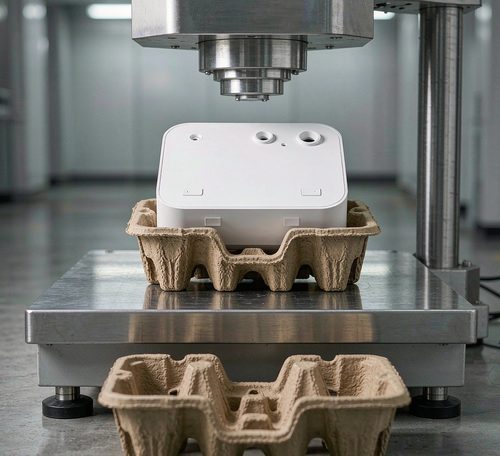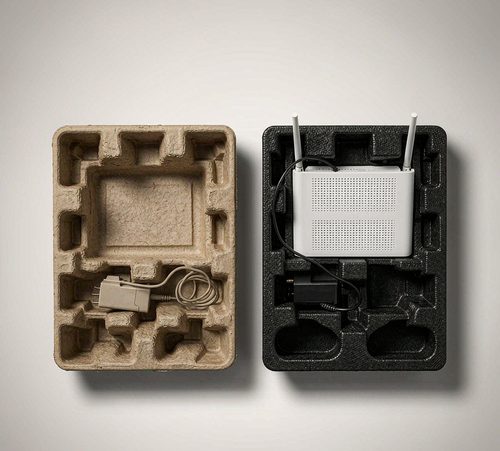

While molded pulp is often recognized for its environmental value, it also offers strong economic advantages. Its raw materials-post-industrial fibers-are inexpensive, stable in supply, and unaffected by fluctuations in petroleum prices. This makes molded pulp a cost-predictable option for long-term packaging programs.
Development costs are also far more accessible compared to plastic injection molding or EPS tooling. Brands working with partners such as Hesheng D&I and CSL-Packaging often discover that new shapes, inserts, and trays can be created at a fraction of traditional tooling budgets. This lowers financial risk and enables faster iteration during product launches.
Another cost-saving benefit lies in logistics. Molded pulp components can be engineered to nest tightly, reducing both storage footprints and shipping volumes. Since each part is formed to shape, no assembly is required-helping streamline packing lines and reduce labor hours.
Behind every molded pulp project is a simple economic truth: when materials, tooling, logistics, and labor all work in your favor, the entire supply chain breathes easier. For companies pushing toward leaner operations, molded pulp often becomes not only the greener choice but also the smarter business decision.