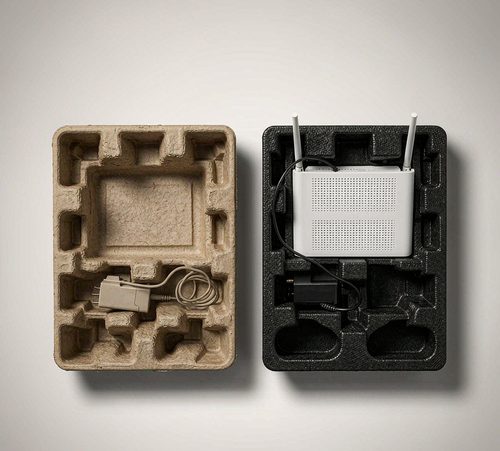

In recent years, due to the worldwide ban on the production and import of polluting packaging products, the foam packaging industry has been shrinking, and the price of oil has risen sharply, resulting in a substantial increase in EPS foam manufacturing costs and a sharp drop in profits. Even at a loss, it further accelerated the fading of EPS foam plastics from the market.
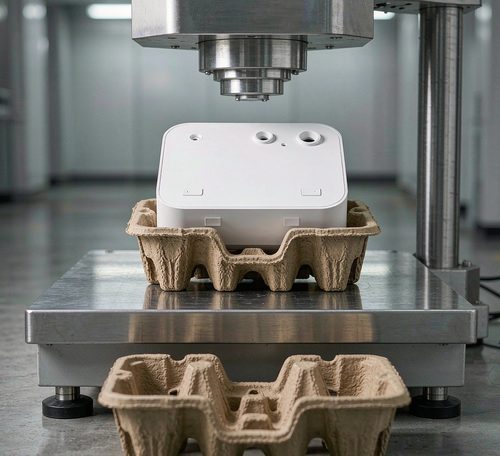
Paper trays can be divided into three categories: industrial paper trays, agricultural paper trays and food trays.
1. Industrial paper tray: Mainly used in the lining packaging of household appliances, medical equipment, electrified materials, and lighting.
2. Agricultural paper trays: mainly used for fruits, eggs, agricultural nutrition bowls, etc.
3. Food paper trays: mainly used in food bowls, pots, supermarket food trays, etc.
(1) Pulp molded products are made of plant fiber pulp or waste paper products that can be completely recycled and used as basic materials, and are made of unique technology and are widely used in food (medicine) products, electrical packaging, Non-polluting scientific and technological green products in the fields of planting seedlings, medical utensils, handicraft base blanks and fragile liner packaging.
(2) With the development of industry, a large number of fluorine-containing substances have risen into the atmosphere, causing extensive damage to the ozone layer on which human beings depend. Thousands of kilometers of ozone holes have been formed in the Antarctic and Arctic, giving the earth's ecological environment. It has caused great harm. For this reason, the United Nations Environmental Protection Agency convened a worldwide environmental protection conference. In 1998, it passed the "Vienna Convention for the Protection of the Ozone Layer" and the "Montreal Protocol" on substances that deplete the ozone layer. It should be gradually reduced until the ozone-depleting fluorine-containing substances are prohibited from entering the atmosphere.
(3) In recent years, plastic products, one of the three major packaging materials, especially expanded polystyrene (EPS) products, have become increasingly serious, and have become "white pollution" that everyone hates. The waste disposal of these polystyrene foam packaging brings serious pollution to the environment. Burning destroys the Earth's atmospheric ozone layer; burials destroy geological structures because they cannot corrode. These foam waste products have caused great damage to the global environment. Switching to degradable environmentally friendly packaging materials to eliminate "white pollution" and improve people's living environment has become an international and domestic requirement.
(4) The tableware products and industrial packaging products produced by pulp molding technology are truly environmentally friendly products. They use natural plant fibers or waste paper as raw materials, and there is no pollution in the production process and use process. In addition to its positive role in replacing disposable plastic tableware, pulp molded products are also widely used in the packaging of industrial products, especially electronic products. Pulp molded products are gradually entering the mainstream of commercial activities. The best alternative products, pulp molding products industry is booming.
(5) The reason why pulp molded products develop rapidly and has good prospects is because it has unique performance advantages:
(1) The process technology is simple and practical, and the production process is basically pollution-free, which meets the requirements of clean production. In addition, in each process of the production line, except for the high quality requirements of the personnel in the automatic control system management, the rest are all skilled technologies, which can be mastered and used after short-term training. In addition, the degree of localization of its equipment is very high, which is very conducive to the popularization of this project. Promotion, which is also a convenient condition for quickly exerting the environmental advantages of pulp molded products.
(2) Wide source of raw materials and low cost. It mainly uses waste paper or annual herb fiber pulp.
(3) It has good shock resistance and cushioning properties, and uses the suspension method to produce excellent adsorption, which can effectively protect the product from damage during transportation.
(4) Light weight, low recycling cost, and can be used repeatedly.
(5) Good protection, interchangeability and decoration performance.
(6) From production and use to waste disposal, there is no pollution to the environment, less water consumption in the production process, no waste water discharge, reducing environmental pollution.
(7) Good air permeability, which has unique benefits for the packaging of fresh products.
(8) Pulp molded products have good water absorption, hydrophobicity and heat insulation. When pulping, various additives can be added according to customer requirements to make the product resistant to acid, alkali, sunlight, water, oil, leakage and deformation.
(9) Modern production technology can realize high-speed, automated mass production.
(10) Compared with traditional packaging materials, such as styrofoam (EPS), EPE foam, etc., the volume is small, and it can be stacked and stored, saving stacking space and transportation costs.
(11) According to the different requirements of users, the surface quality, color, graphics and other appearance elements of the product can be post-processed to meet the needs of product display.
(6) Due to the sufficient sources of raw materials for pulp molding products, the production and use process is pollution-free, has a wide range of applications, low cost, light weight, high strength, good plasticity, cushioning, interchangeability, and decorative performance, and can be used repeatedly. It has strong vitality and broad application prospects, and its economic value and replacement status have been recognized by the international community.
(7) According to the scope of application, pulp molding mainly includes two categories: disposable environmental protection tableware and environmental protection packaging products, both of which have been widely used.