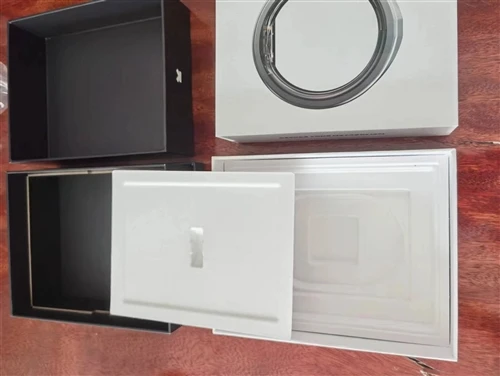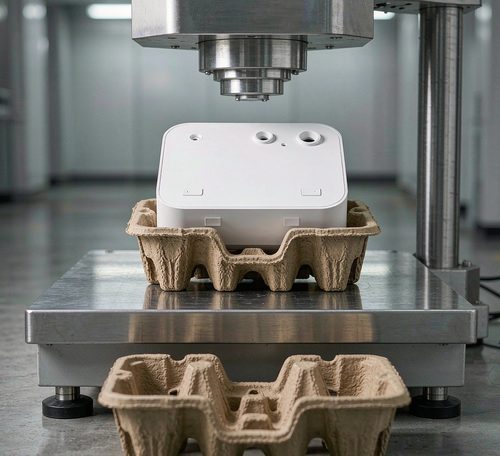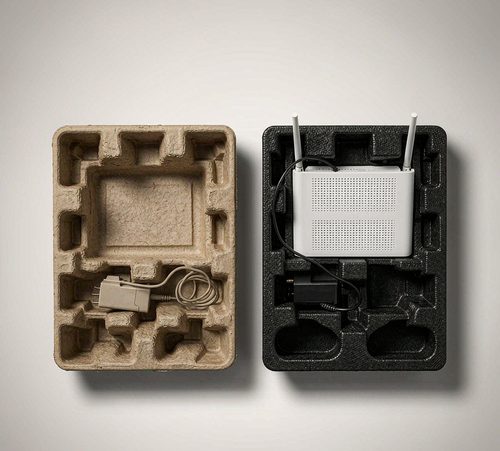

Smart rings and fitness trackers create a packaging problem most inserts aren't built for: the product is small, expensive-looking, and shaped like nothing else in a typical electronics line. A tray designed for a router or a charger doesn't translate - brands need something that holds a ring securely in transit, presents it like a piece of jewelry at unboxing, and still meets sustainability expectations. Wet press molded pulp, engineered specifically around ring geometry, is where most of the successful designs in this category land.
(For a full breakdown of wet press versus dry press molded pulp - process, cost, and surface finish - see our wet press vs. dry press comparison guide. This article focuses specifically on what changes when the product is a ring.)
Why Ring-Shaped Products Are a Different Design Problem
Most molded pulp trays are designed around a footprint - a device sits in a recess, and the tray's job is to keep it from sliding. A ring has no footprint. It has to be gripped around its circumference, held vertically or seated in a groove, without a flat surface to rest against. That changes the design brief from "contain the product" to "grip and release a three-dimensional object at a tolerance measured in fractions of a millimeter."
Wet press molded pulp is suited to this because the process - forming fiber on a wire mesh, then pressing and heat-drying it in a closed mold - produces a smoother, more dimensionally stable surface than dry press alternatives. That stability is what makes a snug ring cavity repeatable across thousands of units, rather than a one-off that worked on the first sample.
Two Presentation Formats, Two Different Engineering Problems
Single-ring standing display. Holding one ring upright at the center of a molded base turns the unboxing moment into something closer to a jewelry reveal than an electronics unboxing. The engineering challenge is balancing two opposing requirements in the same cavity: tight enough that the ring doesn't shift during a multi-leg shipping journey, loose enough that a customer can lift it out without prying or forcing it. That balance is controlled by three variables - cavity wall thickness, the depth of the seating groove, and the surface friction between the pulp and the ring material - and getting any one of them wrong shows up immediately as either a rattling ring or one that won't come out.
Seven-ring rotation tray. Multi-ring sets, designed for daily rotation, need a segmented tray - typically seven individual recesses, often built around a central charging dock compartment. The difficulty here isn't any single cavity; it's holding consistent dimensions across all seven at once. A production run where cavity size drifts even slightly recess-to-recess results in some rings sitting loose and others jammed - a defect that's invisible on a single sample and only shows up at scale.
The Core Technical Challenge: Shrinkage
Paper pulp shrinks as it dries, and the shrinkage rate isn't fixed - it moves with fiber type, wall thickness, and part geometry. A ring cavity's mold has to be cut larger than the finished target dimension, by an amount calculated to offset that shrinkage. Get the offset wrong and the result is either a cavity too large to hold the ring securely or too small to release it without damage.
| Factor | Typical Effect on Shrinkage | Design Implication |
|---|---|---|
| Fiber blend (recycled vs. virgin, or ratio) | Higher recycled content generally shrinks slightly more | Cavity offset must be recalculated per fiber blend, not assumed from a prior project |
| Wall thickness | Thicker walls shrink less uniformly than thin walls | Ring-gripping walls need their own offset calculation, separate from the tray's outer shell |
| Part geometry (curved vs. flat) | Curved, enclosed geometries like ring grooves shrink less predictably than flat panels | Requires mold trials and iterative measurement, not a single calculated pass |
(Ranges vary by supplier and fiber source - request specific shrinkage data for your fiber blend before finalizing a cavity design.)
Accounting for this correctly at the mold design stage - rather than discovering the mismatch after the first production run - is what determines whether a project needs one tooling iteration or several. A mold that's right from the start also means the first run yields usable parts, avoiding the cost and lead-time hit of iterative rework.
Frequently Asked Questions
Can a single mold be adjusted to fit slightly different ring sizes?
Not reliably. Because the fit tolerance for a ring cavity is tight, a mold engineered for one ring diameter generally won't hold a meaningfully different size securely - a new or modified cavity is usually needed rather than relying on the original mold's tolerance range.
How many prototype iterations does a ring tray typically need?
With accurate shrinkage compensation built into the initial mold design, many projects reach a usable first-run sample without iteration. Without that upfront calculation, two to three rounds of cavity adjustment is common before dimensions stabilize.
Does a seven-ring rotation tray cost significantly more to tool than a single-ring display?
Yes, primarily because of the precision required to hold consistent dimensions across seven cavities simultaneously rather than one - tooling complexity and inspection time both increase with cavity count, not just tray size.
Is wet press molded pulp durable enough to protect a ring through a multi-leg shipping route?
Yes, when the cavity geometry and wall thickness are engineered for the specific product weight and transit profile - the same drop-test and compression-test principles that apply to any molded pulp insert apply here (see our guide on reading a molded pulp test report for what to check before approving a design).
If you're developing packaging for a smart ring or similar small wearable and need a cavity engineered around your product's exact dimensions and fiber blend, our packaging engineering team can walk through shrinkage compensation and mold planning before you commit to tooling.