1. What Is Molded Pulp
Molded pulp (also called molded fiber) is a three-dimensional, environmentally friendly packaging or daily-use product manufactured from fibrous raw materials - recycled waste paper, virgin wood pulp, or non-wood pulp such as bamboo pulp, bagasse pulp, and reed pulp - through beating, forming, drying, and finishing processes. Compared with petrochemical-based materials such as expanded polystyrene (EPS) foam or PS trays, molded pulp is fully biodegradable and recyclable, making it one of the fastest-growing packaging segments under the global "paper instead of plastic" policy trend.
2. Global Market Size and Growth Data
Estimates vary somewhat by research firm and scope, but the growth trajectory is consistent across sources:
Straits Research projects the global molded pulp packaging market will grow from USD 5.94 billion in 2026 to USD 9.97 billion by 2034, a compound annual growth rate (CAGR) of 6.68%.
Fortune Business Insights forecasts growth from USD 6.16 billion in 2026 to USD 11.01 billion by 2034, a CAGR of 7.52%; the thermoformed molded pulp sub-segment grows even faster at 9.32%, and Asia Pacific held a dominant 46.79% share of the global market in 2025.
MarketsandMarkets projects the market will grow from USD 8.02 billion in 2026 to USD 10.82 billion by 2031, a CAGR of 6.2%, with e-commerce growth driving demand for protective/cushioning molded pulp inserts.
Towards Packaging data shows U.S. molded pulp demand rising from 1.85 million tonnes in 2020 to 2.25 million tonnes in 2024, while European demand reached 2.6 million tonnes in 2024, with average selling prices ranging from USD 1,100 to USD 3,600 per tonne depending on product type.
Future Market Insights notes that in 2026, recycled pulp materials account for roughly 62% of raw-material sales, while electronics packaging represents about 38% of end-use applications.
|
Industry Consensus Although individual estimates range from roughly USD 5.5 billion to over USD 10 billion (reflecting different scopes and segmentation), the industry-wide consensus is clear: Asia Pacific - particularly China - leads in both production capacity and consumption; CAGR generally falls in the 6%–7.5% range; and e-commerce protective packaging, food service ware, and medical/electronics cushioning are the three primary growth drivers. |
3. Core Manufacturing Process in Detail
The standard molded pulp production process consists of five major stages:
1. Raw Material Pulping
Waste paper or virgin pulp is disintegrated in a hydrapulper and mixed with water to form a slurry, typically at 3%–5% consistency (dry fiber weight to water).
Freeness (measured in Schopper-Riegler degrees, °SR) is generally controlled at 35°–45° SR. Freeness that is too low results in weak fiber bonding and a product prone to shedding; freeness that is too high makes dewatering difficult and reduces production efficiency.
Chemical additives are dosed according to end use, including retention aids (e.g., polyacrylamide, PAM), sizing agents (AKD, rosin size), and wet-strength agents (PAE resin), with wet-strength agent dosage typically 0.5%–1.5% of oven-dry fiber weight.
2. Vacuum Forming (Core of the Wet-Press Process)
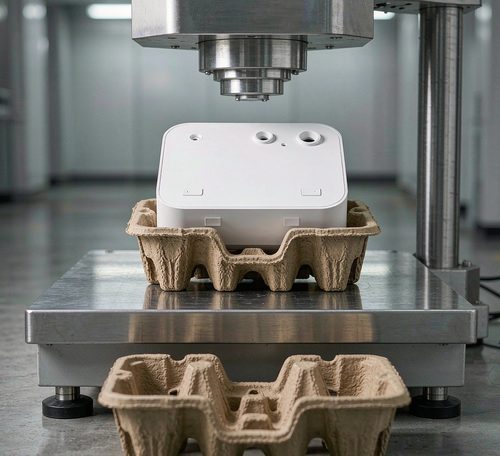
A forming mold (wire screen) is dipped into the slurry tank; internal vacuum pressure in the mold (typically −0.02 to −0.06 MPa) draws fibers evenly onto the screen surface to form the wet part. Thickness and basis weight are jointly determined by suction time (typically 3–8 seconds) and slurry consistency.
At this stage, the wet part's moisture content is as high as 65%–75%. It is then transferred to a transfer mold for secondary press-dewatering, reducing moisture content to roughly 50%–60% while achieving preliminary shape retention.
3. Drying and Shape-Setting
The industry uses three main drying/forming process routes:
|
Process Route |
Drying / Forming Method |
Temperature Range |
Characteristics |
|
Wet-press molding |
Hot-air tunnel drying |
120–180°C |
Low cost; suited to egg trays and industrial cushioning; rougher surface finish |
|
Thermoformed / premium molded fiber |
Direct heated-mold thermoforming |
180–230°C 0.3–0.8 MPa |
Smooth, precise surface with tight dimensional tolerance; suited to tableware and cosmetic trays |
|
Dry-molded fiber |
Fiber mat pre-dried, then compression-molded |
Combined with heated pressing |
Cycle time cut from minutes to seconds - a key technical breakthrough in recent years |
Notably, dry-molded fiber production lines are compressing cycle time from minutes to seconds, narrowing the cost gap with injection-molded plastics - currently one of the most important cost-reduction and efficiency pathways in the molded pulp industry.
4. Post-Processing and Functional Coatings
Oil/water-resistant coatings: Food-contact products increasingly use PFAS-free water-based barrier coatings in place of traditional fluorinated compounds, in line with EU and multi-state U.S. bans on per- and polyfluoroalkyl substances (PFAS).
Surface finishing: Polished hot-press molds can achieve a surface roughness of Ra 3–8 μm, approaching the appearance of injection-molded parts.
Trimming, inspection, and palletizing: Automated trimming equipment achieves cutting accuracy of ±0.5 mm.
4. Key Process Parameters at a Glance
|
Key Process Parameter |
Typical Control Range |
|
Pulp slurry consistency |
3%–5% |
|
Freeness (Schopper-Riegler) |
35°–45° SR |
|
Wet-part moisture content |
65%–75% |
|
Vacuum-forming (suction) time |
3–8 seconds |
|
Vacuum level |
−0.02 to −0.06 MPa |
|
Wet-strength agent dosage |
0.5%–1.5% of oven-dry fiber weight |
|
Hot-press temperature |
180–230°C |
|
Hot-press pressure |
0.3–0.8 MPa |
|
Finished-product moisture content |
≤ 8%–10% |
|
Automated trimming accuracy |
±0.5 mm |
|
Daily output per mold set |
5,000–20,000 pieces / 24 hours (depending on product complexity) |
5. Policy and Demand Factors Driving Market Growth
Over 100 countries and regions have enacted single-use plastic bans; combined with the EU's 2030 mandatory recyclability targets and California's SB 54, these policies have elevated the replacement of expanded polystyrene from a cost option to a compliance necessity.
Continued growth in e-commerce parcel volume is driving demand for cushioning and inner-packaging molded pulp products; the medical device/healthcare sector, driven by sterile-barrier requirements and PFAS bans, is projected to grow at a CAGR of 8.6%, the fastest-growing end-use segment.
Regionally, the Middle East, propelled by Saudi Arabia's "Vision 2030" and the UAE's circular economy policies, is projected to grow at a CAGR of 8.4%, the fastest-growing regional market.
6. Major Application Areas
Food service: disposable plates, coffee cup carriers, egg trays, fruit mesh trays
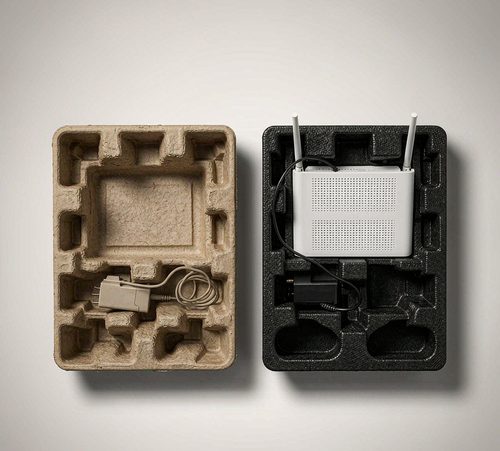
Industrial protection: interior packaging and cushioning inserts for home appliances, automotive parts, and 3C electronics
Medical and healthcare: pharmaceutical trays, sterile packaging inserts for medical devices
Premium packaging: high-end molded trays for cosmetics, spirits, and consumer electronics (surface finish approaching that of thermoformed plastic)
7. Technology Development Trends
Dry / semi-dry fiber molding: substantially improves production efficiency and narrows the cost gap with plastic injection molding.
PFAS-free eco-coatings: increasingly a market-entry requirement for food-contact materials as global PFAS regulation tightens.
Premium, high-definition molded fiber: multiple hot-press cycles and polished molds achieve near-plastic surface texture and dimensional tolerances, opening up mid-to-high-end consumer packaging markets.
Intelligent production lines: integration of vacuum dewatering, AI-based visual inspection, and automated palletizing to improve yield and capacity stability.
8. Summary
The molded pulp industry is benefiting from the combined tailwinds of policy support and technology upgrades. The global market is projected to maintain a CAGR of roughly 6%–7.5% through 2034/2035, with Asia Pacific - especially China - accounting for over 40% of both production capacity and consumption. Dry-molded fiber, PFAS-free coatings, and premium surface finishing are the three technology directions most worth watching. For manufacturers, precise control of process parameters such as freeness, vacuum-forming time, and hot-press temperature profiles will directly determine product yield and cost competitiveness.