


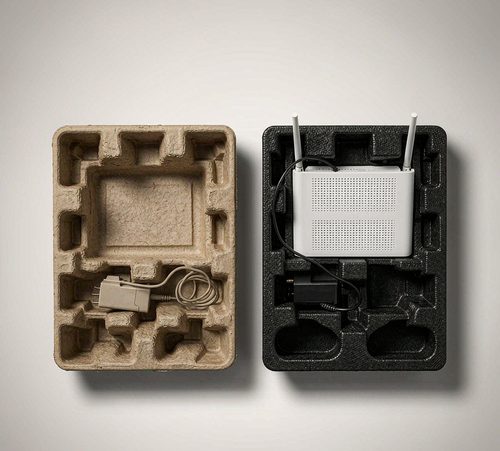
Two problems sink most electronics brands shipping internationally: products arriving damaged from in-transit knocks, and packaging materials that trip up environmental compliance in the destination market - plastic packaging restrictions across the EU and parts of Southeast Asia keep getting stricter. Both problems trace back to the same decision: what protective inner packaging do you actually use - molded pulp, or EPE (expanded polyethylene) foam?
Both materials show up constantly in electronics packaging, but they are not interchangeable. This article compares them across four dimensions - cushioning performance, cost, environmental compliance, and fit precision - to help you decide which one actually fits your product.
1. What Sets the Two Materials Apart
Molded pulp trays are structural inserts pressed from recycled or virgin wood pulp through pulping, vacuum forming, drying (or wet-press setting), and die-cutting. The material itself is paper-based - fully biodegradable and recyclable.
EPE foam (Expanded Polyethylene) is a closed-cell foam made by expanding polyethylene beads. It is lightweight, soft, and offers excellent cushioning, making it one of the most widely used plastic protective materials in electronics packaging.
One is a paper-based structural component; the other is an expanded plastic cushioning material. Molded pulp protects through structural design - recesses, ribs, locating features. EPE foam protects through the material's own elastic deformation absorbing impact. That fundamental difference is what drives their strengths and weaknesses across different use cases.
2. Head-to-Head Comparison
|
Criteria |
Molded Pulp Tray |
EPE Foam |
| Cushioning / impact resistance | Moderate - depends on structural design; suits low-to-medium drop heights | Excellent - reliable across high-frequency, high-drop-risk scenarios |
| Precision fit | Good, but tooling precision has limits; less ideal for complex curved parts | Excellent - can be die-cut to match product contours almost exactly |
| Biodegradability / recyclability | Fully biodegradable and recyclable; aligned with tightening global packaging regulations | Not naturally biodegradable; increasingly taxed or restricted in some regions |
| Tooling cost | Moderate-to-high; pulp molds are typically more complex and slower to produce | Relatively low; molds are quick to make and prototype |
| Unit price at volume | Varies with pulp type and structural complexity | Typically lower than an equivalent-complexity pulp structure |
| Stacking / compression strength | Good - suitable for multi-layer stacking in transit | Average - prone to permanent deformation under sustained load |
| Moisture / water resistance | Weaker; needs a moisture-resistant coating or liner for humid conditions | Naturally water- and moisture-resistant |
| Look and feel | Industrial, natural tone; increasingly used as a visible "eco" cue by premium brands | Plastic feel; more color options (white, black, pink, etc.) |
3. Which One Fits Your Product? Three Common Scenarios
Scenario 1: Mid-to-large consumer electronics (routers, small appliances, speakers)
These products tend to have regular shapes and moderate weight, so structural support matters more than extreme cushioning. Molded pulp can lock the product and its accessories (power cable, manual) into one integrated tray, saving package volume while still meeting most countries' drop-test requirements. Since these products are often sold online, unboxing experience and eco-labeling (such as Amazon's Frustration-Free Packaging certification) directly influence conversion - an area where molded pulp has a clear edge.
Scenario 2: High-precision, high-value electronic components (camera modules, sensors, precision instruments)
These products demand extremely tight fit tolerances and strong anti-static / impact protection - even a small shift or knock can damage a delicate component. In this scenario, EPE foam (especially anti-static grades) is usually the safer choice, since it can achieve near-zero-gap contouring around the part. Molded pulp, limited by pulp flow and mold draft-angle constraints, struggles to match that level of precision.
Scenario 3: Exporting to the EU, Canada, and other regions with tightening environmental rules
If the destination market restricts single-use plastic packaging or imposes a plastic packaging tax, it's worth evaluating a hybrid approach - molded pulp for the overall structural shell and bulk cushioning, with EPE foam reserved only for the specific spots that need precision fit. This keeps compliance costs in check without sacrificing protection where it matters most.
4. Cost Details Buyers Often Overlook
Comparing "price per piece" alone is a common trap. When making a sourcing decision, factor in:
- Tooling amortization: molded pulp tooling is generally more expensive and takes longer to produce (roughly 3–4 weeks vs. 1–2 weeks for foam), but the per-unit cost gap narrows significantly on large, stable long-term orders.
- Logistics volume cost: molded pulp can be engineered to hug the product's contours more tightly, reducing package volume, whereas foam typically needs extra clearance to maintain cushioning thickness - a meaningful difference in dimensional-weight cost over long-haul ocean or air freight.
- Hidden compliance cost: if the destination country already restricts plastic packaging - or is likely to - moving to molded pulp early avoids the cost of an emergency packaging redesign later.
(Figures above reflect typical market ranges; request a quote based on your actual product structure for exact pricing.)
Frequently Asked Questions
Q: Can molded pulp fully replace EPE foam in electronics packaging?
A: In most cases, no - especially for components requiring extremely tight fit tolerances or anti-static protection. The more common approach is a hybrid design: molded pulp for the main structure, with foam or anti-static material reinforcing the critical precision points.
Q: Does molded pulp lose its cushioning performance when it gets damp?
A: Untreated molded pulp can soften and absorb moisture in high-humidity conditions. For long ocean shipments or humid destinations, apply a moisture-resistant coating to the tray surface or pair it with a moisture-barrier liner.
Q: Wet-press vs. dry-press molded pulp - which suits electronics packaging better?
A: Dry-press (secondary heat-set) molded pulp has a smoother, more precise surface and suits designs with tight locating features. Wet-press pulp is lower-cost and faster to produce, making it a better fit when appearance precision matters less than structural support and environmental credentials.
Q: How is molded pulp packaging classified for customs (HS code)?
A: Molded or pressed articles of paper pulp fall under HS 4823.70 (the digits beyond the 6-digit international level vary by country - for example, 4823700000 under China Customs). Note that this classification is based on material and forming process only, and does not distinguish between wet-press and dry-press methods.
If you're evaluating protective packaging for an electronics product and aren't sure whether molded pulp or EPE foam is the right fit, our packaging engineering team can review your product dimensions, weight, and target market and provide free sampling and structural design recommendations. You can also browse our molded pulp inserts for electronic charger packaging as a reference.


