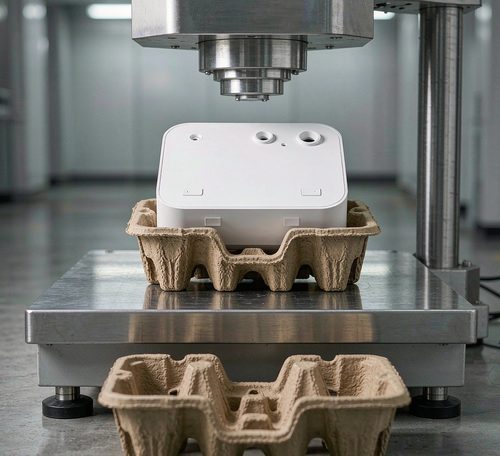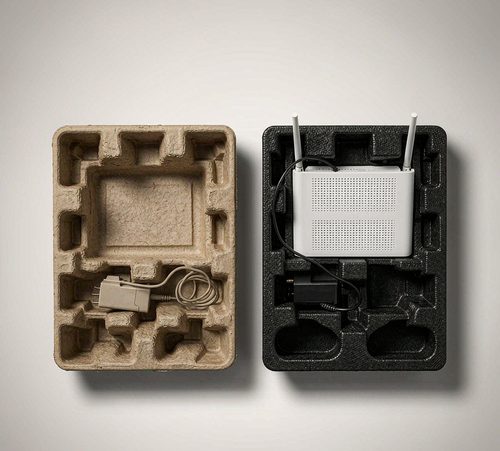
1. The "basic adaptability" of home appliance packaging is determined by the precision of the mould.
Household appliances have very strict criteria for their external dimensions, structural qualities, and assembly precision. This means that pulp moulding packaging needs to be able to manage sizes down to the millimetre level. For example, if the size of the mould cavity for refrigerator liner packaging is off by more than ± 0.2mm, the packaging and liner may not fit together properly, which could cause friction scratches during shipping and potentially structural deformation. Also, if the size difference between each cavity of the multi-cavity mould for the air conditioning outlet grille is more than ± 0.5mm, the blades of the grille will not be spaced evenly, which will make installation less efficient.
Three dimensions show the heart of mould accuracy:
Dimensional accuracy: The mould cavity's dimensional tolerance is kept within ± 0.1mm by using high-precision CNC machining centers and laser interferometer calibration. This is necessary for the precise assembly of home appliances.
form accuracy: Using five-axis linkage machining technology to cut down on tool path errors, the mould contour fits the product design with an accuracy of over 99%. This keeps the package from being loose or stuck because of form deviation.
Position accuracy: The core and cavity are designed with precise positioning pins that make sure the mold's relative position deviation is less than 0.05mm when it is closed. This keeps burrs and uneven wall thickness from happening during the injection moulding process.
2. The accuracy of the mould impacts how well the packaging works.
The packaging for home appliances needs to do more than just protect the goods. It also needs to be able to do things like buffer, resist moisture, and prevent static electricity. This means that the mold's structural design needs to be very precise. For example, the mould for washing machine pulsars needs to have a honeycomb-shaped cushioning structure. If the hole deviation is more than 0.3mm, it will make the cushioning units unevenly spread out and make the impact resistance lower. Data reveals that if the mold's precision goes up by 0.1mm, the packaging's drop test pass rate might go up by 15%.
The surface roughness of the mould has a direct effect on how well the waterproof layer of pulp moulding sticks to the surface. By adopting precision grinding technology to keep the mold's surface roughness below Ra0.8 m, the waterproof performance of the packing may be increased by 30%. This meets the needs of long-distance transportation of household appliances. Also, for electronic component packaging that needs to be anti-static, the nanoscale spraying technology must be used to manage the uniformity of the mold's conductive coating. This will make sure that the surface resistance value of the packaging stays steady between 10 ⁶ and 10 ⁹ Ω.
3. The precision of the die dictates how "economically feasible" it is to make something.
The home appliance business has very high standards for how quickly packaging can be made, and the precision of the moulds has a direct impact on how long it takes to make things and how much it costs. For example, when an air conditioning company used low-precision moulds to make exterior packaging, the production stopped twice an hour because of problems like flying edges and stuck moulds. Each time, the cost of maintenance was more than 500 yuan. The production interruption frequency went down to once a week after converting to high-precision moulds, and the overall equipment efficiency (OEE) went up by 25%.
The accuracy of the mould also affects the material utilisation rate, which is another way to measure its economic value. By optimising channel design, high-precision moulds can cut down on slurry waste, which means that each package uses 8% less material. At the same time, precision moulds can last more than 500,000 times, which is three times longer than regular moulds. This makes it much cheaper to replace them. If the company makes 1 million packing pieces a year, improving the accuracy of the mould can save the company more than 2 million yuan in direct expenditures.
4. The accuracy of moulds helps packaging have a "brand premium ability."
As consumers get more picky, home appliance packaging has become an important way for brands to pass on their value. High-precision moulds can make fine designs like cutting micro textures into container surfaces and making company logos stand out in three dimensions. This makes packaging 40% more visually appealing. A high-end refrigerator company, for example, used moulds with an accuracy of 0.01mm to perfectly copy the texture of ice crystals on the packing surface. This led to a 20% increase in the rating of the unboxing experience and a 15% increase in sales.
Also, precise moulds can make complicated, irregular shapes in one go, which cuts down on the time it takes to package and put things together. For example, one TV brand uses integrated moulds to make packaging, which cuts assembly time from three minutes to thirty seconds. Not only does this save money on labour, but it also makes the environment look better by using less tape.
5. Technological Breakthrough: A Useful Way to Make Moulds More Accurate
The industry is pushing for mould enhancements through three main technology pathways to fulfil the high standards for home appliance packaging:
Equipment upgrade: Adding five-axis linkage machining centers, high-precision electric discharge moulding machines, and other tools to make mould processing more accurate to within ± 0.02mm.
Process optimisation: Using high-speed cutting (HSM) and ultra-precision grinding technology to cut down on deformation caused by processing stress and make sure the mould stays stable for a long time.
Smart detection: Use coordinate measurement tools and laser scanning technologies to fully check moulds online and keep the defect rate under 0.1%.
How important is mold accuracy for household appliance molding pulp packaging?

Jimmy Louis
Senior Packaging Engineer at HESHENG with 8+ years specializing in molded pulp product design and sustainable packaging solutions. Expert in dry-pressing, semi-wet-pressing, and custom tray development for electronics, cosmetics, and consumer goods i
Popular Blog Posts