
Paper trays and egg trays introduce three different types of paper packaging materials. As the country attaches importance to "white pollution", replacing foam plastics with environmentally friendly materials as cushioning packaging materials has become a development trend for cushioning packaging, and all-paper packaging has also become an avoidance The new favorite of modern packaging for trade barriers. In recent years, the structural development of paper packaging materials has been rapidly developed. The structure of cushioning materials has also changed from a single type to a complex type, from a process type to a functional type. Here take paper honeycomb materials, corrugated cardboard and pulp molded products as examples to summarize the structure development of cushioning paper materials.
Pulp Molded Products
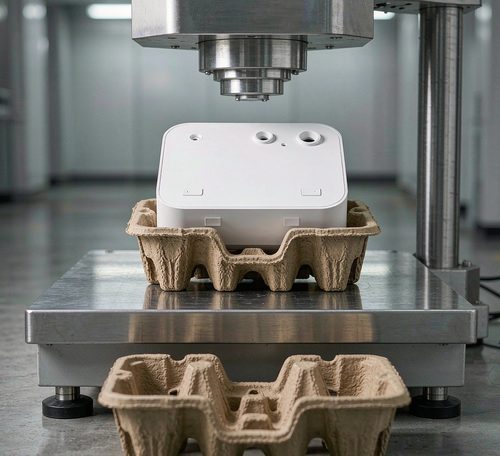
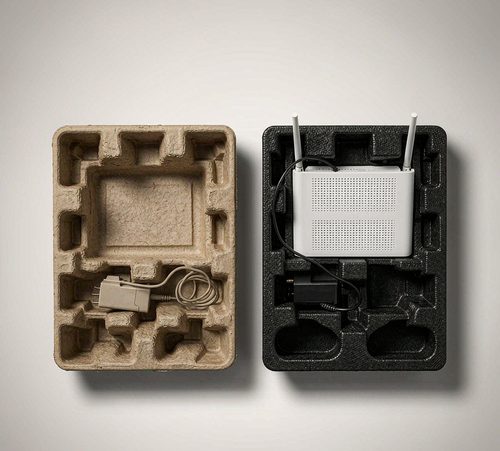
Pulp molded products are mainly used in industrial product inner packaging, poultry egg trays, fresh fruit trays, food and semi-finished products packaging, medical device packaging, special materials for the production of children's toys, drama props, handicraft blanks, furniture, parts, etc., military industry , Clothing and other industries packaging. Pulp molded products are generally processed by combining multiple sets of molds. With the improvement of mold technology, it is now possible to produce cavity-type pulp molded products.
Such molded pulp products are mostly used as containers or decorations. The combined processing mode is to realize a certain application requirement by combining multiple pulp molded bodies of different shapes during forming, and complete the required packaging function. Disposable pulp molded urinals abroad have replaced multiple-use urinals made of polyester materials. Therefore, with the improvement of mold technology, the structure of pulp molded products is becoming more and more complicated and detailed.
In addition to traditional honeycomb paperboard, corrugated paperboard and pulp model products, foamed paper particles that meet the needs of environmental protection are gradually being developed and used in the cushioning of electronic products. A company in Hamburg, Germany, shreds waste paper and mixes it with starch. The pulpy substance is made into granules, put in a sealed container, and then high-pressure and high-temperature steam is applied, and then the granule packaging is foamed. The porous pellets are made into foam packaging materials, which can be used as cushioning materials, and the cushioning performance is better than EPS. Suitable for buffer packaging of electronics, instruments and sensitive materials.
To sum up, with the increasing demand for environmental protection and packaging reduction in recent years, as well as the further improvement of electromechanical technology, the structure of cushioning materials has been developed rapidly, with different structures and suitable for special products. Its structure came into being.
The structure of cushioning materials has changed from a single type to a complex type, and from a process type to a functional type. Paper honeycomb has developed from a traditional structural change to an innovation in the molding process; corrugated cardboard has also changed from a single corrugated structure to a corrugated composite structure; with the further improvement of mold technology, pulp molded products have become more detailed and complex.
Paper honeycomb material
In 2000, Pflug applied for a patent for folding corrugated paper honeycomb, which is made by using the original corrugated paperboard production line and adding cutting, rotating, folding and pasting processes. It is difficult to paste and cut corrugated paper honeycombs. The one-way compressive strength of corrugated paper honeycombs is very high, which is especially suitable for the cushioning packaging of heavy products.
In 2004, Basily invented a 3D paper honeycomb made directly from paper by means of a molding process. It is suitable for automated production and is isotropic in two orthogonal directions. Such packaging materials can reduce costs and save space. , The least use of materials, it is a new force leading the reform and innovation of packaging materials. The 3D folding paper honeycomb core in Figure 3 is processed from kraft paper, and they can all be produced from sheet paper. The 3D folding paper honeycomb core adopts a new type of packaging machinery technology, which can be produced at high speed, and its production cost is lower than that of the current traditional paper honeycomb core.
The main feature of 3D folding paper honeycomb cores is that they can absorb a lot of energy compared with the current honeycomb structure for damage and earthquake resistance. In addition, the 3D folded core can increase the energy absorption rate per unit material and reduce its cost.
Paper honeycomb is known for its advantages of light weight, environmental protection, sound insulation, shock resistance, and high cost performance. It is mainly used to make cushioning pads to absorb shock or vibration during product transportation or loading and unloading. The structural forms of paper honeycombs mainly include regular hexagons, hexagons with reinforcing bands, rectangles, prismatic shapes, corrugated shapes, squares, sparsely arranged circles, densely packed circles, triangles, etc. The traditional paper honeycomb structure has a regular hexagonal shape, which is pasted by interlacing multiple layers of paper, cut into pieces after drying, and then pulled apart to form a regular hexagonal structure. The regular hexagonal paper honeycomb is a labor-intensive product and is not suitable for fully automated production.
Basily and Elsayed's invention of the Chevron Pattern folding method can be made into a square block or cylindrical barrel to play a buffer role. The Chevron Pattern folding core can greatly reduce the size and weight of the packaging, save the manufacturer's resources and funds, and can achieve lightweight packaging during the transportation process.
Since the 3D folding paper honeycomb can be rotated, wound, and bent, it can be easily used to process any packaging products. The packaging made by the 3D folding paper honeycomb is relatively small, light and has a better protective effect on the product. Irregular fragile products can be wrapped with 3D folding paper honeycombs and placed in other packaging containers. The new paper folding technology can be used to eliminate the need for printing on the packaging, and the company's LOGO can be made using this folding technology, the required physical colors, etc. The 3D folding paper honeycomb can not only play a promotional role but also protect the product from shock and vibration.
In order to further improve the processing performance of the paper honeycomb core and increase its automatic production capacity, in 2007 the author developed a variety of honeycomb sandwich structures suitable for paper processing. They all use two kinds of corrugated paper with alternating large and small corrugations alternately laminated and bonded. become.
Corrugated cardboard
In order to replace foam plastics, people have used corrugated cardboard structures to develop a variety of corrugated cardboard combined cushioning packaging materials. In 1996, KimDoWook and KimKiJeong developed double-ply reinforced corrugated cardboard on the basis of the original corrugated cardboard. The interlayer in the original three-layer corrugated cardboard was transformed into two corrugated corrugated layers, basically without increasing the thickness of the corrugated cardboard. The compressive strength of corrugated cardboard is increased on the basis of this.
Myung HoonLee et al. commented on five different structures [single layer SW, double layer DW, single layer with double sandwich core DM, double layer with a double sandwich core (AA'+Aflute) DMA, double layer with a double clip The core (AA'+Bflute) DMB] corrugated cardboard has been subjected to four-point bending experiments along the MD direction and the CD direction. The results show that the corrugated cardboard of the new structure has better structural advantages than the traditional corrugated cardboard.
Guo Juan et al. also conducted comparative experiments on 4-layer double-ply corrugated cardboard and five-layer corrugated cardboard. Guo Yanfeng and others analyzed the structural characteristics of X-PLY super-strong corrugated cardboard, and carried out comparative tests of breaking strength, puncture strength, flat compression strength and edge compression strength. In 2007, the author tested the static compression and dynamic compression properties of a variety of corrugated composite materials, and compared the load-bearing and cushioning properties of different corrugated composite materials.
The foldable corrugated composite material has high load-bearing performance, and its static cushioning energy absorption is also relatively large, which is more suitable for the cushioning packaging of products with heavy weight and hard surfaces. The cushioning performance of 0/90/0 overlapping corrugated composite material and 0/0/0 parallel overlapping corrugated composite material is very similar, its load-bearing capacity is not high, but its resilience is good, and it is more suitable for poor surface hardness and easy Packaging of products that are broken and fragile.
The load-bearing performance of corrugated/honeycomb/corrugated composites largely depends on the mechanical properties of the honeycomb sandwich core. The corrugated/honeycomb/corrugated composite material greatly increases the thickness of the composite material with a small amount of material, and its buffering and energy absorption efficiency is higher than that of pure corrugated stacking. Later, the author improved the original corrugated sandwich structure and invented a high-elastic corrugated cardboard structure.