
1. It can produce products of various specifications and complex shapes through molds, so that it can meet the packaging needs of products of various shapes, facilitate isolation and positioning, and prevent collisions.
2. The paper is light and soft, and the overall structure has suitable strength and rigidity, which makes it have good protection and cushioning properties.
3. It has ideal ventilation and moisture absorption, which is conducive to the preservation of food. As long as an appropriate amount of waterproofing agent is added to the slurry, the paper molded product can achieve good water resistance; for example, egg trays and fruit trays can be filled with water not higher than 35 ℃ within 24 hours without water marks on the reverse side; but generally The inner packaging of industrial products does not need to have this performance, because waterproofing should be a requirement for storage, transportation, and outer packaging.
4. According to needs, pulp molded products can be flame-retardant, anti-static, waterproof, laminating, printing, and applied to terminal retail packaging.
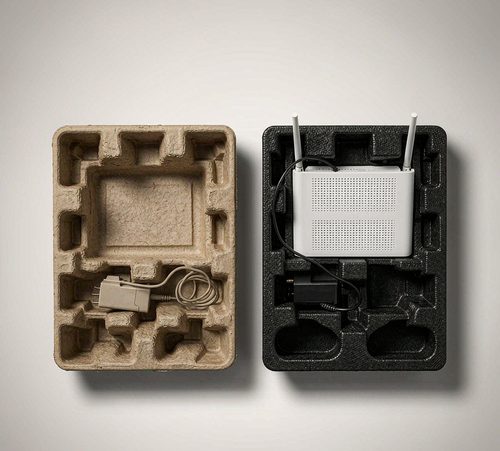
5. In terms of protective packaging, pulp molded parts have many advantages over EPS, EPE, and EPP cushioning parts:
A. The raw materials of molded pulp packaging products are waste paper and various fiber materials, which have a wide range of sources and are easy to collect, which will not cause obstacles to the environment and recycling, and are beneficial to product exports. However, foamed plastics are derived from petroleum products, and resource depletion and price problems will become more and more serious.
B. Pulp molded packaging products have a wide range of applications. The products currently using foam as lining can basically be replaced by pulp molded products. Pulp molded products can be stacked in stacks, which occupies 1/2~2/5 less storage space than foamed plastics, and the freight and storage costs are smaller.
C. Paper products have good anti-static properties, and the friction of foamed plastics is prone to generate static electricity, which has a better protective effect on electronic products and home appliances.
D. When the plastic products are packaged, the water content of the food is not easy to volatilize, and is easy to mold and rot, while the paper products have water vapor permeability, so as to achieve the anti-corrosion effect.
E. At present, paper molded products are already cheaper than foam plastics in terms of specific packaging costs.
6. The raw materials are extensive and can be used as wastes. The social benefits are obvious. The recycling and reuse rate of products is high. No matter the waste products in production or the finished products after use, they can be used as raw materials for re-production.
Development status of pulp molding: The market for pulp molding packaging materials is quite mature. At present, China has formed three pulp molding technology development centers in the Pearl River Delta, the Yangtze River Delta, and Beijing, Tianjin, and Dalian. The application of paper mold package products has spread to major brand products. Especially since 2001, related enterprises have increased at an annual rate of 20%. At present, the development level of domestic pulp molding technology is close to that of foreign countries. Many domestic pulp molding manufacturers can independently develop corresponding equipment, special processes, and auxiliary materials to produce mid-to-high-end paper-plastic packaging products.
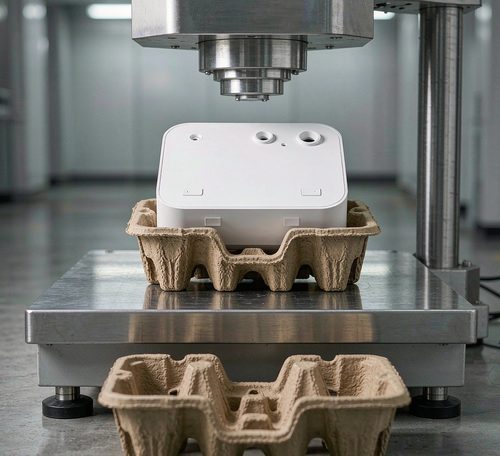
Paper-plastic paper tray, also known as pulp molding, is based on carton leftovers, newsprint, white pure wood pulp, etc., which are pulverized and mixed into a certain proportion of slurry. On the customized CNC mold according to the product design, After being vacuum-adsorbed and molded, and then dried, environmentally-friendly paper products of different types and uses are formed.
It has good shock-proof, anti-shock, anti-static and anti-corrosion effects, and has no pollution to the environment. It is more conducive to the export of manufacturers' products. It is widely used in electronics, electrical appliances, computers, mechanical parts, industrial instruments, handicraft glass, ceramics , Toys, pharmaceuticals and other industries.
Paper plastics can be divided into four categories: industrial paper plastics, agricultural paper plastics, food products paper plastics and medical products.