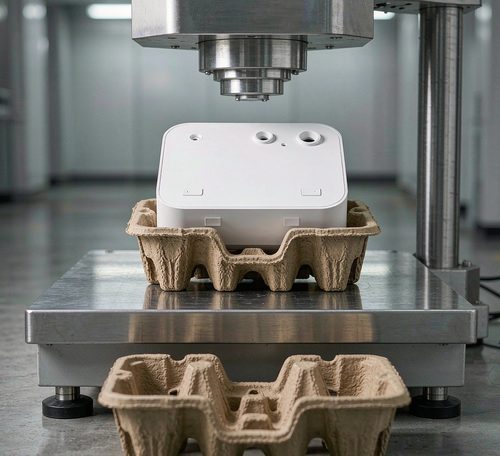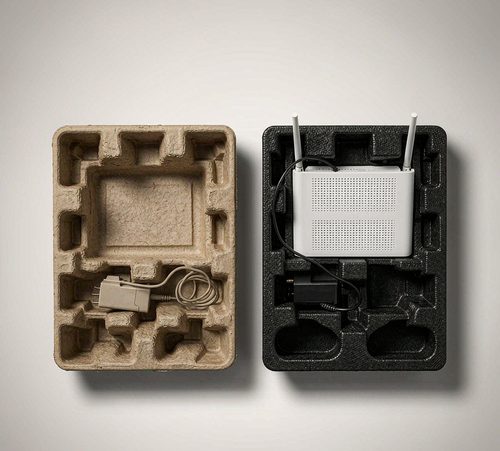

Pulp molding is a three-dimensional papermaking technology. It uses waste paper as raw material, and a special mold is used to mold a certain shape of paper product on a molding machine. It has four major advantages: The raw material is waste paper, including board paper, waste carton paper, waste white edge paper, etc., with a wide range of sources; its production process is completed by pulping, adsorption molding, drying and shaping, and other processes, which are not harmful to the environment; It can be recycled and reused; the volume is smaller than foamed plastic, it can be overlapped, and the transportation is convenient. Pulp molding is not only used for lunch boxes and tableware, but also for industrial cushioning packaging. It is currently developing very rapidly.
Features include egg boxes, egg trays, fruit trays, flower pots, disposable bedpans, etc. It uses waste paper as raw material, adds some moisture-proofing agent (aluminum sulfate) or water-proofing agent, and then makes various shapes of model products according to different uses, which are used as eggs, fruits, precision devices, and fragile glass. , Ceramic products, handicrafts, etc. packaging liner, with good cushioning and protection performance. The production of pulp molding technology and equipment has developed rapidly. The basic process is slurry preparation, molding, drying, and shaping. Domestically, it is mainly semi-automatic equipment, while foreign countries are almost all fully automatic high-energy-consuming assembly lines.
Model products
Pulp molded products are a fast new packaging material in recent years and an excellent substitute for wood. Pulp molded products adopt the manufacturing process of raw material beating-ingredients-molding forming-drying-shaping. Since there is a large amount of moisture (about 55-60%) left on the workpiece after compression molding, the moisture content of the final product is 12-14%, so during the drying process of the workpiece, the moisture that accounts for the weight of the workpiece should be removed , This part of the water is all removed by absorbing heat and turning into water vapor. Due to the phase change in the drying process, the energy consumption is very large, and the pulp molded products are processed into high energy consumption products. For this reason, it is very necessary to conduct thermal analysis on the energy conversion process of its drying. Because, through analysis, the design and processing of drying equipment can be improved, and the energy utilization rate can be improved, which has very important guiding significance for reducing the production cost of the pulp molded product industry.
Application field
Pulp molded products are solid containers used to contain and limit the contents to be packaged. They serve the circulation, storage, and transportation of commodities, that is, they are mainly used in the transportation and packaging of commodities.
Product function
The function of molded pulp products is to contain and protect the packaged products, which is convenient and practical.
Containing and protecting packaging products is the primary function of molded pulp products. Pulp molded products should be able to reliably contain the packaged products specified by the packaging, so that the packaged products are not damaged during transportation, handling, and use, and they should meet the requirements of strength, rigidity and stability. The materials used in pulp molded products are also safe for the packaged products, and the two do not interact.
The structure of the pulp molded product that is convenient to use should be pleasant. The structure and shape of pulp molded products should not harm the human body, and adapt to the operation and handling of the human body during use.
Furthermore, the pulp molded product is through its own special structure that deforms when loaded to prolong the corresponding time and absorb external energy, thereby reducing the impact and vibration of the packaged object. It is different from the cushioning mechanism of foamed plastic packaging products, because foamed products have a large number of compressible cells distributed in the material, regardless of the shape of the product, it has better cushioning performance, if paper pulp plastic film materials and Foam plastics are made into a large plane. Obviously, the former can be cushioned, while the latter cannot be cushioned. Therefore, for pulp-plastic film products, a good structural design is to complete the protection of the contents and improve it during transportation and handling. The basic guarantee of shock absorption capacity. The designed structural performance will directly affect the strength, rigidity, stability and practicability of the package, that is, the structure of the pulp molded product directly affects the realization of its packaging function.
Pulp molding is a three-dimensional papermaking technology. It uses waste paper as raw material, and a special mold is used to mold a certain shape of paper product on a molding machine. It has four major advantages: The raw material is waste paper, including board paper, waste carton paper, waste white edge paper, etc., with a wide range of sources; its production process is completed by pulping, adsorption molding, drying and shaping, and other processes, which are not harmful to the environment; It can be recycled and reused; the volume is smaller than foamed plastic, it can be overlapped, and the transportation is convenient. Pulp molding is not only used for lunch boxes and tableware, but also for industrial cushioning packaging. It is currently developing very rapidly.
Features include egg boxes, egg trays, fruit trays, flower pots, disposable bedpans, etc. It uses waste paper as raw material, adds some moisture-proofing agent (aluminum sulfate) or water-proofing agent, and then makes various shapes of model products according to different uses, which are used as eggs, fruits, precision devices, and fragile glass. , Ceramic products, handicrafts, etc. packaging liner, with good cushioning and protection performance. The production of pulp molding technology and equipment has developed rapidly. The basic process is slurry preparation, molding, drying, and shaping. Domestically, it is mainly semi-automatic equipment, while foreign countries are almost all fully automatic high-energy-consuming assembly lines.
Model products
Pulp molded products are a fast new packaging material in recent years and an excellent substitute for wood. Pulp molded products adopt the manufacturing process of raw material beating-ingredients-molding forming-drying-shaping. Since there is a large amount of moisture (about 55-60%) left on the workpiece after compression molding, the moisture content of the final product is 12-14%, so during the drying process of the workpiece, the moisture that accounts for the weight of the workpiece should be removed , This part of the water is all removed by absorbing heat and turning into water vapor. Due to the phase change in the drying process, the energy consumption is very large, and the pulp molded products are processed into high energy consumption products. For this reason, it is very necessary to conduct thermal analysis on the energy conversion process of its drying. Because, through analysis, the design and processing of drying equipment can be improved, and the energy utilization rate can be improved, which has very important guiding significance for reducing the production cost of the pulp molded product industry.
Application field
Pulp molded products are solid containers used to contain and limit the contents to be packaged. They serve the circulation, storage, and transportation of commodities, that is, they are mainly used in the transportation and packaging of commodities.
Product function
The function of molded pulp products is to contain and protect the packaged products, which is convenient and practical.
Containing and protecting packaging products is the primary function of molded pulp products. Pulp molded products should be able to reliably contain the packaged products specified by the packaging, so that the packaged products are not damaged during transportation, handling, and use, and they should meet the requirements of strength, rigidity and stability. The materials used in pulp molded products are also safe for the packaged products, and the two do not interact.
The structure of the pulp molded product that is convenient to use should be pleasant. The structure and shape of pulp molded products should not harm the human body, and adapt to the operation and handling of the human body during use.
Furthermore, the pulp molded product is through its own special structure that deforms when loaded to prolong the corresponding time and absorb external energy, thereby reducing the impact and vibration of the packaged object. It is different from the cushioning mechanism of foamed plastic packaging products, because foamed products have a large number of compressible cells distributed in the material, regardless of the shape of the product, it has better cushioning performance, if paper pulp plastic film materials and Foam plastics are made into a large plane. Obviously, the former can be cushioned, while the latter cannot be cushioned. Therefore, for pulp-plastic film products, a good structural design is to complete the protection of the contents and improve it during transportation and handling. The basic guarantee of shock absorption capacity. The designed structural performance will directly affect the strength, rigidity, stability and practicability of the package, that is, the structure of the pulp molded product directly affects the realization of its packaging function.