
一, The genes in natural fibres that absorb moisture: from their physical structure to how they respond to the environment
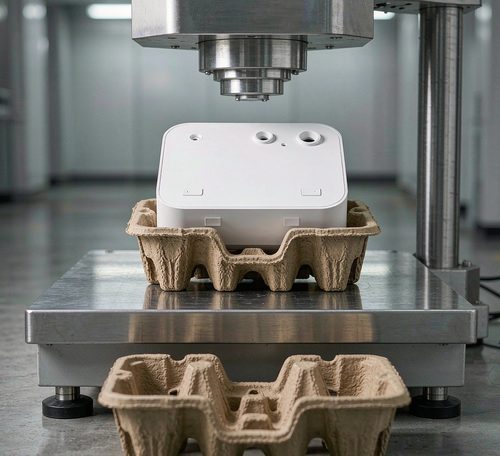
Moulded pulp is created from natural plant fibres including sugarcane bagasse, waste paper, and bamboo fibre. Its three-dimensional network fibre structure gives it special qualities that make it absorb moisture. There are a lot of polar groups on the fibre surface, like hydroxyl groups (-OH). These groups may establish hydrogen bonds with water molecules and actively absorb moisture from the air when the air is humid. Experimental data indicates that untreated native pulp moulding can attain a moisture absorption rate of 12.3% within 24 hours in a 90% humidity condition, leading to a 65% reduction in material strength. This trait used to make it hard to use in electrical packaging.
Possible dangers of moisture absorption for electronic goods:
Corrosion of parts: When the humidity is above 60%, metal contacts might oxidise, which makes the contact bad.
Accumulation of static electricity: When fibres absorb moisture, their surface resistance goes down, which can lead to electrostatic discharge (ESD) mishaps.
Structural failure: When the cushioning pad absorbs moisture, it changes shape, which makes it less effective in protecting against earthquakes while being moved.
二, Technological breakthrough: a change from passively absorbing moisture to actively stopping it
The industry has built a three-dimensional moisture-proof system to stop moisture from getting in. This was done by three main methods: changing the materials, coming up with new processes, and improving the structure.
1. Hydrophobic alteration of fibres: a waterproof barrier at the molecular level
Chemical grafting technology adds hydrophobic groups, including fluorocarbon chains and siloxanes, to the surface of fibres. This stops water molecules from adhering to hydroxyl groups. For instance, a company produced a paper plastic purifier that can change the surface contact angle of fibres from 0° to 120°. The moisture absorption rate goes down from 12.3% to 4.5% after being in a room with 90% humidity for 24 hours, while the strength retention rate is up from 35% to 85%. This method has been used to package Huawei Mate 60 batteries. By adding modifiers to the paste, the inside packaging got an IPX3 waterproof rating.
2. Nano coating technology: "invisible armour" for protecting surfaces
The moulded pulp surface was covered with a nano hydrophobic layer using either the plasma spraying or sol gel technique. The packaging of the Apple iPhone 15, for instance, has a nano hydrophobic coating with carbon black conductive agent. This coating not only protects against static electricity with a surface resistance of less than 10 ⁹ Ω, but it also makes the phone waterproof to IPX4 level with a contact angle of 150 °. This coating can withstand more than 500 times the friction of standard surface coatings (<100 times).
3. Structural optimisation design: "Microenvironment control" for controlling humidity
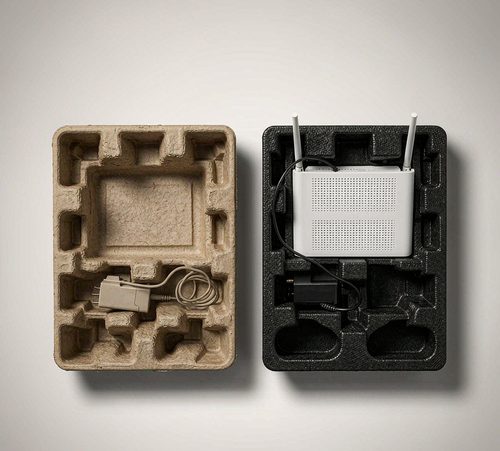
Use simulation tools to improve the packing structure, and add breathable holes and chambers for desiccant in important places. For instance, the packaging for Tesla charging stations has a double-layer pulp moulding structure. The outer layer is reinforced with conductive fibres to protect against impact, and the inner layer has honeycomb-shaped breathable channels and silicone desiccant to keep the humidity inside the packaging at 40% to 50%, which meets the IP65 protection level requirements.
三, Industry application: complete scenario testing from consumer electronics to industrial equipment
The moisture-proof technology of moulded pulp has made its way into many parts of the electronics industry chain. Its durability has been shown through strict testing and real-world examples.
1. Consumer electronics: the "protective shield" for parts that need to be very precise
Mobile phone packaging: One brand's camera module got scratched because of electrostatic adsorption, costing the company more than 8 million yuan a year. After utilising 4:3 graphite/carbon black conductive fibres, the surface resistance went down to 10 ⁴ Ω, and the yield of the product went up from 92% to 98.5%.
Packaging for headphones: Cochlear cochlear implant packaging is made with pulp that is both antibacterial and anti-static, has a surface resistance of < 10 ΩΩ, and is coated with nano silver ions. It can be kept in a place with 85% humidity for 72 hours without losing its ability to work.
2. Industrial equipment: a "seismic fortress" for big parts
Tesla uses moisture-proof pulp moulding for the charging pile packing, and it has passed ISTA 3A transportation testing. The interior parts haven't rusted and the structure hasn't changed shape after being transported for 1000 kilometres in a 90% humidity environment.
Server packaging: The Lenovo ThinkSystem server packaging uses vacuum adsorption moulding technology. The wall thickness is consistent within 0.1mm, and the packaging has humidity sensing cards to keep an eye on the humidity during shipping.
3. Medical electronics: the "guardian" of clean places
Medtronic's insulin pump packaging is made of biobased moisture-proof materials and has achieved ISO 13485 medical certification. It can be kept in a place with 75% humidity for 30 days, and the humidity inside the packing doesn't change by more than 5% to keep the equipment sterile.