Quick Answer Yeson Most FrontsButEco-FriendlyStill Needs to Be Backed by Data
Here's the direct answer before getting into the details. Green Molded Pulp Packaging genuinely lines up well with where global environmental policy and consumer expectations are heading, particularly around reducing single-use plastic and improving recyclability. That said, switching to molded pulp doesn't automatically make every claim on your packaging legally or factually sound. The material itself is a strong fit for current trends, but regulators are getting increasingly specific about what brands are actually allowed to say about it.
A lot of brands assume that choosing a pulp-based material is the whole job. It isn't. Regulators in multiple regions are now actively cracking down on vague sustainability language, and simply using an eco-friendly material doesn't give you a free pass to describe it however you like on the box.
A Question That Comes Up When Brands Start Reporting Sustainability Metrics
This question tends to surface once a brand's sustainability or ESG reporting team gets involved. A packaging or procurement team switches to molded pulp, feels good about the decision, and then finds out that reporting "we use eco-friendly packaging" isn't enough anymore, especially for companies selling into the EU or dealing with retailers that have their own sustainability scorecards.
The gap usually comes from treating "environmentally friendly material" and "compliant sustainability claim" as the same thing. They're related, but they're not identical. A brand can genuinely be using a strong, low-impact packaging material and still run into trouble if its marketing language doesn't have the data or certification behind it to back it up.
What Global Environmental Trends Actually Means Right Now
It helps to break this down into concrete pieces rather than treating "environmental trends" as one vague blob. Three things are actually happening in parallel right now, and each one affects packaging decisions differently.
First, single-use plastic restrictions keep expanding, with more countries and individual US states introducing specific bans or fees targeting foam and certain plastic packaging formats. Second, extended producer responsibility (EPR) programs, which shift the cost and responsibility for packaging waste back onto the companies that produce it, continue rolling out across more regions, particularly in the EU and a growing number of US states. Third, and this is the part a lot of packaging teams miss, regulators are cracking down hard on how companies are allowed to talk about sustainability, independent of whether the underlying material choice is actually a good one.
How Molded Pulp Fits Into the Plastic Reduction Trend
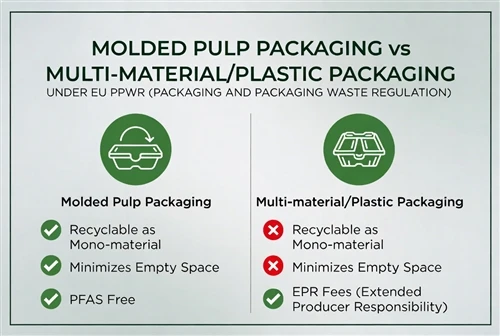
Molded pulp is a genuinely strong fit for the first of these trends. As a replacement for foam and certain plastic packaging formats, it directly answers the kind of restrictions showing up in packaging legislation. The EU's Packaging and Packaging Waste Regulation (PPWR) is pushing hard toward genuinely recyclable materials rather than composite packaging that only looks sustainable, and several US states have introduced specific restrictions on expanded polystyrene packaging.
For appliance brands specifically, this means molded pulp checks the box on the "get away from plastic and foam" side of the equation reasonably well, assuming the specific product doesn't rely on a plastic coating that undermines its recyclability, which is a separate issue covered further down.
Comparison Table Environmental Compliance AngleMolded Pulp vs Foam vs Plastic
|
Material |
Recyclability |
Directly Affected by Plastic Restrictions |
General Carbon Footprint Direction |
|
EPS foam |
Poor, rarely accepted in standard recycling streams |
Yes, frequently targeted by bans and fees |
Generally higher, derived from petroleum |
|
Standard plastic packaging |
Varies by plastic type, often limited in practice |
Yes, increasingly restricted for single-use formats |
Generally higher, derived from petroleum |
|
Molded pulp (uncoated or bio-coated) |
Generally strong, especially without plastic-based coatings |
No, typically viewed as a compliant alternative |
Generally lower, derived from renewable fiber |
Biodegradable vs Compostable vs Recyclable Why These Words Aren't Interchangeable
This is one of the most common sources of accidental greenwashing, and it's worth being precise about it. These three words describe genuinely different things, and using them loosely is exactly the kind of vague claim that regulators are now targeting.
Biodegradable means a material will break down naturally over time, but it doesn't specify how long that takes or under what conditions, which is why the term alone is considered too vague by a lot of regulators without further qualification.
Compostable is more specific, meaning the material breaks down into non-toxic components within a defined timeframe under specific composting conditions, and this claim is generally expected to be backed by recognized testing standards or certification.
Recyclable means the material can be processed through existing recycling infrastructure, but this claim only holds up if that infrastructure genuinely exists and is accessible in the market where the product is sold. Recent EU guidance has specifically flagged that packaging can only be described as recyclable where a real, functioning recycling pathway actually exists for it, not just in theory.
Mixing these terms up, or using one when another actually applies, is a common and avoidable mistake.
Real ExampleHelping a Brand Align Packaging Claims With Actual Certification
We've worked with appliance brand clients who had already switched to molded pulp packaging and were using general phrases like "eco-friendly" on their packaging and marketing materials, without anything specific backing that language up. After reviewing their supply chain, the brand added FSC (Forest Stewardship Council) chain-of-custody certification for their pulp sourcing and started referencing a specific, verified recyclability rate for the packaging rather than a generic sustainability claim.
That adjustment did two things at once: it reduced the brand's regulatory exposure around unsubstantiated environmental claims, and it gave the brand something concrete and credible to show increasingly sustainability-conscious retail partners and customers, rather than a vague assertion that could be challenged.
(Note: figures and specifics above are illustrative and should be replaced with verified project data before publishing.)
Rollguard Molded Pulp and Molded Pulp Trays Eco-friendly Where They Fit the Bigger Picture
Different product lines map onto this trend in slightly different ways. Rollguard Molded Pulp, used for structural protection around cylindrical or roll-shaped components, typically replaces plastic or foam corner and edge protectors, which puts it squarely in the category of products directly displacing the plastic packaging formats facing the most regulatory pressure. Molded Pulp Trays Eco-friendly designs generally replace PE-based internal trays and inserts, another common target of plastic reduction policy.
Both product lines genuinely align with the broader plastic reduction trend by design. That said, fitting the trend doesn't automatically mean every unit produced is "low carbon" in some absolute sense. Actual environmental performance still depends on production-specific factors, like whether a plastic-based coating was used for moisture resistance, or how the fiber was sourced, so it's worth treating "this product category aligns with the trend" and "this specific batch has a verified low footprint" as two separate claims.
Common Mistakes When Marketing Molded Pulp as Eco-Friendly
A handful of mistakes show up repeatedly in how brands describe molded pulp packaging:
Treating "bio-based" and "compostable" as the same thing. A material can be made from renewable fiber and still not qualify as compostable without meeting specific testing standards for breakdown time and conditions.
Claiming recyclability without checking if plastic coatings were used. Molded pulp treated with a traditional PFAS-based moisture barrier is significantly harder to recycle cleanly, and claiming full recyclability without disclosing that coating is a common and risky oversight.
Using generic terms like "environmentally friendly" with nothing specific behind them. EU guidance has specifically flagged vague, unsubstantiated environmental language as a primary target of enforcement, and similar scrutiny applies in other major markets as well.
Assuming a compliant claim in one country is automatically compliant everywhere. Different regions have different specific legal requirements for environmental marketing language, and a claim that's fine in one market can create real legal exposure in another.
Industry Trends Sustainability Reporting Is Becoming a Procurement Requirement, Not Just Marketing
This shift is worth taking seriously because it's changing who actually cares about packaging sustainability data. It's no longer just a brand's own marketing team deciding whether to mention sustainability. A growing number of retailers and e-commerce platforms have started incorporating supplier packaging sustainability data directly into their procurement scoring systems, meaning a brand without verifiable packaging data can face real friction getting shelf space or platform approval, independent of what its own marketing wants to say.
This trend has been accelerating as more large retailers formalize their own sustainability commitments and push those requirements down through their supply chains, effectively making credible packaging data a business requirement rather than an optional brand differentiator.
Regulatory Context Worth Knowing Before You Make Sustainability Claims
The regulatory picture here has shifted meaningfully in the past year, and it's worth being current on where things actually stand. The EU's proposed Green Claims Directive, which would have required mandatory third-party verification for environmental claims, was effectively withdrawn by the European Commission in mid-2025 after industry pushback over administrative burden, particularly concerns about the impact on smaller businesses.
That withdrawal does not mean the EU has backed off on greenwashing enforcement, though. A separate law, the Empowering Consumers for the Green Transition Directive, referred to as ECGT or EmpCo, was already adopted in 2024 and becomes enforceable across EU member states from late September 2026. This directive specifically bans generic, unsubstantiated environmental claims, self-created sustainability labels without recognized certification behind them, and claims like "climate neutral" based purely on carbon offsets rather than actual verified emissions reductions. Enforcement carries real financial risk, with potential fines reaching a meaningful percentage of a company's annual turnover in the relevant member state.
In the United States, the Federal Trade Commission's Green Guides provide the primary framework for evaluating environmental marketing claims, generally requiring that terms like "recyclable" or "biodegradable" be supported by evidence and not mislead a reasonable consumer about the product's actual environmental impact.
Given how quickly this regulatory landscape is shifting, particularly with the EU's ECGT enforcement date approaching in September 2026, it's worth confirming the current specific requirements in your target markets directly rather than relying on general guidance, since enforcement details continue to be clarified even as the underlying rules take effect.
How to Make Sure Your Molded Pulp Packaging Claims Actually Hold Up
A few concrete steps can help make sure your packaging language is defensible rather than just well-intentioned:
Request documented fiber sourcing certification, such as FSC chain-of-custody certification, rather than relying on a general claim of "sustainably sourced" material.
Ask specifically whether any moisture-resistant coating used is PFAS-based or a bio-based alternative, since this directly affects whether recyclability claims actually hold up.
Get a specific, verifiable recyclability or compostability rate from your supplier, rather than defaulting to a generic "eco-friendly" description with nothing behind it.
Check the specific environmental marketing regulations in each market you sell into, since requirements differ meaningfully between the EU, the US, and other regions, and a claim compliant in one place isn't automatically compliant everywhere.
If you're working with a Green Molded Pulp Packaging manufacturer or factory directly, it's worth asking for this documentation as a standard part of your supplier relationship, not something you only chase down after a compliance question comes up.
FAQ
Q: Is molded pulp packaging actually recyclable everywhere?
A: Not automatically. Recyclability depends on whether functioning recycling infrastructure actually exists in the specific market where the product is sold, and whether the pulp uses a plastic-based coating that complicates recycling. It's worth verifying this specifically rather than assuming pulp is universally recyclable.
Q: What's the difference between biodegradable and compostable packaging?
A: Biodegradable simply means a material breaks down naturally over time, without specifying how long that takes or under what conditions. Compostable is more specific, referring to breakdown into non-toxic components within a defined timeframe under recognized composting standards. The two terms are not interchangeable.
Q: Does molded pulp packaging help with EPR compliance?
A: Generally yes, since molded pulp is typically viewed favorably under extended producer responsibility frameworks compared to non-recyclable plastic or foam packaging, though specific EPR fee structures and requirements vary by region and should be confirmed for your specific market.
Q: Can I legally call my packaging "eco-friendly" without certification?
A: This is increasingly risky. Regulators in the EU and elsewhere have specifically flagged generic, unsubstantiated environmental claims as a target for enforcement, and using vague language without supporting data or certification creates real legal exposure, particularly as EU rules become enforceable from September 2026.
Q: Does molded pulp have a lower carbon footprint than plastic packaging?
A: Generally yes in direction, since it's derived from renewable fiber rather than petroleum-based materials, but the specific footprint depends on production methods, fiber sourcing, and any coatings used, so a verified lifecycle assessment is the most reliable way to make a specific claim.
Q: Are retailers actually requiring sustainable packaging now, or is it optional?
A: Increasingly required rather than optional. A growing number of retailers and e-commerce platforms have incorporated supplier packaging sustainability data into their procurement scoring systems, making credible documentation a practical business requirement rather than a purely voluntary marketing choice.
Q: What certifications should I ask for to support sustainability claims?
A: FSC chain-of-custody certification for fiber sourcing is a common and verifiable starting point, along with specific, third-party verified data on recyclability or compostability rather than relying on self-created sustainability labels, which are increasingly restricted under EU rules.
Q: Does PFAS coating affect whether molded pulp counts as eco-friendly?
A: Yes, significantly. A PFAS-based moisture-resistant coating complicates recycling and undermines a straightforward "recyclable" or "eco-friendly" claim, even though the base fiber material itself is renewable. It's worth confirming directly with your supplier whether any coating used is PFAS-based or a bio-based alternative.
Alignment With Trends Still Requires Proof, Not Just Material Choice
Green Molded Pul p Packaging as a material genuinely fits where global environmental policy and consumer expectations are heading, particularly around reducing plastic and foam use. But fitting the trend and being able to prove specific claims are two different things, and regulators in major markets are increasingly focused on the second part.
Before making sustainability claims about your packaging, it's worth asking your supplier for the specific certification and data to back those claims up, rather than assuming that switching to molded pulp automatically means every statement on your packaging is safe to make.