Quick Answer Molded Pulp Generally Wins on Real-World Outcomes, Not Just Lab Conditions
Here's the direct answer, since this comparison gets muddier than it should. In actual, real-world use, Green Molded Pulp Packaging generally comes out ahead of biodegradable plastics like PLA, mainly because of what happens after the packaging gets thrown away, not because of what the material is made from. Both options get marketed as "green," but they rely on completely different disposal infrastructure, and that difference matters enormously in practice.
The confusion here is understandable. "Biodegradable" sounds like an automatic win. In reality, most biodegradable plastics only break down properly under specific industrial conditions that a lot of regions simply don't have the infrastructure to provide, which means the material can end up behaving almost exactly like regular plastic once it's actually thrown away.
A Question That Comes Up When Brands Compare Two "Green" Options Side by Side
This comes up constantly when brands are choosing between two packaging suppliers pitching different "green" materials. One supplier offers PLA-based bioplastic trays, marketed as biodegradable and plant-based. Another offers molded pulp trays, marketed as recyclable and fiber-based. Both pitches sound equally convincing, and most buyers have no easy way to tell which claim actually holds up once the product leaves the warehouse.
The part that rarely gets explained clearly is that these two materials have completely different real-world fates. One depends on specialized industrial infrastructure that may or may not exist where your customers actually live. The other slots into an already widespread recycling system that's been around for decades. That difference matters far more than which material sounds more "advanced" or "natural" on a spec sheet.
What "Biodegradable Plastic" Actually Means
"Biodegradable plastic" is a broad label covering several genuinely different materials, and lumping them all together causes a lot of confusion. PLA, short for polylactic acid, is the most common one used in packaging, typically made from fermented plant starch like corn or sugarcane. Other bioplastics, like PHA, behave quite differently and can break down under a wider range of natural conditions.
The critical detail that gets lost in marketing is that PLA specifically requires very particular conditions to break down at any meaningful speed. Industrial composting facilities typically need to sustain temperatures around 55 to 70°C, combined with consistent moisture and active microbial activity, to get PLA to compost within a reasonable window, generally somewhere in the range of one to a few months under those controlled conditions. Outside of that specific environment, the story changes completely.
Why "Compostable" Bioplastic Often Ends Up in Landfill Anyway
Here's the part that catches a lot of brands off guard. In a standard landfill, without the heat, oxygen, and microbial activity that industrial composting provides, PLA can persist essentially unchanged for decades. Research on real-world PLA behavior has shown it doesn't meaningfully break down in ordinary landfill conditions or in natural bodies of water, since it lacks the heat and moisture needed to trigger its breakdown process.
The bigger issue is access. Industrial composting facilities capable of properly processing PLA are genuinely limited in number in most regions, and most consumers have no reliable way to know whether their local waste system actually routes this material to the right place. In practice, most PLA products end up mixed into general landfill waste or standard recycling streams that aren't built to handle it, meaning the "compostable" label on the package often has very little bearing on what actually happens to it.
How Molded Pulp's End-of-Life Path Compares
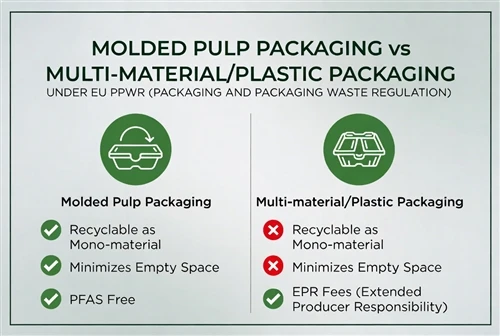
Molded pulp doesn't have this same infrastructure problem. Standard paper and fiber recycling systems are already widespread across most developed markets, far more so than industrial composting facilities specifically built for bioplastics. As long as a molded pulp product doesn't use a plastic-based moisture coating, it can typically go straight into ordinary paper recycling streams that already exist almost everywhere.
Even in a worst-case scenario, if pulp packaging does end up in a landfill instead of getting recycled, fiber-based material generally breaks down considerably faster than plastic-based material in that same environment, since it doesn't require the specific heat and microbial conditions that PLA needs to start decomposing.
Comparison Table Molded Pulp vs Biodegradable Plastic (PLA) Across Key
Environmental Factors
| Factor | Molded Pulp | Biodegradable Plastic (PLA) |
|---|---|---|
| Raw material source | Recycled or virgin wood/plant fiber | Fermented plant starch (corn, sugarcane) |
| Disposal infrastructure needed | Standard paper recycling, widely available | Industrial composting, limited availability in most regions |
| Landfill behavior | Breaks down considerably faster than plastic | Can persist largely intact for decades without industrial conditions |
| Recycling compatibility | Compatible with standard paper recycling streams (if uncoated) | Generally not compatible with standard plastic recycling streams |
| Consumer disposal clarity | Generally straightforward, fits existing recycling habits | Often confusing, requires specific composting access most consumers lack |
Carbon Footprint It's Not as Simple as "Plant-Based Wins
Here's a genuinely counterintuitive point worth understanding. Just because PLA comes from a plant doesn't automatically mean its production carbon footprint is lower than molded pulp's. Making PLA involves fermenting plant starch into lactic acid and then chemically polymerizing it into a plastic resin, an industrial process with real energy inputs of its own, separate from however "natural" the starting material sounds.
A proper environmental comparison needs to account for the entire lifecycle: how the raw material is grown and harvested, how much energy the manufacturing process consumes, transportation, and critically, what actually happens at end of life. Molded pulp production is generally a more straightforward mechanical and thermal process compared to the chemical polymerization PLA requires, and its widely available recycling pathway gives it a real advantage in the part of the lifecycle that most comparisons underweight, what happens after the customer throws it away.
Real Example A Brand That Switched From PLA Trays to Molded Pulp After a Sustainability Audit
We've worked with consumer brand clients who initially chose PLA-based trays specifically because the material felt more modern and technologically impressive for their sustainability messaging. During a later supply chain sustainability audit, the brand discovered that their primary markets lacked meaningful industrial composting infrastructure, meaning the overwhelming majority of their "compostable" packaging was actually ending up in ordinary landfill waste, providing essentially none of the environmental benefit the packaging had been marketed around.
After switching to Molded Pulp Trays Eco-friendly designs, the brand was able to point to a much higher real-world recycling and diversion rate, since their packaging could now integrate directly into existing paper recycling infrastructure that customers were already using for other household paper waste, rather than depending on specialized composting access that simply wasn't there.
Rollguard Molded Pulp vs Bioplastic Structural Inserts Which Holds Up Better in Both Senses
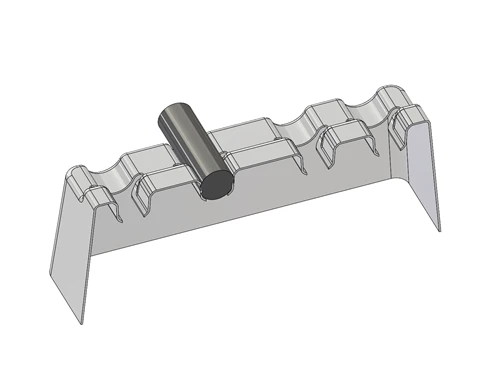
Structural cushioning and corner protection is another area where this comparison plays out. Rollguard Molded Pulp, designed for cylindrical or roll-shaped components, offers genuine structural strength through fiber density and mold geometry, and its end-of-life path follows the same favorable paper recycling route as other molded pulp products.
Bioplastic structural inserts attempting to serve the same function often face an additional complication. To achieve the rigidity and impact resistance needed for structural protection, some bioplastic formulations incorporate additives or blended materials, which can further complicate the "fully biodegradable" claim on the label, since these additives don't necessarily break down the same way the base bioplastic resin does.
When Biodegradable Plastic Might Actually Make Sense
It's worth being fair here rather than dismissing bioplastics outright, because there are situations where PLA and similar materials genuinely make sense. In closed-loop systems where the end-of-life path is actually guaranteed, for example specific B2B logistics operations with dedicated industrial composting arrangements, or regions with genuinely robust municipal composting infrastructure, bioplastic packaging can perform close to its marketed environmental promise.
The honest takeaway is that this isn't a question of one material being universally better in every case. It's a question of whether the disposal infrastructure your specific customers actually have access to matches what the material needs to deliver its environmental benefit. For most general consumer and appliance packaging use cases, where the end customer's actual disposal habits and local infrastructure are unknown or highly varied, molded pulp's reliance on already widespread paper recycling gives it a meaningful practical edge.
Common Mistakes When Choosing Between These Two "Green" Options
A handful of mistakes come up repeatedly in this comparison:
Assuming "plant-based" automatically means "lower carbon footprint." The manufacturing process matters just as much as the raw material source, and chemically processed bioplastics don't automatically win this comparison.
Treating "compostable" as equivalent to "will naturally break down." Compostable specifically means breakdown under defined industrial conditions, not general natural decomposition, and the difference matters enormously in practice.
Not confirming whether your target market actually has the required disposal infrastructure. A material's environmental credentials are meaningless if the facilities needed to realize them don't exist where your product is actually sold and discarded.
Overlooking additives in structural bioplastic components. Reinforced or structural bioplastic parts may include additives that complicate full biodegradability claims, something worth specifically asking a supplier about.
Industry Trends Growing Scrutiny on Bioplastic Environmental Claims
Environmental researchers and regulators have increasingly begun questioning the real-world environmental benefit of biodegradable plastics, particularly given how often the actual disposal pathway fails to match the marketing claim. Studies examining bioplastic behavior in real environmental conditions, including marine settings, have found that materials like PLA can persist essentially unchanged for well over a year even in natural water environments, directly undermining assumptions that "biodegradable" plastic behaves meaningfully differently from conventional plastic once it actually enters the environment.
This growing scrutiny is pushing the packaging industry toward more transparent, infrastructure-aware claims rather than relying on the general appeal of plant-based materials alone, which lines up with molded pulp's more straightforward and already well-established end-of-life pathway.
Regulatory Context Worth Knowing
Compostability claims for bioplastics are generally expected to be backed by recognized certification standards, such as EN 13432 in Europe or ASTM D6400 in the United States, both of which specifically test whether a material breaks down under defined industrial composting conditions within a set timeframe. A compostability claim without this kind of certification behind it is increasingly viewed as unsubstantiated marketing language, the exact kind of claim that current EU anti-greenwashing rules, including the Empowering Consumers for the Green Transition Directive becoming enforceable in late 2026, are specifically designed to challenge.
It's worth confirming that any bioplastic supplier can provide this specific certification, rather than accepting a general "compostable" label at face value, and equally worth confirming whether your target market's actual waste infrastructure can even process a certified compostable material properly.
How to Decide Which Material Actually Makes Sense for Your Product
A few concrete steps can help make this decision based on real conditions rather than marketing appeal:
Check whether your target market actually has industrial composting infrastructure available to consumers, rather than assuming a "compostable" label guarantees proper disposal.
Ask your supplier for actual lifecycle assessment data, covering raw material sourcing, manufacturing energy use, and end-of-life pathway, rather than relying on a general "plant-based" or "biodegradable" claim.
Evaluate whether your product's structural requirements would require additives in a bioplastic component, which could complicate biodegradability claims.
Confirm certification standards like EN 13432 or ASTM D6400 if you're considering a compostable plastic claim, since these are the recognized frameworks regulators and retailers increasingly expect to see behind that language.
If you're sourcing from a Green Molded Pulp Packaging manufacturer or factory directly, it's worth asking specifically for recyclability data and confirmation of whether any coatings used affect that recyclability, so you're comparing real, verifiable outcomes rather than general marketing claims from either material category.
F A Q
Q: Is molded pulp more eco-friendly than biodegradable plastic?
A: Generally yes in real-world conditions, mainly because molded pulp integrates into already widespread paper recycling infrastructure, while biodegradable plastics like PLA require specialized industrial composting facilities that are much less commonly available.
Q: Does biodegradable plastic actually break down in a regular landfill?
A: Not efficiently. PLA specifically requires sustained high heat, moisture, and microbial activity to break down at a meaningful rate, conditions that standard landfills don't provide, meaning it can persist largely intact for decades in that environment.
Q: What's the difference between biodegradable, compostable, and PLA plastic?
A: Biodegradable broadly means a material can be broken down by microorganisms, without specifying conditions or timeframe. Compostable specifically means breakdown into non-toxic components under defined composting conditions within a set time. PLA is one specific type of bioplastic that is compostable only under industrial conditions, not through general biodegradation in typical environments.
Q: Can molded pulp be recycled through normal paper recycling?
A: Generally yes, as long as the pulp product doesn't use a plastic-based moisture coating, in which case it can typically go directly into standard paper recycling streams that are already widely available.
Q: Does bioplastic have a lower carbon footprint than paper-based packaging?
A: Not necessarily. While the raw material for bioplastics like PLA is plant-based, the manufacturing process involves fermentation and chemical polymerization with its own energy costs, and a full lifecycle comparison, including end-of-life handling, doesn't automatically favor bioplastic over molded pulp.
Q: Is compostable plastic legally required to have certification?
A: Certification standards like EN 13432 in Europe and ASTM D6400 in the US are the recognized frameworks for verifying compostability claims, and making a compostable claim without this kind of backing is increasingly treated as unsubstantiated marketing language under tightening anti-greenwashing regulations.
Q: When does biodegradable plastic actually make sense over molded pulp?
A: In situations with a genuinely guaranteed disposal pathway, such as closed-loop B2B logistics systems with dedicated industrial composting arrangements, or regions with robust municipal composting infrastructure available to consumers, bioplastic packaging can perform closer to its marketed environmental promise.
Q: How do I know if my target market has industrial composting infrastructure?
A: This generally requires checking directly with local waste management authorities or municipal recycling programs in your specific target market, since infrastructure availability varies significantly by region and can't be assumed based on general environmental policy trends alone.
Final ThoughtsThe "Greener" Material Depends on Where It Actually Ends Up
Comparing Green Molded Pulp Packaging and biodegradable plastic isn't really a question of which raw material sounds more environmentally friendly. It comes down to what actually happens to the packaging after your customer is done with it, and whether the disposal infrastructure that each material depends on genuinely exists in the markets where your product is sold. Molded pulp generally wins this comparison because it relies on paper recycling systems that are already widespread, while biodegradable plastics depend on industrial composting access that remains far more limited in practice.
Before choosing between these two materials, it's worth asking directly what disposal infrastructure actually exists where your customers live, rather than letting a "biodegradable" or "plant-based" label make the decision for you.