
Quick Answer Mold Cost Is a One-Time Investment, Not a Per-Unit Cost Driver
Here's the short version, because this is the exact question most buyers are trying to answer before they commit to a quote. The mold cost for Green Molded Pulp Packaging is a one-time, fixed investment, and once it's spread across a real production run, its actual impact on the per-unit cost of your packaging is usually far smaller than it looks on the initial quote. What tends to drive long-term cost isn't the mold at all, it's the material, labor, and logistics that repeat with every single unit you produce.
A lot of buyers see a mold quote for the first time, notice it's a bigger number than they expected, and assume that's why molded pulp packaging seems more expensive than foam. That assumption usually doesn't hold up once you actually run the math across a full order.
A Question Every Home Appliance Buyer Asks Before Switching to Molded Pulp
We hear this constantly from appliance brands and their packaging teams, especially the ones moving away from EPS foam toward something more sustainable. A small appliance brand, say someone packaging vacuum parts, kitchen electrics, or fan components, gets a quote for switching to molded pulp trays, sees a line item for mold cost sitting there at a few thousand to a few tens of thousands of dollars, and immediately assumes the whole switch is going to be more expensive than what they're currently paying for foam.
That reaction makes sense on the surface. It's a real number, and it shows up before you've produced a single unit. But it's also the wrong number to focus on if you're trying to understand your actual long-term packaging cost. The mold fee is genuinely a one-time cost. Everything else, material, labor, drying and finishing, logistics, repeats every single production run for as long as you keep ordering.
What Actually Goes Into a Molded Pulp Packaging Quote
Before getting into the math, it helps to understand what you're actually paying for in a typical molded pulp packaging quote, because the mold fee is just one piece.
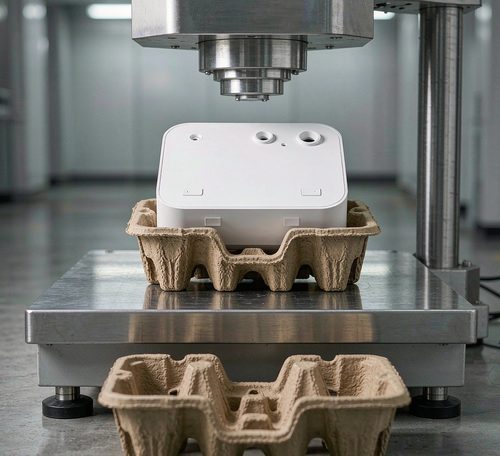
The mold cost covers the design work, CNC machining of the mold tooling, and the trial runs needed to get the mold dialed in and producing consistent parts. It's not just a block of metal, it's a precision-engineered forming tool built specifically to match your product's shape and cushioning requirements.
Beyond the mold, every production run also involves the raw pulp material cost, which depends on the paper stock used and how much of it goes into each tray. There's production labor and energy cost, since molded pulp manufacturing involves pressing, drying, and often trimming each piece. Many designs also need finishing steps, like additional drying cycles, surface pressing for a smoother finish, or a water-resistant coating depending on the application. And finally there's design and sampling cost, which usually happens once at the start of a project but can recur if the design needs revisions.
Mold Cost vs Per-Unit Cost Why the Math Changes at Scale
This is really the core of the whole question. Mold cost is what's called a fixed cost, meaning it doesn't change no matter how many units you eventually produce. Material, labor, and energy costs are variable costs, meaning they scale directly with volume and stay roughly the same on a per-unit basis whether you order a thousand units or a million.
Here's what that means in practice. If your mold costs, say, ten thousand dollars, and you're only ordering a thousand units for an initial trial run, that mold cost alone adds ten dollars to every unit. That's a real, meaningful number for a small trial batch. But if that same mold produces a hundred thousand units over the course of a year, the same ten-thousand-dollar mold cost now only adds ten cents to each unit. The mold itself didn't get cheaper. The order volume just did the work of spreading that fixed cost thin.
Comparison Table Mold Cost Share at Different Order Volumes
|
Order Volume |
Mold Cost Share of Total Unit Cost (Illustrative) |
Typical Stage |
|
500–2,000 units |
Can represent a significant portion of per-unit cost, often in the double digits percentage-wise |
Sampling / initial trial run |
|
10,000–50,000 units |
Drops substantially, generally into the low single digits as a percentage of unit cost |
Small-scale production |
|
100,000+ units |
Often becomes a negligible fraction of total unit cost |
Full-scale production |
Real Example Switching a Small Appliance Line to Molded Pulp Trays
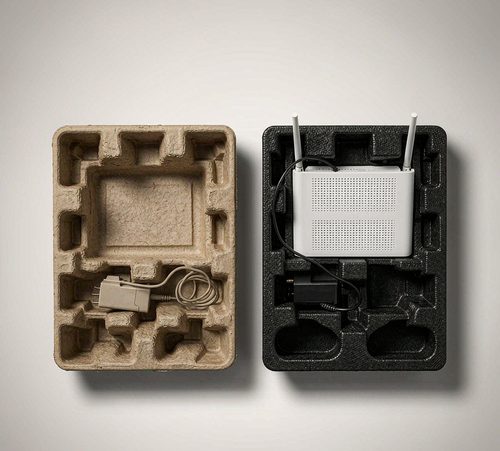
We've worked with small appliance clients making this exact switch, moving a vacuum cleaner accessory line from EPS foam to Molded Pulp Trays Eco-friendly. In the first few months after the switch, the client felt the packaging cost was higher than expected, largely because the mold investment hadn't been spread across enough units yet to make a real difference in the per-unit number.
By around the six-month mark, once order volume had stabilized into regular production runs, the mold cost's share of the per-unit price had dropped to a small fraction of what it represented during the initial trial batch, and the total packaging cost per unit ended up landing close to, and in some cases below, what the client had previously paid for EPS foam trays, once logistics savings from the lighter, more stackable pulp trays were factored in.
Molded Pulp vs EPS Foam Full Cost Comparison, Not Just Sticker Price
Comparing molded pulp and EPS foam purely on a per-unit sticker price misses a lot of the real financial picture. A more complete comparison needs to account for several factors beyond the unit price itself.
Logistics cost is one of the biggest overlooked factors. Molded pulp trays are generally lighter and stack more efficiently than bulky foam inserts, which can meaningfully reduce shipping volume and weight-based freight costs, especially on large export shipments.
Regulatory and compliance cost is another growing factor. Some regions have introduced restrictions or added environmental fees specifically targeting single-use foam packaging, which can add hidden costs to an EPS-based packaging strategy that don't show up on the initial material invoice.
Brand perception and customer experience matters too, even though it's harder to put a hard number on. Appliance brands increasingly find that sustainable, recyclable packaging plays well with end customers who unbox the product, and that goodwill has real, if less measurable, value.
Rollguard Molded Pulp When the Extra Structural Cost Is Worth It
Some product shapes need more than a standard flat tray design. Rollguard Molded Pulp refers to a reinforced structural design commonly used for cylindrical or roll-shaped components, things like motor housings, drum sections, or other rounded appliance parts that need extra cushioning support around their curved surfaces.
Mold tooling for this kind of reinforced design typically costs somewhat more than a standard tray mold, simply because the geometry is more complex to machine and requires tighter tolerances to hold the product securely. That extra tooling cost is usually worth it in practice, though, because a well-designed structural mold reduces shipping damage rates meaningfully compared to a generic tray that wasn't shaped for that specific product. Lower damage rates mean fewer replacement shipments, fewer customer complaints, and lower return processing costs, all of which offset the higher initial mold investment over time.
Common Mistakes When Evaluating Molded Pulp Packaging Cost
A few recurring mistakes show up when buyers evaluate molded pulp packaging costs:
Comparing only the mold quote, without calculating per-unit cost at realistic order volumes. The mold number alone tells you almost nothing about your actual long-term cost per unit.
Ignoring material weight and thickness trade-offs. Heavier paper stock generally costs more per unit but can also improve structural strength, and cutting material weight too aggressively to save cost can lead to weaker packaging and higher damage rates.
Overlooking logistics cost changes. Switching to lighter, more stackable pulp trays can reduce freight costs meaningfully, and skipping that calculation understates the real savings of the switch.
Treating trial-batch cost as representative of production cost. Small sampling runs will always show a higher mold cost share than full production volumes, and judging the whole project based on trial-run numbers leads to an inaccurate cost picture.
Industry Trends Why More Appliance Brands Are Moving to Molded Pulp
Appliance manufacturers globally have been steadily shifting away from EPS foam and toward molded pulp and other fiber-based packaging solutions, driven largely by tightening environmental regulations and growing consumer preference for recyclable, biodegradable packaging materials. Industry market reports covering sustainable and molded fiber packaging have generally pointed to continued growth in this segment, with electronics and appliance packaging cited as one of the categories seeing the fastest adoption of molded pulp as a foam replacement.
This shift isn't purely regulatory either. A growing number of retailers and e-commerce platforms are actively pushing suppliers toward more sustainable packaging as part of their own environmental commitments, which is putting additional pressure on appliance brands to make this transition sooner rather than later.
Regulatory & Sustainability Context for Packaging Material Choices
Several regions have introduced restrictions or additional environmental fees targeting single-use plastic and foam packaging, including certain EU member states and a number of individual US states, which can add real cost pressure to continued use of EPS foam packaging over time. These policies vary significantly by jurisdiction, so it's worth checking the specific regulatory environment in your target markets rather than assuming a blanket rule applies everywhere.
On the material side, molded pulp packaging is generally produced from recycled or sustainably sourced paper fiber, and can often carry certifications like FSC (Forest Stewardship Council) chain-of-custody certification when the pulp source is properly documented. That kind of verifiable certification is worth asking about directly, since it provides a real, checkable sustainability claim rather than a general "eco-friendly" label with nothing behind it.
What to Ask Your Supplier Before Approving a Molded Pulp Mold Quote
Before signing off on a mold quote, a few direct questions can help you evaluate the real cost picture rather than reacting to the mold number alone:
Does the mold cost include trial runs and a reasonable number of revision rounds, or are additional adjustments billed separately?
Who owns the mold once it's paid for, a dedicated mold built specifically for your product, or a shared mold used across multiple customers?
Can you provide a per-unit cost estimate at several different order volumes, so you can see how the mold cost share actually changes as your order grows?
Does the material weight and thickness match our product's actual weight and shipping conditions, or is the quote based on a generic template that might need adjustment?
If you're sourcing directly from a manufacturer or factory for a larger appliance packaging program, it's worth putting these questions into the RFQ in writing, since the answers usually reveal whether a supplier is quoting based on your actual product needs or working from a generic template.
F AQ
Q: Is mold cost the biggest expense in molded pulp packaging?
A: Only at very low order volumes. Once production reaches a reasonable scale, mold cost typically becomes a small fraction of total unit cost, with material, labor, and logistics accounting for most of the ongoing expense.
Q: How much does a molded pulp packaging mold typically cost?
A: Mold cost varies significantly based on design complexity, size, and the number of cavities in the tool, so it's best confirmed directly with your supplier based on your specific product design rather than assumed from a general range.
Q: Does molded pulp packaging cost more than EPS foam overall?
A: Not necessarily, once total cost is considered rather than just the sticker price. Lighter shipping weight, better stackability, and avoiding potential foam-related environmental fees can offset or even undercut the cost of continuing with EPS foam in many cases.
Q: How many units does it take to make the mold cost worthwhile?
A: This depends on the specific mold cost and per-unit material cost involved, but generally, once order volumes reach the tens of thousands of units, mold cost typically becomes a minor factor in the overall per-unit price.
Q: What affects molded pulp packaging cost besides the mold?
A: Raw pulp material cost, production labor and energy, finishing steps like drying or coating, and logistics costs tied to shipping weight and volume all factor into the total cost alongside the mold investment.
Q: Is Rollguard structural design worth the extra mold cost?
A: For cylindrical or irregularly shaped products, generally yes, since the improved structural fit typically reduces shipping damage rates meaningfully, which can offset the higher initial tooling investment through fewer replacements and returns.
Q: Are molded pulp trays actually eco-friendly and recyclable?
A: Generally yes, since molded pulp is typically made from recycled or sustainably sourced paper fiber and is both recyclable and biodegradable. Asking for FSC chain-of-custody certification is a good way to verify the sustainability claim rather than relying on general marketing language.
Q: Can I use a shared mold to reduce upfront cost for a smaller order?
A: In some cases, yes, if a supplier offers a shared or semi-custom mold design that fits your product dimensions closely enough. This can reduce upfront tooling cost for smaller orders, though it typically offers less design flexibility than a fully dedicated mold.