
一, Changing the material: complete chain reinforcement from fiber properties to chemical additives
1. Fiber orientation technology: rebuilding the microstructure
You may greatly improve the mechanical qualities of molded pulp by manipulating how the fibers are arranged. For instance, Lenovo utilizes a fiber-oriented layout algorithm to make computer cushioning packing 40% stronger while using 15% less material. This method mimics how natural fibers crystallize by lining them up in an organized way in the stress direction to make a "mechanical reinforcement channel." Samsung has used nanoscale fiber orientation technology to make mobile phone packaging 50.6% more durable and 30% less likely to break down over time.
2. The synergy between fiber compounding and reinforcing agents
Different fibers can work together to make a material function better than it could on its own. Studies indicate that combining broad-leaved wood pulp and bagasse pulp in a 1:1 ratio enhances the tensile index, burst index, and stiffness of pulp molding materials by 22.0%, 65.8%, and 12.4%, respectively. Mineral fiber reinforcing technique may also give large home appliance packaging material support by giving it a tensile strength of 16.51 MPa and an elastic modulus of 535 MPa. A certain firm made a pulp tray for freezers that can now hold 220 kilograms instead of 150 kilograms. This is because they included 20% mineral fibers.
3. Changing the way chemical additives work
Waterproofing agent: By adding aluminum sulfate or paraffin lotion, you can make a hydrophobic layer on the fiber surface that cuts down on water absorption from 15% to less than 3%. In a room with 90% humidity, a certain air conditioning manufacturer uses micro silica coating technology to keep 85% of the packaging's original strength.
Cationic starch makes fibers stick together better by forming hydrogen bonds. Adding 1% can make the tensile strength go up by 30%. Epoxy-coated sodium bicarbonate microcapsules form a microporous structure by releasing gas, which makes them lighter and better at compressing.
Graphene conductive coating is an antistatic compound that keeps the surface resistivity between 10 ⁶ and 10 ⁹ Ω/sq, which stops static electricity from damaging electronic parts.
二, Structural Design: New Ways of Doing Things from Bionics to Topology Making the best use of
1. New ideas for three-dimensional geometric shapes
The honeycomb structure looks like the hexagonal unit arrangement of a honeycomb, which may spread out outside stresses uniformly. For example, a company made a pulp lining for washing machines that has a honeycomb unit layout. In a 1-meter drop test, this lining lowers the product's peak acceleration by 27% without damaging the structure.
Hollow cavity and reinforcing ribs: Molds are used to make cavities and vertical ribs inside the product, which makes it stronger against bending. The cavity design of a certain hanger mold has more than doubled its load-bearing capacity, and the high-temperature and high-pressure composite of the multi-layer composite structure has enhanced its compressive strength by 30% to 50%.
Structure of gradient density: The package surface density is high to resist impact, and the inside density is low to absorb energy. This is done via density gradient control technology. With this technique, Apple has made phone packaging 20% thinner while keeping the same level of protection.
2. Optimizing topology and designing things that look like living things
Biomimetic use: To make pulp materials that can mend themselves, copy the way chitin fibers are knitted together. Fibers can partially regain their strength by hydrogen bonding recombination when they are injured in a certain area.
Algorithm for optimizing topology: Using computer simulations to improve fiber distribution so that the material is denser in regions where stress is high. A business made packaging for TVs that enhanced the density of the area by 20% through topology optimization. This cut the drop and damage rate from 1.2% to 0.3%.
三, Process optimization: exact control over everything from molding settings to drying technologies
1. Making the molding process parameters better
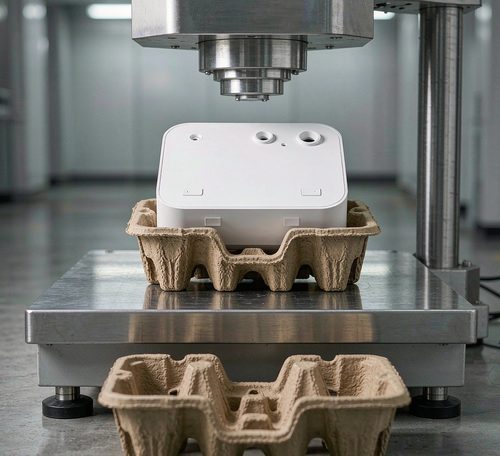
Temperature and pressure of the mold: Raising the mold temperature to the right level (180–250 °C) can speed up the evaporation of water and encourage hydrogen bonding between fibers. Raising the molding pressure (5–10MPa) can make the fibers more closely organized. Through process improvement, a specific company has increased the density of pulp trays from 0.4g/cm³ to 0.7g/cm³ and made them 60% stronger against compression.
Time for vacuum adsorption: If you increase the vacuum adsorption period from 3 seconds to 8 seconds, the fiber deposition will be more even and there will be fewer weak spots. The packaging for a certain microwave oven has been changed so that it can hold 18 layers instead of 12.
2. New ways to dry things
Microwave drying: heating the inside and outside of the product at the same time with microwaves, which lowers stress concentration. After a certain business started using microwave drying, the warpage rate of packing went down from 5% to 0.5%, and the strength went up by 15%.
Combining the penetrability of infrared with the uniformity of hot air, infrared hot air composite drying increases drying efficiency by 40% while keeping the fibers' elastic modulus.
四, Composite Technology: Moving from single materials to system solutions
1. Composite of pulp and plastic
Surface coating: To make a layer that won't wear away, spray water-based polyurethane or acrylic lotion on the pulp surface. Through this technology, one company has tripled the wear resistance of its packaging and made it last five years longer.
Embedded injection molding: Putting plastic reinforcement ribs within pulp structures to make a hybrid load-bearing system. The packaging for a certain refrigerator has been made such that one tray can hold more weight, going from 200 kilos to 350 kilograms.
2. Composite of pulp and metal
Composite aluminum foil layer over the top of pulp can make it better at both waterproofing and shielding against electromagnetic waves at the same time. This method has made the packaging for a high-end TV IPX7 water-resistant and passed EMC testing.
Steel skeleton reinforcement: putting steel frames into heavy-duty packaging to make a "soft hard" bonding structure. This design has cut the rate of breakage during shipping for a given air conditioner's outdoor unit from 2.1% to 0.1%.