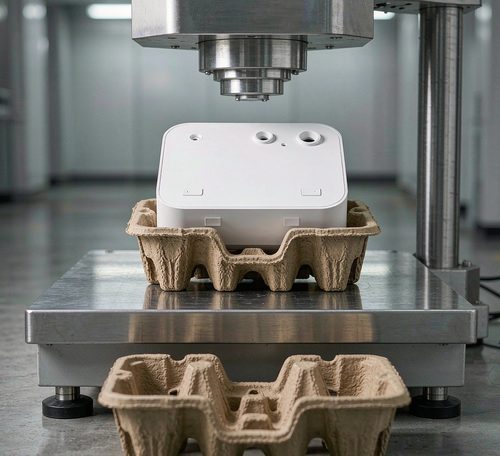

With the emphasis on and development of the environmental economy, the innovation of the pulp molding industry has been promoted, and the improvement of the people's material and cultural living standards has put forward new requirements on the pulp molding industry, which has promoted the increase in the number and variety of pulp molded products. Increase and improve quality. To make high-quality pulp molded products, it must be equipped with high-quality fibers, because this is the main raw material. In order to save costs, we usually use waste paper to beaten pulp. Statistics in the packaging industry show that more than 60% of waste paper is reused multiple times, and the fiber becomes very short. The binding capacity is relatively much lower. How can fiber make high-quality products?
Now we rely on the research and development results of Central South University, combined with the actual production experience of our Hedong Paper Support Plant, to develop a pulp that combines short waste paper fibers and specially processed cotton long fibers (usually 3-9mm in length). Through this combination, the combination of length and short length is achieved, which increases the binding capacity of pulp fibers, thereby improving the toughness and strength of the pulp molded product, which is 20%-30% higher than the product made of waste paper pulp alone. However, the cost has been reduced, and the savings ranged from several hundred yuan per ton. This is the benefit of science and technology.
The ratio of combined fiber: waste paper fiber (70-80% of the total weight is beaten with 1:100 water)
Special cotton fiber (20-30% of the total weight be beaten with 1:250 water)
The composition of the SL modifier is the co-clustering of starch acrylamide and the composition of polyacrylamide. The modified product of natural products is an environmentally friendly modifier. It is also used in high-end writing paper and binding paper.
Two kinds of fiber mixing and beating
When beating, add an appropriate amount (1-10%) of a professional SL modifier for pulp molding.
The SL modifier series is a product produced by using imported raw materials and the latest achievements developed by Central South University. It is a new generation of multifunctional pulp and paper additives that have widely replaced cationic starch and polyacrylamide in the world. Its mechanism of action is: SL can form a bridge through chemical action in the pulping process, so that long fibers and short fibers "implicate" each other to increase the strength of pulp and paper; in addition, the cationic groups of SL and the anions in the fine fibers of the pulp The groups and short fibers form aggregates through absorption, and settle on the surface of the paper mold product and the paper sheet, thereby increasing the surface strength, thus eliminating the phenomenon of hair removal and powder loss; because electrical packaging cannot have hair removal and falling Powder phenomenon, if hair removal or powder loss, the anions carried by the dust will cause electrical short circuits. The quaternary amine group in the SL modifier can reduce the surface tension of aggregates and fibers, reduce the degree of contact with water molecules, make it easier for water molecules to leave the mesh under stress, and significantly improve the water filtration performance of the slurry.