
1. Processing raw materials: turning trash into fibre pulp
Moulded pulp packaging is made from a lot of different things, like sugarcane bagasse, wheat straw, bamboo, discarded newspapers, and cardboard box scraps. Sugarcane bagasse is a good example of a material that is good for manufacturing high-end packaging since it has a reasonable fibre length and a high strength. To process the raw materials, you need to do the following:
Sorting and crushing: The raw materials are put into a hydraulic pulper after being manually or mechanically screened and cleaned of contaminants like plastics and metals. This machine uses fast-moving water and the force of an impeller to break down cardboard into a fibrous mixed slurry in 5 to 8 minutes. When working with a 60kg dry pulp board, for instance, it is important to keep the soaking period between 5 and 10 minutes so that the fibres are completely separated.
Screening and cleaning: A sieve is used to screen the crushed slurry to get rid of sand and other large pieces that haven't been crushed. Some procedures will use centrifugal purification equipment to extract pollutants with a higher density and make the slurry cleaner.
Combining and mixing: Food-grade additives are added to the slurry based on how well the product needs to work, including being waterproof, resistant to oil, and flame-resistant. For instance, waterproofing additives can make packaging more stable in humid conditions, and oil repellent agents are good for food contact situations. To get the best moulding effect, the slurry concentration should be between 0.5% and 2% after mixing, and the pH value should be between 4.5 and 5.0.
2. The process of forming involves depositing fibres in three dimensions and shaping their structure.
The most important step in making pulp packaging is forming, which is when fibres are placed on the mold's surface through physical adsorption or mechanical pressure to make the required shape. Vacuum forming, compressed air forming, and grouting forming are all common ways to do this.
To vacuum form, put a porous metal mesh mould in a slurry and use a vacuum pump to suck air out of the mould cavity. This will equally spread the fibres in the slurry over the surface of the mesh mould. Take the mould to the drying station when the fibre layer is 2 to 3 mm thick. This approach works well for thin-walled, high-precision items like phone liners and headphone cases.
How to make things with compressed air: It uses compressed air as a power source to speed up the deposition and drying of fibres on the mold's surface, which is different from vacuum forming. This method is more efficient for making things, but to avoid uneven fibre distribution, you need to be very careful about the air pressure and slurry flow rate.
How to mould with grout: For items with complicated shapes or standardised batches (like dinnerware), a quantitative pump sends the slurry into the sealed mould cavity, and the fibres are put in place by mould pressure and gravity. This method can cut down on slurry waste, but the mould is rather expensive.
3. Shaping and drying: turning a damp billet into a strong structure
The created wet billet has a lot of moisture in it, up to 70% to 80%. To get rid of the moisture and make the fibres stick better, it needs to be dried and heat pressed. There are two types of drying: drying in a mould and drying outside of a mould.
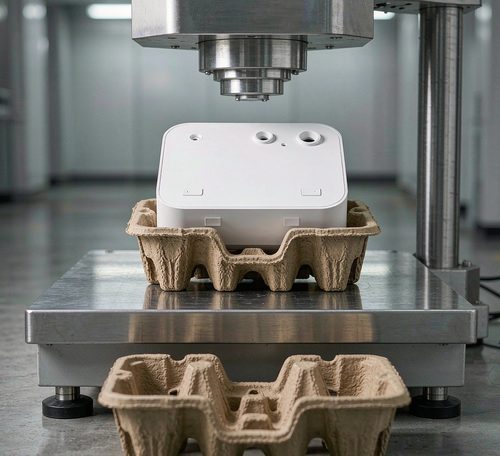
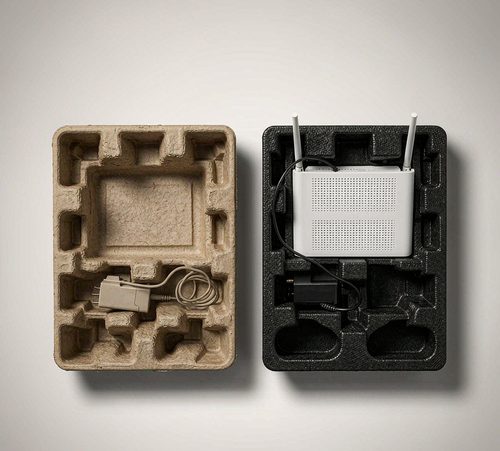
When using the wet pressing method, the wet billet is put straight into the hot pressing mould, where it is dried and shaped at the same time at a temperature of 180–220 °C and a pressure of 0.4–0.6 MPa. This technology is commonly used for packaging high-end electronics since it has a rapid production cycle (approximately 30–50 seconds per piece), a flat surface, and great dimensional precision. For instance, the Lenovo ThinkPad X1 series has a pulp-molded lining that uses the wet pressing method, which makes it 30% stronger than the dry pressing method.
External drying (dry pressing method): Wet blanks are dried to a moisture content of 15% to 20% using a drying oven or solar energy. Then, they are shaped by hot pressing. This approach doesn't require a lot of equipment, but the product shrinkage rate is rather significant (up to 5% to 10%), thus it's best for low-end items like egg trays and fruit trays.
4. After processing: Final tweaks to improve accuracy and usability
To make sure the product meets quality standards, it needs to go through stages including cutting, inspecting, disinfecting, and packaging once it has dried and been shaped.
Edge cutting and shaping: Using lasers or machines to chop out burrs from items and hot pressing moulds to fix distortion. For instance, the cutting accuracy of high-end headphone packaging needs to be kept between ± 0.1mm to minimise gaps in the assembly.
Surface treatment: Printing, laminating, or dyeing as needed. Water-based ink printing may provide beautiful patterns in many colours, and PLA film coating can make packaging more resistant to moisture. Some products will also use transfer printing to print complicated logos on surfaces that aren't even.
Quality control: Machines are used to check the size, strength, and cleanliness of products. For instance, you could use a compression testing machine to see if the packing can handle a 1.5-meter drop or gas chromatography to find dangerous material residues.
5. Process innovation: the main thing that makes industries better
With new technology, the process of making moulded pulp packaging is becoming smarter and more efficient:
Closed loop circulation system: Some companies utilise water circulation and pulp recovery technology to clean up production wastewater and use it again to make pulp. This cuts down on water use by more than 30%.
Digital mould design: Using CAD/CAM technology to improve the structure of moulds so that fewer trials are needed. For instance, it now only takes 18 days to make packaging moulds for the Huawei Mate 60 Pro instead of 45 days.
Adding nanocellulose to packaging can make it 40% stronger and use less raw material. Through this technology, Sony's bamboo fibre packaging at the 2025 CES presentation can withstand 120 kPa of pressure.