
一, The main elements that affect the design of thickness
1. Requirements for the weight and drop impact of the product
ISTA 3A is an international standard for testing the packing of electronic products for shipping. The standard drop height is between 0.8 and 1.2 meters. Experimental data indicates that when a mobile electronic device, weighing 1.6N, descends from a height of 1 metre, and the requisite impact acceleration remains below 25g, the subsequent requirements must be satisfied:
Elastic coefficient requirement: The elastic coefficient of pulp moulding must be 12N/mm or higher. This can be done by making the thickness thicker or changing the support rib structure.
Relationship between thickness and load: Pulp moulded structures that are 1–2.5mm thick can hold static loads of 50–120N, making them good for lightweight electronics like tablets and mobile phones. For heavier items like laptops (3–5kg), products made with the wet pressing process that are 2–3mm thick should be used, or cushioning performance should be improved through laminated design.
2. Type of process and optimisation of structure
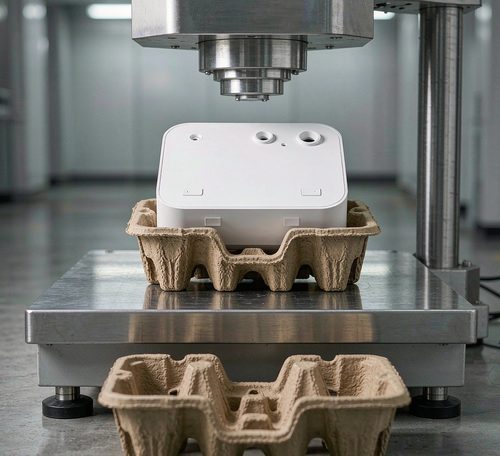
The thickness is greatly affected by the different moulding processes:
Wet pressing process: High-pressure moulding makes the fibres denser, and the product is usually between 0.5 and 2mm thick. The packaging for the Sony Xperia 1 V phone, for example, is made of 0.8mm wet pressed pulp and has a honeycomb-shaped support rib design. This lowers the rate of damage to the parts from 8% to 0.3% during drop testing.
The dry pressing method uses hot-pressed cured fibres to make a product that is generally 1.5 to 3 mm thick. Lenovo laptop packaging uses 2mm dry pressed pulp moulding and gradient flow channels to improve fibre dispersion. This makes the product 20% tighter and the surface flatness error less than 0.08mm.
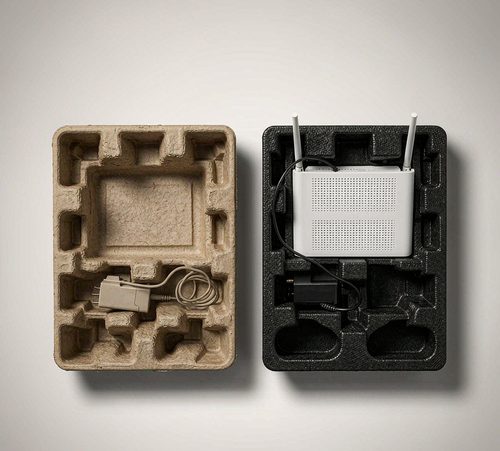
For heavy-duty electronic equipment like servers and industrial instruments, pulp moulding with walls that are 4 to 12 mm thick is needed. A company has made 10mm thick tray packing that has been treated with chrome plated coating moulds. This has lowered the cost of shipping each piece of equipment by 15% and raised customer satisfaction by 12%.
3. Balancing costs and space limitations
When packaging ultra-thin electrical items like smartwatches and headphones, the thickness must be kept to within 3mm. The packaging for Apple Beats Studio Pro earbuds is composed of 0.3mm nanocellulose reinforced pulp moulding. This design has a microporous array with a pore size of 0.2mm, which increases the energy absorption rate by 40% while still being lightweight. Also, by employing modular design (such snap connections instead of glue), the thickness of packing parts can be cut by 30%, and the recycling rate can go up to 82%.
二,Standards for industry thickness and common cases
1. Standards and testing rules that are used around the world
ISTA 3A standard: The package must not let the product accelerate more than 25g when dropped from a height of 0.8 to 1.2 meters. A business produced a 1.5mm thick pulp moulded package to meet this criterion. They used simulation to improve the layout of the support ribs, which led to a 99.7% pass rate for mobile phone packaging in the 1.2-meter drop test.
GB/T 10739 Environmental Testing: The sample must be pre-treated for 24 hours in an atmosphere with a temperature of 23 °C ± 1 °C and a relative humidity of 50% ± 2%. By managing the moisture level of pulp moulding (4% to 12%), a certain business has made its products 50% more stable in circumstances where the humidity changes.
2. Business Practice and New Ideas
Lenovo's strategy to replace plastic: Use 1.5 to 2 mm thick pulp moulding instead of plastic cushioning in laptop packing. This will lead to performance breakthroughs through the following changes:
Fibre ratio optimisation: Add 30% long fibres to make the skeleton structure, and combine high velocity mechanical pulp (TMP) to make the fibres interweave better.
Use of Enhancer: Adding 0.2% PAM solution to make a network membrane structure cuts chip shedding by 86%;
Upgrading the hot pressing process: Using a combination of 180 °C, 0.5 MPa, and 40 seconds, the product's tightness is raised by 20%, and the inaccuracy in surface flatness is less than 0.08 mm.
Apple's new Fibre Aesthetics: The packaging for the Beats Studio Pro headphones is made entirely of fiber-based materials (bamboo fibre and sugarcane bagasse fibre). This design strikes a compromise between robustness and accuracy:
Nanocellulose as a support: Adding nanocellulose (50–100 nm in diameter) makes the material 50% stronger under tension.
Micro porous structure design: Honeycomb cells that are 0.3 mm apart are employed to partition the region. This lowers the damage rate from 8% to 0.3% during drop testing.
Modular manufacturing: Using CNC precision machining moulds guarantees that the packing size is accurate to within ± 0.05 mm, which makes it easy to put together with the product.