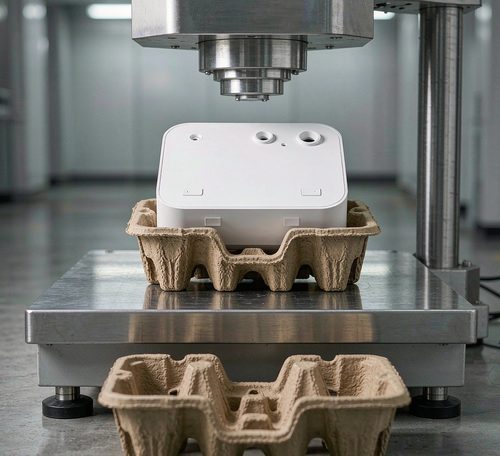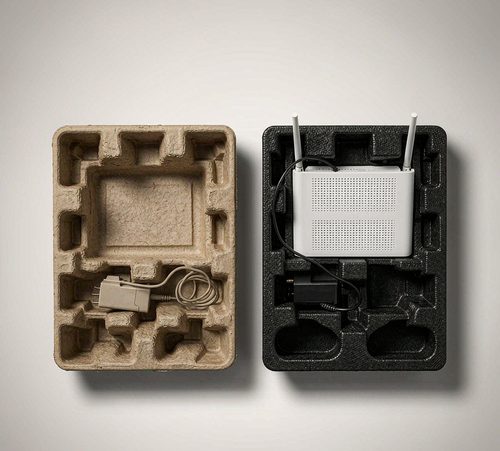

The raw material of the paper tray is only about 1% of the pulp of the paper fiber. The moisture content of the wet paper sheet after forming is reduced to 55% by the mechanical pressing method, and the moisture content of the paper tray after forming is as high as 65%-75%, which makes it difficult to pass Mechanical methods reduce the moisture content. In the production process of the paper tray, every kilogram of the finished paper tray is dried. About 3.5-4.5 kg of water should be removed in the process, which is of great significance for improving drying efficiency, reducing production costs, and improving the quality of paper trays.
The wet paper mold with paper fiber as the main component is a porous object with capillary structure inside. Water exists between the surface of the fiber and the pores of the fiber capillary.
Paper tray products used in product inner packaging usually need good dynamic cushioning properties, and the moisture in them cannot be completely mechanically suppressed.
It can be removed by pressing it, and it needs to be removed in a dry manner. Therefore, compared with the traditional paper drying process, the dry strength of pulp molded products is very high.
On the one hand, hot air serves as a heat source to provide energy to remove moisture, and on the other hand, it acts as a moisture carrier to remove continuously evaporating moisture. The water removal under the wet pressure paper support depends on the internal and external diffusion of water. The so-called internal diffusion refers to the migration process of moisture from the inner to the outer surface under the wet pressure paper support.
External diffusion refers to the process by which water is carried away after evaporating from the surface. The drying rate of the paper support depends on the speed at which the water diffuses inside and outside and the balance between the two. Reasonable process conditions should be formulated around the above two aspects and the drying performance of the paper tray product!