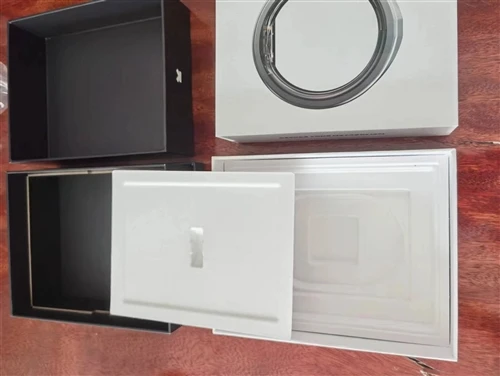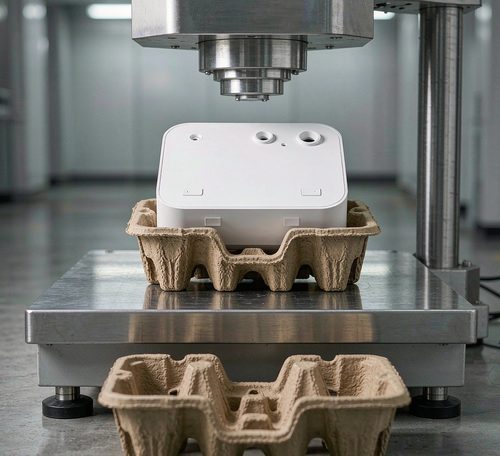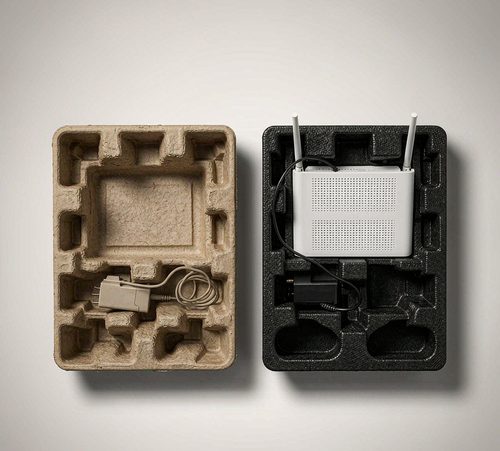

The tray is currently a new type of packaging that is very environmentally friendly and practical. Therefore, products in many fields have gradually begun to use paper trays as packaging, and paper tray packaging usually needs to be customized according to your own products. Below, Kunbaoda will share with you the common problems of packaging paper tray customization customers!
Wrapping paper tray
Why can't you or you can't make the color I need?
In packaging dyed paper trays, water-based dyes are mostly added to the pulp preparation process on the basis of the original pulp. First of all, the concentration of the dye changes with the concentration of the pulp during the production process. Secondly, most dyes are very sensitive to temperature (during the drying process, the color also changes with the temperature of the drying line. In the process of hot pressing and shaping, the temperature of the mold changes between 150 ~ 250 ℃. In short, Products with higher color requirements should not be dyed.
Why are there slight cracks on the surface of this product?
When the product is molded, the pulp fibers are naturally absorbed layer by layer, and the liquid pulp cannot flow out in some grooves, which causes the thickness of the paper tray to be different from the design standard thickness after drying. When the product is squeezed by a strong external force during high pressure forming, the fibers at the outermost layer with uneven inner and outer thickness will break and small cracks will appear from the surface. This phenomenon will not affect the packaging strength of the paper tray, so it is acceptable in the industry
Why can't I add a button to fix my product?
For the product, the mold is closed up and down during the molding and shaping process, and there must be a certain draft angle. During the molding process, the wet product cannot be separated from the mold, so the paper tray cannot be designed with a retreat position.
Why is there a big difference between different hardness paper trays?
The basic shock-proof and buffering principle of the paper tray is realized by using the loop structure and the position of the reinforcing ribs, so different design structures of the same size will have different shock-proof strength and feel different. Different sizes are used for the same type of mold, because the length and shrinkage characteristics of the pulp fibers will also reflect different hand feelings. Therefore, before selecting raw materials and design schemes, we should let engineers understand the seismic standards that need to be met, so that different loop structures and reinforcement positions can be designed according to seismic requirements.
Why are there uneven burrs around the flanging product?
The flanging structure product is formed with flat edges. When a vacuum is formed to absorb the pulp naturally, the edge of the mold is a stainless steel filter screen, and the edges of the agglomerated pulp fibers after being adsorbed will be irregular cotton wool, which is formed due to an uncontrollable process. After forming and flanging, the burr will turn to the side, which will not affect the packaging and will not be used as an industrial production control element. If customers have high requirements for this, they can use trimming and die-cutting to remove burrs.
Many customers don't know much about paper tray customization, so they will ask more questions about quality production during the customization process. As a large-scale paper tray manufacturer in China, Kunbaoda has a number of large-scale production lines and mature technology, which can provide high-quality packaging paper trays for products in various fields!