
一,Technical feasibility: Moving from buffering performance to functional integration
1. A big improvement in how well buffering works
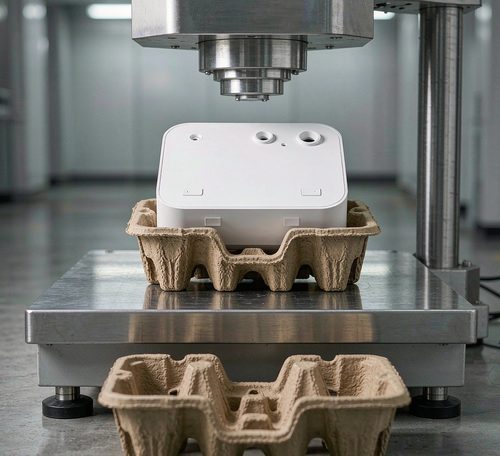
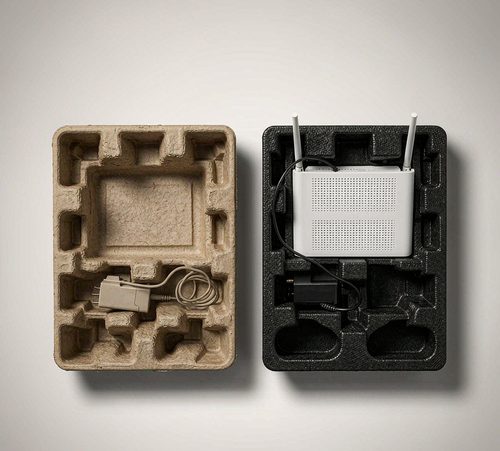
EPS foam plastic is widely used to package home appliances. It is light and provides good cushioning, but it is hard to break down and pollutes the environment a lot during manufacture. Wet pressing and semi-dry pressing are two ways that molded pulp might get buffering performance that is similar to EPS. For instance, the Huawei Mate 60 Pro phone liner is made from pulp that has been wet pressed, which makes the fibers line up and the density spread out in the best way possible for drop testing and to safeguard delicate electronic parts. Lenovo laptops have been slowly replacing the plastic in laptop cushioning packing with pulp molding. By 2024, the company plans to have completely replaced the plastic, proving that it can be used for large-scale home appliance packaging.
2. New ways to use functional integration
Molded pulp is a technological development that goes beyond only cushioning performance. The design of composite functional layers has made it possible to use it in more places, like for moisture-proofing, anti-corrosion, and smart monitoring.
How to keep moisture and rust from happening: Using chitosan stearic acid double-layer coating technology, the oil resistance level of pulp molding reaches level 12. After soaking in 95 °C hot water for 30 minutes, there is no leakage. This means that it can be stored and transported for a long time in household appliances like refrigerators and washing machines.
Smart packaging: The pulp matrix has natural pigment strips in it that change color based on pH. The pigment strips change from green to yellow as moisture in the appliance makes acidic chemicals. This lets you see how the product is doing; With a simple sensor circuit printed with biodegradable conductive paste, data like storage temperature and transportation time can be read by NFC sensing on mobile phones. This makes it possible to trace high-end home goods.
3. Structural design that is flexible
A 3D honeycomb bubble composite construction can protect a zone with molded pulp. The gradient density buffer layer was designed because TV screens are easy to break. The outside layer is made of high-density fiber that absorbs impact force, and the interior layer is made of low-density structure that spreads energy. This makes the energy absorption rate 89J/g, which is 40% greater than typical EPE foam. Also, its capacity to be molded helps integrated design, cuts down on the amount of packaging parts, and minimizes the cost of putting things together.
二, Cost-effectiveness: long-term benefits and short-term problems that go hand in hand
1. The cost benefit of raw materials
The major raw materials for molding pulp are agricultural waste like sugarcane bagasse, bamboo fiber, and waste paper. They are cheaper than virgin polymers. For example, in Guangxi in 2023, sugarcane bagasse will make up 12% of the principal pulp used, and bamboo pulp will make up 2%. It has a moderate fiber length and great mechanical qualities, so it may replace some wood pulp and lower the cost of raw materials. Also, the growth of global pulp molding capacity (with China's capacity making up 40.5% of the world's total by 2025) has made economies of scale even more important. It is projected that manufacturing costs will drop by 15% to 20% over the next five years.
2. Costs of production and running
A comparison of energy use: Compared to typical plastic injection molding, the dry pressing process uses 30% less energy. The wet pressing process, on the other hand, improves the process by drying the mold, which makes it 40% more efficient. But semi-dry pressing and direct pressing still use more energy than plastic molding, thus thermal energy recovery technologies need to be used to make them better.
Investment in equipment: The molded pulp production line made in the country is now fully automated. It can make 22,000 tons of product per year on one line, and the investment payback period is only 3 to 5 years, which is similar to plastic packaging equipment.
三, Benefits for the environment in the long run
Compared to plastic, molded pulp has 60% less carbon emissions during its whole life cycle. It is also compostable and biodegradable, which keeps microplastic contamination from happening. Changhong Electric used pulp molding for its air conditioning packaging, which cut costs by 20 million yuan per year, cut down on white pollution, and opened up a "green channel" for export items.
3. Market acceptance: two things that affect consumer preferences and brand strategy
1. More people are aware of how to safeguard the environment.
Research shows that 72% of people are willing to pay more for eco-friendly packaging. They also care more about the sustainability of home appliance packaging than 3C products. Molded pulp is made from natural materials and is biodegradable, which meets consumers' expectations for "zero pollution." This is notably true in Europe and the United States, where more than 85% of people are willing to buy it.
2. Requirements for brand image and compliance
The EU Directive on Scrap Electrical and Electronic Equipment says that more than 60% of the packaging for household appliances must be recyclable. China's 14th Five Year Plan for the Development of Circular Economy also clearly supports biodegradable packaging. International firms like Apple and Sony are the first to use pulp molded packaging. Domestic companies like Xiaomi and Huawei have used case studies to show off their green image and make themselves more competitive in the market.
四, Policy Environment: Required Change Due to Global Plastic Ban
1. Pressure from international policies
The EU Carbon Border Tax (CBAM) says that imported goods must have complete lifetime data traceability. Molded pulp has a carbon footprint that is 40% lower than that of plastic, which can assist enterprises avoid tariff issues. The United States put a 400% anti-dumping duty on Chinese pulp molded products. This made American companies use their global production capacity in places like Türkiye and Mexico.
2. Support for domestic policy
As part of its 14th Five Year Plan, China has named pulp molding as a major development material and is offering tax breaks and grants. For instance, starting in 2021, enterprises who use eco-friendly packaging would get a maximum subsidy of 30% to encourage technological progress in the industry. In Guangxi, Jiangsu, and other areas, industrial Internet of Things platforms have been set up to keep track of carbon credits with blockchain technology. This helps businesses make more money by exchanging carbon credits.
五, Problems and how to deal with them
1. Technical roadblock
Not enough heat resistance: The current maximum temperature resistance for molded pulp is 120 degrees Celsius, which is not high enough for packing high-temperature home appliances like ovens. To improve performance, it is required to use nanocellulose reinforcement or combine it with biobased polymers.
Not having standards: China hasn't made any national standards for pulp molding yet, thus the quality of the products is not always the same. We need to speed up the process of writing technical standards for things like flame resistance and moisture resistance, and increase the bar for the industry.
2. Working together in the supply chain
The availability of agricultural waste raw materials changes with the seasons, hence a system for storing raw materials across regions needs to be set up. At the same time, work with household appliance firms to make designs stronger and cut down on the time it takes to produce new products.
3. Teaching the market
People still think of pulp molding as a "low-end alternative," therefore it's important to use case studies and brand links to make it clear that it is "high-end, environmentally friendly, and technological."