
Pulp molding compound
In the early years, pulp molding products generally used waste paper as the base material, and used special equipment and molds to carry out three-dimensional modeling through a common process to produce packaging products and objects of various shapes. Pulp molding products first started from the transport packaging used for eggs, fruits and other agricultural and sideline products, and gradually expanded the scale of use and research. Nowadays, high-quality paper-plastic products made of reeds, straw husks, sugarcane, wheat straw, bamboo, wood, etc. are used more and more widely, and there are protective packaging for industrial products, such as: electronic products, household appliances, exteriors, glass ceramic products , small machinery, etc. There are also high-quality paper-plastic retail packaging for consumer durables. Pulp molding mainly uses low-cost renewable and recyclable fiber-based natural materials as raw materials to produce high-value and environment-friendly packaging products. Its appearance greatly reduces the use of foamed plastics. Environmental pollution At the same time, it has opened up a new broad road for the recycling of waste paper.
The production process of pulp molding products
1. Pulping → pulping → pulping process
Using reeds, straw husks, sugarcane, wheat straw, bamboo, wood and recycled paper as raw materials, through pulping, refining and other processes, it is turned into fibers, suspended in water, and constitutes pure pulp. According to the characteristics of the final product, it can be In the process of pulping → pulping → pulping, control the length of the pulp fiber, the concentration of the pulp, add functional additives (brighteners, water repellents, etc.), dyes and other auxiliary operations, and the final composition can meet the Produce the required pulp.
Equipment used: pulper, mixing tank, pulping tank, etc.
2. Forming process
The molding process of pulp molding products is mainly through a series of methods such as vacuum forming method and grouting method, so that the original pulp fiber is formed into the shape planned by the mold; among which the vacuum forming method is the most commonly used and the most efficient method.
Equipment used: molding machine
3. Drying process
The drying process is mainly that the drying machine uses fuel, oil, gas, electricity or steam, heat transfer oil or other medium as a heat source, heats the air, dries the molded pulp products in hot air, and uses a fan to extract the evaporated products. Moisture for fast drying effect.
Equipment used: drying machine (heating method: gas, fuel oil, steam, electric heating)
4. Plastic trimming process
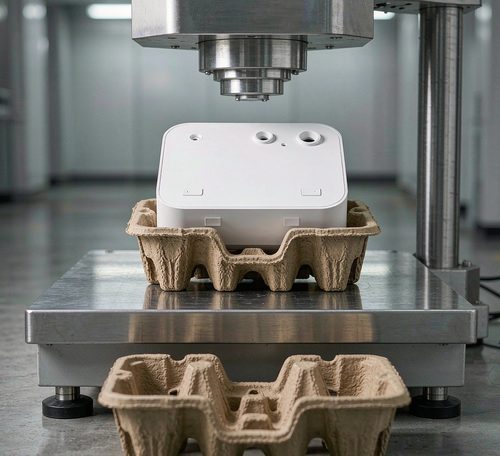
After the pulp product is formed and dried, it has been basically shaped, and then the heating plate is heated by electric heating or other heat medium (such as heat transfer oil), so that the pulp product mold has a higher temperature (150 ~ 250 ℃), using air pressure Or hydraulic pressure, press the paper support product under high temperature and high pressure to make the shape neat and beautiful, achieve better toughness, and have better shock resistance.
Equipment used: shaping, trimming machine
5. Packing
Inspect, pack and store the products that are finally produced through a series of processes. According to the characteristics of different products, manual packing or automatic packing machine can be used for counting and packing.
Equipment used: Active baler
Pulp molding products have the following characteristics
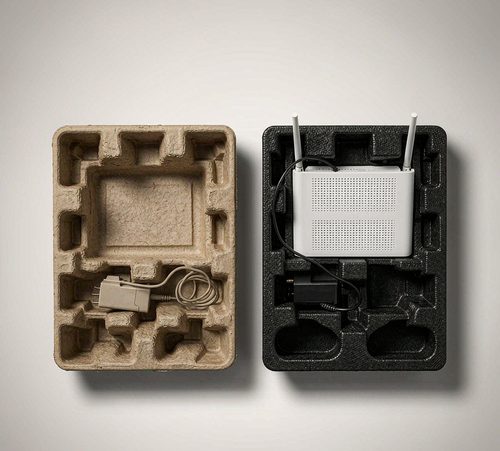
1. It can form products with various specifications and shapes through molds, so that it can adapt to the packaging needs of products of various shapes, facilitate blocking and positioning, and prevent bumps.
2. The paper is light and soft, and the overall structure has suitable strength and rigidity, which makes it excellent in protection and cushioning.
3. It has ideal ventilation and moisture absorption, which is conducive to the preservation of food. As long as an appropriate amount of water repellent is added to the slurry, the paper molded products can obtain excellent water resistance; for example, egg trays and fruit trays can be filled with water at a temperature not higher than 35 °C within 24 hours. The inner packaging of general industrial products does not need to have this function, because waterproofing should be a requirement for storage, transportation and outer packaging.
4. Pulp molded products can be flame-retardant, anti-static, waterproof, film-coated, printed, and used in terminal retail packaging as required.
5. In terms of protective packaging, pulp molded parts have many advantages over EPS, EPE, and EPP buffer parts:
A. The raw materials of pulp molding packaging products are waste paper and various fiber materials, which are widely sourced and easily collected, which will not hinder the environment and recycling, and is conducive to product export. And foamed plastics are derived from petroleum products, and resource depletion and price problems will become more and more serious.
B. Pulp molding packaging products are widely used in a wide range of applications, and the products that use foam as inner lining can basically be replaced by pulp molding products. Pulp molding products can be stacked and stored, which is 1/2~2/5 less than the storage space occupied by foamed plastics, and the freight and storage costs are smaller.
C. Paper products have good anti-static properties, and foamed plastics are prone to static electricity due to friction, which has a good protective effect on electronic products and home appliances.
D. When plastic products are packaged, the moisture of food is not easy to evaporate, and it is easy to mold and rot, while paper products have the function of water vapor permeability, and then achieve anti-corrosion effect.
E. Now, paper moldings are cheaper than foam plastics in terms of specific packaging costs.
6. The raw materials are extensive and can be used as waste, with significant social benefits, and the recycling rate of products is high. No matter the waste products in production or the finished products after use, they can be used as raw materials for remanufacturing.
Development Status of Pulp Molding
The market for pulp molding packaging materials is quite mature. At present, three pulp molding technology development centers in the Pearl River Delta, Yangtze River Delta and Beijing, Tianjin and Dalian regions have been formed in China. Especially since 2001, related enterprises have increased by 20% every year. At that time, the development level of domestic pulp molding technology was close to that of foreign countries, and many domestic pulp molding manufacturers were able to develop corresponding equipment, special processes and auxiliary materials to manufacture medium and high-end paper-plastic packaging products.