The Case for Molded Pulp Packaging in Precision Hardware: Material Performance, Drop Testing and Sustainability Benefits
For decades, precision hardware and metal component påckaging has been dominated by PVC/PET blister trays, EPS/EPP foam inserts, and injection-molded plastic trays. But as environmental regulations tighten and raw material costs fluctuate, more precision manufacturers are turning to molded pulp (molded fiber) packaging. This article examines molded pulp's suitability for precision metal parts across five dimensions: material properties, drop-impact cushioning (including real lab test data), part-nesting efficiency, tooling cost, and environmental compliance - drawing on published material data and a first-hand drop test case study.
1. Material Properties: Density, Hardness, and Impact Absorption
How well a packaging material protects a precision part comes down to how its density, surface hardness, and impact-energy absorption interact with the part it's protecting.
| Material | Typical Density | Hardness / Rigidity | Impact Absorption Characteristics |
|---|---|---|---|
| Molded pulp (wet-press / dry-press) | ~0.25 g/cm³ (low-density wet-press) to 0.8–1.2 g/cm³ (standard-density dry-press) | Soft surface; fiber structure has elastic give | Molded pulp fiber cushioning structures provide improved interior package cushioning compared with conventional plastic and plastic foam structures |
| EPS (expanded polystyrene) | Classified into six density grades, roughly 15–60 kg/m³ (about 0.015–0.06 g/cm³) | Closed-cell structure; surface tends to be rigid and brittle, prone to shedding particles | Reasonable single-impact absorption, but compressive recovery degrades quickly after repeated impacts |
| EPP (expanded polypropylene) | Similar density range to EPS, but a more resilient structure | Better elastic rebound; resists cracking | EPP molded foam can withstand higher loads, and its protective performance against repeated impacts outperforms EPS or polyurethane foam, which is why it's widely used for computers and precision instruments |
| PE foam / PE pearl cotton | ~0.05–0.14 g/cm³ | Shore A hardness roughly 40–60 | Relatively limited compressive and tear strength |
For precision metal parts, the core problem is this: if a packaging material's surface hardness is close to or higher than the metal part's, an impact can leave a dent, scratch, or even micro-deformation rather than being absorbed. Molded pulp's surface hardness is significantly lower than that of stainless steel, aluminum alloy, or zinc die-cast components. Its fiber structure absorbs contact force through micro-scale deformation rather than rigid-against-rigid contact - this is the physical basis for molded pulp's "no scratching, no denting" protection logic.

2. Low Density Means Better Drop-Impact Cushioning
Drops and shipping vibration are the leading causes of damage to precision hardware in transit. Molded pulp's mechanical properties correlate directly with its density - as density increases, both elastic modulus and ultimate strength increase; as loading rate increases, elastic modulus decreases while ultimate strength increases. This means engineers can tune density, wall thickness, and rib structure at the design stage to produce a compression-cushioning curve tailored to a specific part's weight and expected drop height.
Specifically:
On impact, the molded pulp structure absorbs impact energy through controlled plastic deformation, preventing the shock from transferring directly onto the metal part's surface.
Cushioning in molded pulp is typically achieved through raised dimple patterns on the pulp sheet, with protective performance more closely tied to the dimple perimeter than the dimple area - giving structural engineers far more design freedom than plastic foam typically allows.
Under sustained shaking/vibration, the low-density structure effectively damps vibration transfer, reducing the micro-wear that precision parts suffer from resonance during transport.


3. Real-World Test Data: Drop Testing on a Precision Switchgear Product
Beyond theory, real test data is the most direct evidence of protective performance. Below is a summary of free-fall drop testing conducted in a mechanical R&D lab, on molded pulp packaging Hesheng designed for a customer, NJA Power, to protect its ELINK precision switchgear tripping device.
Test unit
Product: NJA Power ELINK precision switchgear tripping device (plastic housing with internal electronics)
Product net weight: ~7.4 kg, dimensions 260×500×215mm
Packaged weight: ~8.24 kg, packaged dimensions 280×550×225mm
Packaging structure: outer carton + molded pulp inner liner
Applicable standards: ASTM D5276-19, ISO 2206:1987, ISO 2248:1985, ASTM D4169-23
Test method: A 10-drop sequence covering all 6 faces, 3 edges, and 1 corner of the packaged unit, each drop from a height of 610mm, with visual inspection and functional testing performed before and after every drop.
Acceptance criteria: Pass a 50kV/60-second power-frequency withstand voltage test; partial discharge below 10 picocoulombs; no visible damage, cracks, dents, or scratches; main circuit resistance within acceptable range; normal electrical and mechanical operation.
Results:
| Test location | Carton condition | Molded pulp liner condition | Product protection outcome |
|---|---|---|---|
| 6 faces + 3 edges (9 drops) | No damage to edges | Some deformation and cracking | Function and appearance fully intact |
| 1 corner (corner 3-4-5 drop) | Corner dented 2–5cm | Localized compression cracking of 3–5cm, but no tearing | Product fully protected, no damage |
All 10 drops passed every acceptance criterion, and the ELINK unit passed the full electrical and mechanical performance validation. The deformation and cracking the molded pulp liner itself sustained is the direct result of its design logic - the packaging material absorbs impact energy by sacrificing its own structure, so that the precision electrical components inside come through undamaged.


Data note: The results above reflect real test data for the molded pulp packaging solution only; a side-by-side comparison test using an equivalent plastic foam (EPS/EPP) package has not yet been conducted. Hesheng can provide a custom comparative test for customers who want that benchmark.


4. Contour-Matching Design + Multi-Part Nesting Lowers Packaging and Shipping Costs
Molded pulp forming (whether wet-press or dry-press) uses custom tooling to precisely replicate the outer contour of a precision part, enabling tight, form-fitting packaging - from single-cavity, single-part designs to multi-cavity trays holding several parts at once.
For small and medium-sized precision hardware (connectors, stamped metal parts, precision die-cast components, fasteners, etc.), this contour-matching capability delivers two direct benefits:
Higher parts-per-package density: Molded pulp can often support highly efficient multi-cavity nesting designs, letting a single tray secure multiple parts and reducing overall packaging material use. (High-precision PET blister tooling can also achieve complex geometries, but typically at a higher tooling cost and longer development cycle than molded pulp.)
Better use of shipping volume: A tighter contour fit means less wasted space inside each package, so the same container or truck load can carry more parts - directly reducing per-unit shipping cost.

5. Tooling and Manufacturing Cost: A Clear Advantage over Injection Molding
Common plastic solutions for precision hardware packaging - injection-molded trays and blister/vacuum-formed inserts - typically come with significant upfront costs:
Injection molds: Steel tooling, complex structures, expensive to modify, and long development lead times.
Blister/vacuum-forming molds: Lower cost than injection molds, but limited in achievable precision and structural complexity, with raw plastic sheet costs tied to oil price volatility.
Molded pulp tooling is generally made from aluminum alloy or electroformed nickel, which means both tooling cost and manufacturing lead time are lower than steel injection molds - a major advantage for small-to-medium batch runs, multi-SKU product lines, and any scenario requiring frequent design iteration and sampling, significantly lowering packaging development spend during new product introduction (NPI).

6. Environmental Compliance: An Increasingly Unavoidable Choice
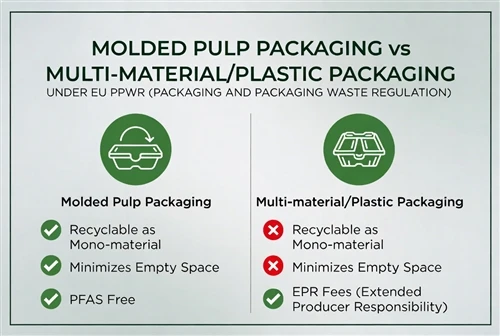
As policies such as single-use plastic bans and extended producer responsibility (EPR) fees tighten, molded pulp's economic and compliance advantages over plastic packaging become more pronounced. Molded pulp is made primarily from recyclable fiber, is biodegradable and recyclable by nature, and aligns naturally with increasingly strict EU, North American, and domestic packaging regulations and brand ESG disclosure requirements - helping export-oriented precision manufacturers avoid tariff, environmental tax, or market-access risk tied to plastic packaging.
Regulatory drivers to watch:
EU Packaging and Packaging Waste Regulation (PPWR): Regulation (EU) 2025/40 entered into force on 11 February 2025 and applies generally from 12 August 2026, replacing the previous Packaging and Packaging Waste Directive. It sets EU-wide recyclability, packaging-efficiency, and (in later phases) minimum recycled-content requirements - including a rule limiting empty space in e-commerce parcels to 40% - with recyclability performance grades and stricter recyclability-at-scale obligations phasing in through the 2030s.
UK Plastic Packaging Tax (PPT): In effect since April 2022, PPT taxes plastic packaging components containing less than 30% recycled content, with the rate rising to £228.82 per tonne from 1 April 2026. From April 2027, only post-consumer recycled content will count toward that 30% threshold, tightening the rules further for manufacturers relying on plastic packaging.
Extended Producer Responsibility (EPR) schemes across the EU, UK, and a growing number of US states shift the cost of end-of-life packaging waste back onto the producer, making a package's recyclability and material weight a direct line item on a company's compliance bill.
Corporate ESG reporting requirements (e.g., the EU's Corporate Sustainability Reporting Directive) increasingly require manufacturers to disclose packaging material composition and recyclability, adding a reputational incentive - separate from any direct tax or fee - to reduce plastic packaging content.
To be balanced: for applications requiring extremely tight dimensional tolerances, moisture barrier properties, or ESD shielding, plastic packaging still tends to outperform pulp in barrier properties, moisture resistance, clarity, and precision control. Material selection should therefore be based on the specific protection requirements of each part - which is exactly where professional structural design adds value.

7. Engineering Considerations When Replacing Plastic Packaging
Switching a precision hardware line from plastic to molded pulp is a structural design exercise, not a drop-in material swap. Before specifying a solution, packaging engineers typically need to evaluate:
Part weight and center of gravity - heavier or unevenly balanced parts need thicker wall sections and rib reinforcement in specific zones to prevent crushing on corner or edge impacts.
Expected drop height and handling profile - hand-carried retail packaging, palletized freight, and small-parcel courier shipping each imply different worst-case drop heights and impact orientations, which should be validated against a standard such as ASTM D4169, ISTA, or GB/T 4857.
Shipping method and duration - ocean freight, air freight, and last-mile parcel delivery each expose packaging to different vibration profiles and handling cycles, which affects density and rib-structure choices.
Moisture exposure - molded pulp is inherently more moisture-sensitive than closed-cell plastic foam, so applications with high humidity exposure or condensation risk may need a coating, liner, or hybrid design.
Hesheng engineers typically evaluate these variables during packaging development, combining structural design, wet-press or dry-press process selection, and drop-test validation to size a solution to the part's actual risk profile - rather than applying a generic cushioning spec.
8. Hesheng: End-to-End Support from Design to Production
Material advantages only translate into real protection when backed by engineering execution. Hesheng brings together a structural design team and wet-press/dry-press molded pulp production experience, supporting precision hardware manufacturers through:
Wet-press molded pulp for high-precision surface requirements and multi-layer cushioning structures on high-value precision parts;
Dry-press molded pulp for cost-sensitive, high-volume applications, balancing cost-efficiency with structural strength;
Full-cycle engineering support - from structural design and sampling to drop-test validation and mass production.
Whether the project involves replacing injection-molded trays or EPS/EPP foam inserts, or developing a new precision hardware packaging structure from scratch, the variables outlined above - part weight, drop profile, shipping method, and moisture exposure - are typically the starting point for the design conversation.