
1. A big step forward in AI design: going from experience-based to data-based
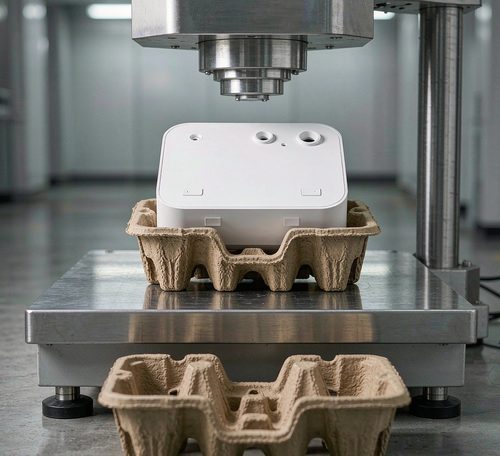
Traditional moulded pulp structure design depends a lot on the experience of engineers. The design cycles are long, the costs of trial and error are significant, and it is hard to push physical limits. The use of AI technology has fundamentally changed the way designs are made by combining deep learning, computer vision, and generative design.
Automated procedure for design
AI can swiftly find important design drawing factors like wall thickness, draft angle, and the placement of structural parts. It can then use machine learning models to come up with early solutions that meet mechanical requirements. For example, once a company in Hangzhou deployed an AI visual inspection system, the mold design cycle was cut from 4 weeks to 1 week, the design cost was lowered by 30%, and the product qualification rate raised to 98%. AI's automatic reworking of the design process-from requirement analysis to parameter optimisation to solution generation-means that no one has to do anything by hand during the whole process.
Ability to optimise many goals
The AI design system may optimise several goals at the same time, even if they are in conflict with each other. For example, it can optimise compressive strength, material use, and how hard it is to demold. For example, while designing a buffer structure, AI looks at tens of thousands of historical data points to create a dynamic model of "buffer coefficient structural unit number paper mould thickness." It then automatically finds the best combination of parameters. A company in Harbin came up with the "internal soft external hard hot pressing moulding technology," which uses AI algorithms to improve the hot pressing parameters of the mould. This technology allows for the first time the right angle stretching and vertical demolding of pulp moulding, which increases the product's compressive strength by 50% and cuts the cost in half.
A creative breakthrough in generative design
AI can not only improve structures that already exist, but it can also make new ones through generative design. In three months, a business in Wenzhou employed AI techniques to come up with 17,000 design alternatives. One of them, a travel kit box, used AI to improve its honeycomb construction, making it 40% lighter and 15% stronger. Orders went up by 300% in the first month of listing. This new technology comes from AI's deep understanding of the rules of material physics. By modelling millions of ways that structures can deform, AI can find optimisation paths that human engineers couldn't even think about.
2. AI-driven process innovation: from static optimisation to a dynamic closed loop
Not only does the design process need to be optimised for moulded pulp, but the whole production process needs to be optimised as well. AI technology creates a closed-loop system of "perception decision execution" to optimise processes in a dynamic and accurate way.
Control of processes in real time
During the pulp production stage, AI can change important settings in real time based on input from sensors. For instance, the AI system automatically changes the amount of retention aid based on the pH value and fibre retention rate of the slurry. This increases fibre use by 5–8% and cuts raw material loss by 10%. Guangdong Hansen Intelligent's fully automatic forming matrix production line has an intelligent dynamic parameter adjustment system that can automatically adjust the hot pressing time and temperature based on the slurry concentration. This saves 200 tonnes of materials and cuts labour costs by 50%.
Predicting and preventing defects
The AI visual inspection system can find more than 20 types of defects, such as wires, hair, and light transmission. It can find 4 faults per second, and the rate of missed detections has dropped from the industry average of 12% to 0.5%. AI can also find possible quality problems ahead of time by looking at how defect data and process parameters are related. For instance, an AI model helped a company find out that when the temperature of the moulding machine changes by more than 2 degrees Celsius, cracks are likely to form at the borders of the product. Based on this, changing the temperature management approach cut the scrap rate by 40%.
Best way to set up energy and materials
AI can change the way energy and materials are used during the whole production process to make them more efficient. A company in Sichuan makes bamboo pulp moulding bases that can hold more than 50 kg. They use AI fibre separation technology to accurately measure the strength of the bamboo fibres. Their blockchain traceability system also keeps track of the carbon footprint, which meets the EU's green tariff certification requirements. This optimisation not only lowers the cost of production, but it also adds value to the market.
3. Industrial use: From a single point of breakthrough to ecological reconstruction
AI design has changed the moulded pulp sector in many ways, from the technical level to the rebuilding of the industrial ecosystem.
Widespread use of personalised production
The rise of C2M mode (user direct manufacturing) puts a lot of pressure on moulded pulp to be able to respond quickly. AI has made it possible to deliver custom packaging in 72 hours by creating a full-chain digital twin platform for a "design manufacturing service." The flexible production line from Guangdong Green Ran Intelligent can handle "small batch, multi batch" customisation and can do sampling in 72 hours. It has given companies like Maotai and Huawei packaging that is quite precise.
Smartly improving collaboration in the industrial chain
AI is changing the way traditional industrial chains work by making them more like networks that work together. For instance, Fenghai Intelligent's "AI perception+mechanical control+data closed-loop" system works with machines made by companies like Zhongxin and Yu through the OPC UA universal interface. This cuts the time it takes to set up across production lines from 30 days to 5 days and the time it takes to train a model from 30 days to 5 days. This concept of working together lets small and medium-sized businesses change and improve by sharing technology resources, so they don't have to construct a whole AI system.
Making money off of sustainable value
AI design not only makes products work better, but it also opens up new economic potential by managing carbon data. A certain brand employs AI to figure out the "carbon value" of each gramme of pulp in real time. This cuts emissions from transportation by 62% and raises the price of the product by 27%. The "carbon algorithm barrier" is becoming the most important competitive factor in the market. It is changing moulded pulp from a "low-cost material" to a "high-value solution."