The Short Answer: They're a Team, Not Rivals
Think of it as inside and outside. The molded pulp tray works on the inside, cradling the appliance, holding it still, and soaking up the shocks of a drop. The corrugated carton works on the outside, giving the package its structure, its stacking strength, and a printable surface for branding and shipping marks. Neither does the other's job well, which is exactly why you want both.
What the Tray Does
The tray is the product's personal bodyguard. A well-designed one earns its keep in three ways:
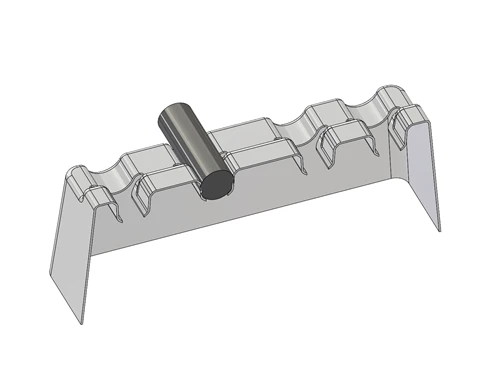
· It immobilizes the product. A contoured cavity stops the appliance from shifting or rattling, which is where most in-box damage starts.
· It absorbs shock. Crushable structures take the energy of a drop so the product doesn't.
· It guards the weak points. Corner blocks and molded endcaps protect the edges and corners that take the worst of any impact.
This is the role where protective Molded Pulp Inserts replace foam directly, cushioning the product without the plastic.
What the Carton Does
The carton brings the muscle. It provides the compression and stacking strength that lets boxes pile high on a pallet and in a container without collapsing. It shields the contents from outside scuffs and moisture, and it carries the printing, labels, and shipping marks the supply chain needs to read. For heavier appliances, a double-wall corrugated box gives the extra stacking strength the load demands.
Designing the Two to Fit
A tray and a box only become a system when they're designed for each other. A few principles get you there:
1. Fit the tray to the product, then to the box. It should cradle the appliance and sit snugly inside the carton with no slop.
2. Match the box wall to the weight. Heavier units want double-wall board for stacking strength.
3. Leave crushable zones. The tray should have room to absorb energy rather than transmitting it straight through.
4. Test the combination, not the parts. Run the packed unit through drop and compression tests to prove the system, since the tray and box pass or fail together.
One Recyclable System
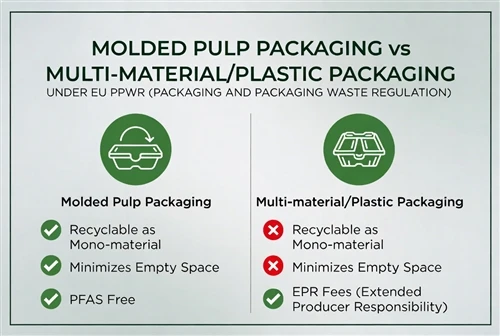
Here's a benefit that's easy to miss. Because both pieces are paper-based, the whole package goes into a single recycling stream, which customers and carriers increasingly require. Major carriers now report that over 90 percent of their outgoing packaging is curbside recyclable, a bar that fiber trays and boxes clear easily while foam-in-box does not.
The fiber tray also saves space before it's ever used. In one widely cited comparison, a stack of 40 molded pulp endcaps took up about 70 percent less room than the same number of EPS endcaps, because the trays nest. That's a storage and freight win that comes built into a Green Molded Pulp Packaging approach.
Component | Its Job | Why It Matters |
Molded pulp tray or insert | Cradle, immobilize, and cushion the product | Absorbs shock and stops shifting, the main causes of in-box damage |
Corrugated carton | Provide outer structure and stacking strength | Handles compression and stacking, carries print and shipping marks |
A Real Example
A [home appliance] brand in [region] was double-protecting with a foam insert inside an oversized box, paying for more material than the product needed. They asked sunhingstones to rethink the system.We designed a contoured fiber tray with reinforced corners that fit a right-sized double-wall carton, then validated the pair to their drop-test standard. The result cut material, shrank the box, and made the whole package recyclable in one stream. (sunhingstones packaging was recognized at [ESTA / industry event] for [award or standout feature], reflecting our focus on smart, sustainable packaging systems.)
Frequently Asked Questions
Q: Do I still need a box if I use molded pulp trays?
A: In most cases, yes. The tray cushions and immobilizes the product inside, while the carton provides the stacking strength and outer protection. They do different jobs.
Q: What does the tray do versus the carton?
A: The tray cradles and cushions the product and guards its corners. The carton supplies structure, stacking strength, and the printable shipping surface.
Q: Can molded pulp replace the box entirely?
A: Usually not for appliances. Molded pulp excels at inner cushioning, but the corrugated carton handles compression, stacking, and external protection that a tray alone can't.
Q: How do I test the tray-and-carton combination?
A: Run the fully packed unit through drop and compression testing. The tray and box perform as a system, so they should be validated together.
Q: Is the whole package recyclable?
A: Yes. Both the Molded Pulp Trays Eco-friendly insert and the corrugated carton are paper-based, so the package goes into a single recycling strea
Talk to Us About Your Packaging System
Send us your product and your current box, and we'll design a tray-and-carton combination that protects the unit with less material, then prototype and test it. Reach out to a molded pulp tray manufacturer for a custom system, samples, or a wholesale quote.
Contact no